

To this end of offsetting the difficult climatic conditions, while meeting the fiveyear plan, ambitious complex irrigations systems were built at too great a speed –
sometimes at a rate of more than 200.000 ha annually (see Fig. 41.3). Thus, many of
these systems’ essential components, such as the dewatering systems, the waterproofing of the canals that were supposed to bring in water to the crops, or the
automatic water-meters were missing (Lup 1997).
41.2.3.1 The Romanian Irrigation Systems’ Main Characteristics
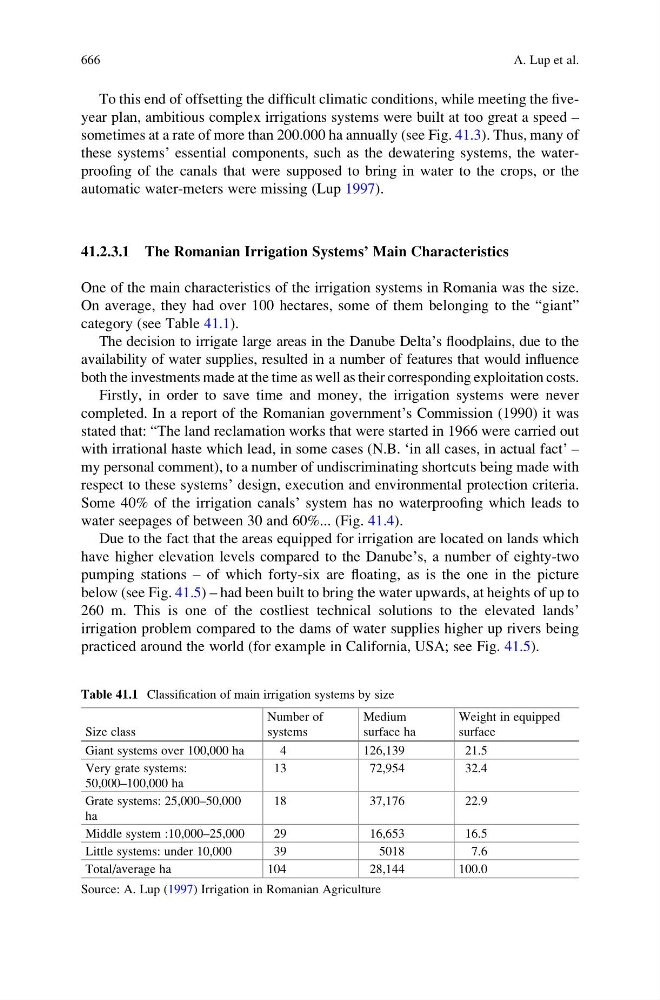
One of the main characteristics of the irrigation systems in Romania was the size.
On average, they had over 100 hectares, some of them belonging to the “giant”
category (see Table 41.1).
The decision to irrigate large areas in the Danube Delta’s floodplains, due to the
availability of water supplies, resulted in a number of features that would influence
both the investments made at the time as well as their corresponding exploitation costs.
Firstly, in order to save time and money, the irrigation systems were never
completed. In a report of the Romanian government’s Commission (1990) it was
stated that: “The land reclamation works that were started in 1966 were carried out
with irrational haste which lead, in some cases (N.B. ‘in all cases, in actual fact’ –
my personal comment), to a number of undiscriminating shortcuts being made with
respect to these systems’ design, execution and environmental protection criteria.
Some 40% of the irrigation canals’ system has no waterproofing which leads to
water seepages of between 30 and 60%... (Fig. 41.4).
Due to the fact that the areas equipped for irrigation are located on lands which
have higher elevation levels compared to the Danube’s, a number of eighty-two
pumping stations – of which forty-six are floating, as is the one in the picture
below (see Fig. 41.5) – had been built to bring the water upwards, at heights of up to
260 m. This is one of the costliest technical solutions to the elevated lands’
irrigation problem compared to the dams of water supplies higher up rivers being
practiced around the world (for example in California, USA; see Fig. 41.5).
Table 41.1 Classification of main irrigation systems by size
Size class
Number of
systems
Medium
surface ha
Weight in equipped
surface
Giant systems over 100,000 ha
4
126,139
21.5
Very grate systems:
50,000–100,000 ha
13
72,954
32.4
Grate systems: 25,000–50,000
ha
18
37,176
22.9
Middle system :10,000–25,000
29
16,653
16.5
Little systems: under 10,000
39
5018
7.6
Total/average ha
104
28,144
100.0
Source: A. Lup (1997) Irrigation in Romanian Agriculture
666
A. Lup et al.