

38.5 Conclusions
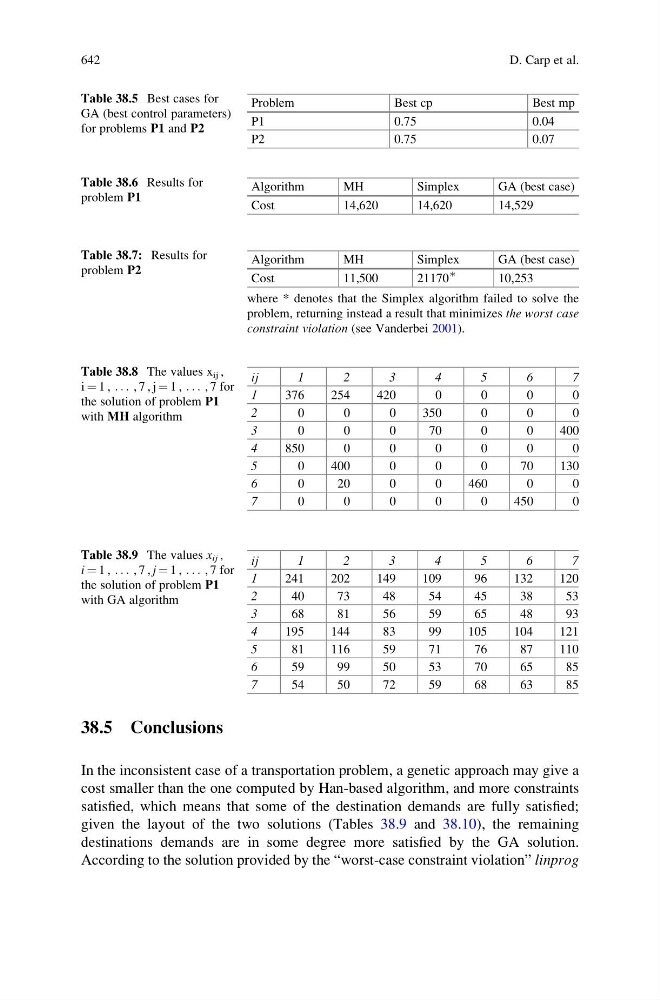
In the inconsistent case of a transportation problem, a genetic approach may give a
cost smaller than the one computed by Han-based algorithm, and more constraints
satisfied, which means that some of the destination demands are fully satisfied;
given the layout of the two solutions (Tables 38.9 and 38.10), the remaining
destinations demands are in some degree more satisfied by the GA solution.
According to the solution provided by the “worst-case constraint violation” linprog
Table 38.7: Results for
problem P2
Algorithm
MH
Simplex
GA (best case)
Cost
11,500
21170
∗
10,253
where * denotes that the Simplex algorithm failed to solve the
problem, returning instead a result that minimizes the worst case
constraint violation (see Vanderbei 2001).
Table 38.8 The values x ij ,
i ¼ 1 , . . . , 7 , j ¼ 1 , . . . , 7 for
the solution of problem P1
with MH algorithm
i j
1
2
3
4
5
6
7
1
3 7 6
2 5 4
4 2 0
0
0
0
0
2
0
0
0
3 5 0
0
0
0
3
0
0
0
7 0
0
0
4 0 0
4
8 5 0
0
0
0
0
0
0
5
0
400
0
0
0
70
130
6
0
20
0
0
460
0
0
7
0
0
0
0
0
4 5 0
0
Table 38.9 The values x ij ,
i ¼ 1 , . . . , 7 , j ¼ 1 , . . . , 7 for
the solution of problem P1
with GA algorithm
i j
1
2
3
4
5
6
7
1
241
202
149
109
96
132
120
2
40
73
48
54
45
38
53
3
68
81
56
59
65
48
93
4
195
144
83
99
105
104
121
5
81
116
59
71
76
87
110
6
59
99
50
53
70
65
85
7
54
50
72
59
68
63
85
Table 38.5 Best cases for
GA (best control parameters)
for problems P1 and P2
Problem
Best cp
Best mp
P1
0.75
0.04
P2
0.75
0.07
Table 38.6 Results for
problem P1
Algorithm
MH
Simplex
GA (best case)
Cost
14,620
14,620
14,529
642
D. Carp et al.