

k A
T Ax
k
À b
À
Á þ k 10
À14 , k b
A
T b
Ab x
k
À b b
þ k 10
À14
:
ð38:18Þ
The genetic algorithm proposed in Sect. 38.3 was implemented in Matlab
R2011a and the terminating condition was to either a predefined number of
generations reached or 97% of the population had same fitness value. After several
generations, the best individual (solution) is obtained, the one with the smallest
numerical value of the fitness function.
First, the genetic algorithm was applied over the consistent linear problem of P1,
in order to calibrate some of the control parameters of the GA (the penalty
parameters a , b and the arithmetic crossover parameter, α). Then, the calibrated
GA attempted to solve the inconsistent linear problems of P2. In both cases, we
evaluated the performance of the proposed GA through several test cases on the rest
of control parameters of the GA: the crossover/mutation probabilities. Currently,
there are no well-established optimum values for these parameters and they are
problem specific (see Kumar et al. 2005). In order to get statistically robust results,
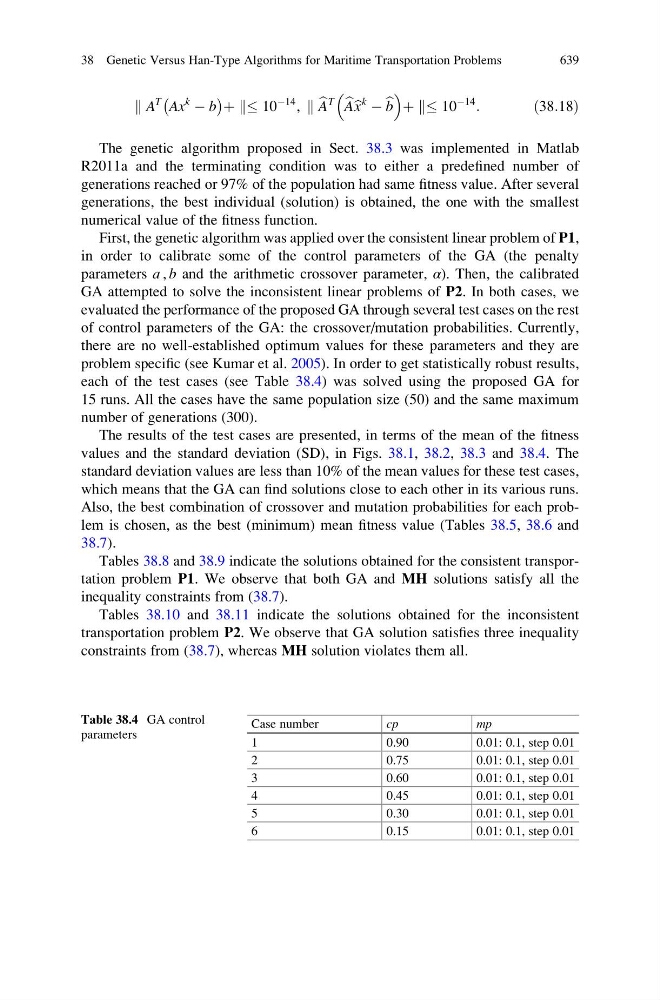
each of the test cases (see Table 38.4) was solved using the proposed GA for
15 runs. All the cases have the same population size (50) and the same maximum
number of generations (300).
The results of the test cases are presented, in terms of the mean of the fitness
values and the standard deviation (SD), in Figs. 38.1, 38.2, 38.3 and 38.4. The
standard deviation values are less than 10% of the mean values for these test cases,
which means that the GA can find solutions close to each other in its various runs.
Also, the best combination of crossover and mutation probabilities for each problem is chosen, as the best (minimum) mean fitness value (Tables 38.5, 38.6 and
38.7).
Tables 38.8 and 38.9 indicate the solutions obtained for the consistent transportation problem P1. We observe that both GA and MH solutions satisfy all the
inequality constraints from (38.7).
Tables 38.10 and 38.11 indicate the solutions obtained for the inconsistent
transportation problem P2. We observe that GA solution satisfies three inequality
constraints from (38.7), whereas MH solution violates them all.
Table 38.4 GA control
parameters
Case number
cp
mp
1
0.90
0.01: 0.1, step 0.01
2
0.75
0.01: 0.1, step 0.01
3
0.60
0.01: 0.1, step 0.01
4
0.45
0.01: 0.1, step 0.01
5
0.30
0.01: 0.1, step 0.01
6
0.15
0.01: 0.1, step 0.01
38 Genetic Versus Han-Type Algorithms for Maritime Transportation Problems
639