

38.3.2 Evaluation
Our proposed genetic algorithm goal is to find an optimal solution of the linear
program stated in (38.7), so the objective function is f obj ( y) ¼ 〈c, y〉. Being a
constrained
optimization
problem
(with
inequality
constraints
g i y
ð Þ ¼ d À B 1 y, i ¼ 1, n
Á
, we must add penalty functions to the objective function:
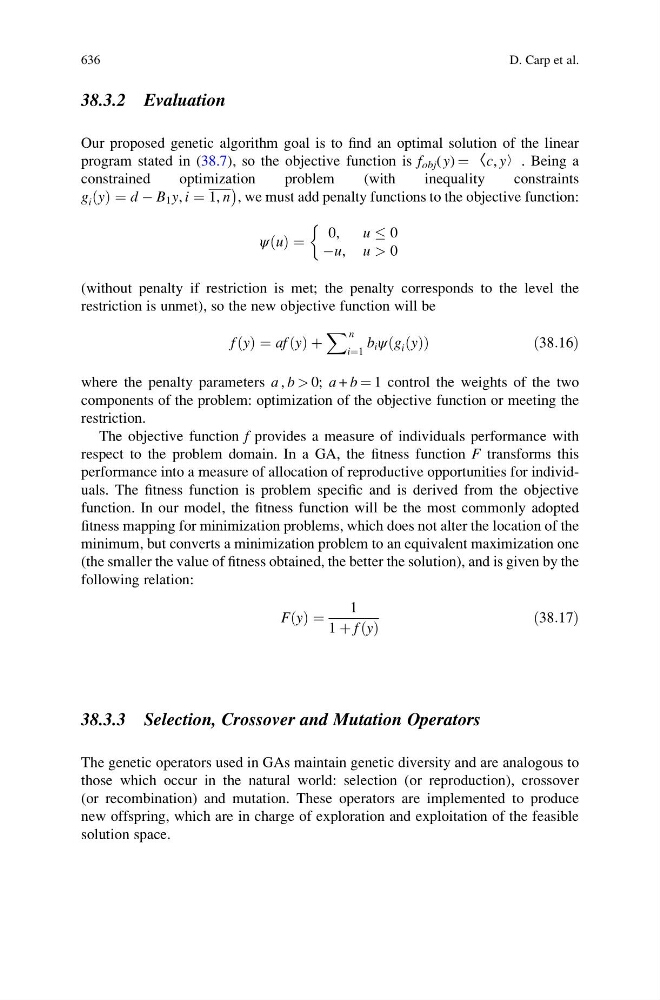
ψ u
ð Þ ¼
0,
u 0
Àu, u > 0
&
(without penalty if restriction is met; the penalty corresponds to the level the
restriction is unmet), so the new objective function will be
f y
ð Þ ¼ af y
ð Þ þ
X n
i¼1
b i ψ g i y
ð Þ
ð
Þ
ð38:16Þ
where the penalty parameters a , b > 0; a + b ¼ 1 control the weights of the two
components of the problem: optimization of the objective function or meeting the
restriction.
The objective function f provides a measure of individuals performance with
respect to the problem domain. In a GA, the fitness function F transforms this
performance into a measure of allocation of reproductive opportunities for individuals. The fitness function is problem specific and is derived from the objective
function. In our model, the fitness function will be the most commonly adopted
fitness mapping for minimization problems, which does not alter the location of the
minimum, but converts a minimization problem to an equivalent maximization one
(the smaller the value of fitness obtained, the better the solution), and is given by the
following relation:
F y
ð Þ ¼
1
1 þ f y
ð Þ
ð38:17Þ
38.3.3 Selection, Crossover and Mutation Operators
The genetic operators used in GAs maintain genetic diversity and are analogous to
those which occur in the natural world: selection (or reproduction), crossover
(or recombination) and mutation. These operators are implemented to produce
new offspring, which are in charge of exploration and exploitation of the feasible
solution space.
636
D. Carp et al.