

site has acquired a residential quarter, restaurants and tourist activities. The port
itself is a naval base, a starting point for excursions-at-sea, the embarkation area for
oceanographic campaigns, a ferry boat station, a freight transshipment point with
“Ro-Ro” facilities, a pleasure craft harbor, and is still a fisheries landing port (Cook
2002).
In 1921 the coast of Flanders suffered a major flood and the Zwin broke through
as it did again in 1973 the year of the great flood. It reached the outskirts of Damme,
but the waters receded after a relatively short period. Today the remnant of the inlet
fills partly at high tide, but the area is an ornithological refuge in collaboration with
the French National Park of Marquenterre (Herrier and Leten 2010). The Dutch
undertook the gigantic Delta Works to protect the land even cutting off one the
Scheldt’s arms, not without creating problems downstream of Antwerp. If Bruges
found a new economic spurt as a tourism destination nearly equaling that of its
Mediterranean counterpart, a new life as a port was in the making completely
separate from developments in the Zwin region, some even surprising. Until recent
history an international dike linked the last Belgian shore resort and the remnant of
the Zwin inlet. It has since been dismantled so as to let the sea waters return to their
natural course and miradors (watch towers) installed for serious observers, particularly ornithologists (Charlier et al. 2005, 2012). At high tide the inlet itself is a
canoe splashing basin and shallow swimmers’ pool. Cadzand is today a very small
gently slumbering port hosting this beautiful nature refuge, preserve and park
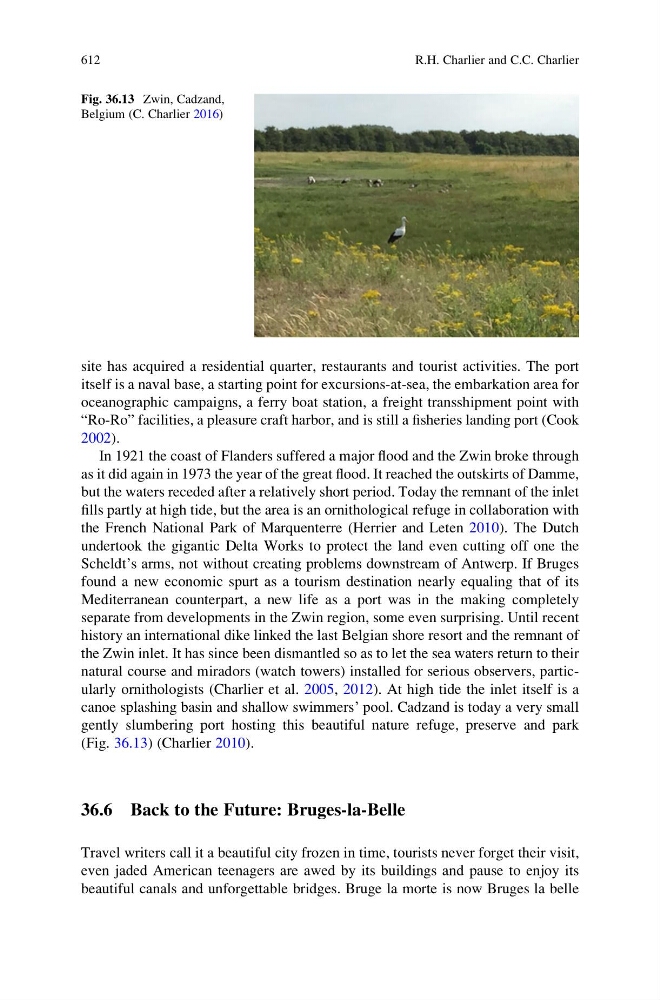
(Fig. 36.13) (Charlier 2010).
36.6 Back to the Future: Bruges-la-Belle
Travel writers call it a beautiful city frozen in time, tourists never forget their visit,
even jaded American teenagers are awed by its buildings and pause to enjoy its
beautiful canals and unforgettable bridges. Bruge la morte is now Bruges la belle
Fig. 36.13 Zwin, Cadzand,
Belgium (C. Charlier 2016)
612
R.H. Charlier and C.C. Charlier
itself is a naval base, a starting point for excursions-at-sea, the embarkation area for
oceanographic campaigns, a ferry boat station, a freight transshipment point with
“Ro-Ro” facilities, a pleasure craft harbor, and is still a fisheries landing port (Cook
2002).
In 1921 the coast of Flanders suffered a major flood and the Zwin broke through
as it did again in 1973 the year of the great flood. It reached the outskirts of Damme,
but the waters receded after a relatively short period. Today the remnant of the inlet
fills partly at high tide, but the area is an ornithological refuge in collaboration with
the French National Park of Marquenterre (Herrier and Leten 2010). The Dutch
undertook the gigantic Delta Works to protect the land even cutting off one the
Scheldt’s arms, not without creating problems downstream of Antwerp. If Bruges
found a new economic spurt as a tourism destination nearly equaling that of its
Mediterranean counterpart, a new life as a port was in the making completely
separate from developments in the Zwin region, some even surprising. Until recent
history an international dike linked the last Belgian shore resort and the remnant of
the Zwin inlet. It has since been dismantled so as to let the sea waters return to their
natural course and miradors (watch towers) installed for serious observers, particularly ornithologists (Charlier et al. 2005, 2012). At high tide the inlet itself is a
canoe splashing basin and shallow swimmers’ pool. Cadzand is today a very small
gently slumbering port hosting this beautiful nature refuge, preserve and park
(Fig. 36.13) (Charlier 2010).
36.6 Back to the Future: Bruges-la-Belle
Travel writers call it a beautiful city frozen in time, tourists never forget their visit,
even jaded American teenagers are awed by its buildings and pause to enjoy its
beautiful canals and unforgettable bridges. Bruge la morte is now Bruges la belle
Fig. 36.13 Zwin, Cadzand,
Belgium (C. Charlier 2016)
612
R.H. Charlier and C.C. Charlier