

32.2 Overview of Present Issues and Science Challenges
Concerning the Ocean
The major issues concerning the marine environment include: pollution, waste and
contamination; overfishing; warming; and acidification. There is also great concern,
including among the public, for changes of the ocean currents, from swimming to
basin-wide scales, sea-ice melting, sea-level rise, coastal flooding, extreme weather
events and changes in their frequency, environmental impacts of aquaculture,
effects of marine invasive species, losses of biodiversity and coastal erosion. Public
perceptions also show strong connections to marine and coastal environments
affected by aesthetics, identity, practical considerations of access, livelihoods,
assessment of impacts on marine wildlife, and clean energy production. International evaluations of human impacts on the marine environment do not assess the
public awareness and perceptions, concerns and priorities (Gelcich et al. 2014).
Public attitudes and understanding is a key to successful implementation of
changes, and public perceptions need be taken into account in specifying national
programmes, management decisions and interventions.
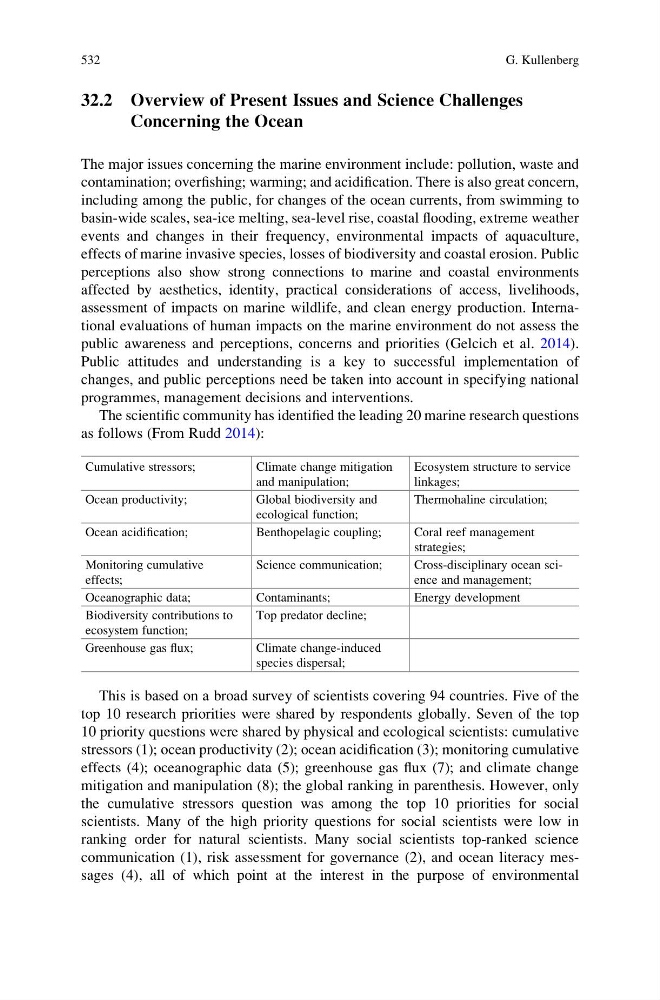
The scientific community has identified the leading 20 marine research questions
as follows (From Rudd 2014):
Cumulative stressors;
Climate change mitigation
and manipulation;
Ecosystem structure to service
linkages;
Ocean productivity;
Global biodiversity and
ecological function;
Thermohaline circulation;
Ocean acidification;
Benthopelagic coupling;
Coral reef management
strategies;
Monitoring cumulative
effects;
Science communication;
Cross-disciplinary ocean science and management;
Oceanographic data;
Contaminants;
Energy development
Biodiversity contributions to
ecosystem function;
Top predator decline;
Greenhouse gas flux;
Climate change-induced
species dispersal;
This is based on a broad survey of scientists covering 94 countries. Five of the
top 10 research priorities were shared by respondents globally. Seven of the top
10 priority questions were shared by physical and ecological scientists: cumulative
stressors (1); ocean productivity (2); ocean acidification (3); monitoring cumulative
effects (4); oceanographic data (5); greenhouse gas flux (7); and climate change
mitigation and manipulation (8); the global ranking in parenthesis. However, only
the cumulative stressors question was among the top 10 priorities for social
scientists. Many of the high priority questions for social scientists were low in
ranking order for natural scientists. Many social scientists top-ranked science
communication (1), risk assessment for governance (2), and ocean literacy messages (4), all of which point at the interest in the purpose of environmental
532
G. Kullenberg
Concerning the Ocean
The major issues concerning the marine environment include: pollution, waste and
contamination; overfishing; warming; and acidification. There is also great concern,
including among the public, for changes of the ocean currents, from swimming to
basin-wide scales, sea-ice melting, sea-level rise, coastal flooding, extreme weather
events and changes in their frequency, environmental impacts of aquaculture,
effects of marine invasive species, losses of biodiversity and coastal erosion. Public
perceptions also show strong connections to marine and coastal environments
affected by aesthetics, identity, practical considerations of access, livelihoods,
assessment of impacts on marine wildlife, and clean energy production. International evaluations of human impacts on the marine environment do not assess the
public awareness and perceptions, concerns and priorities (Gelcich et al. 2014).
Public attitudes and understanding is a key to successful implementation of
changes, and public perceptions need be taken into account in specifying national
programmes, management decisions and interventions.
The scientific community has identified the leading 20 marine research questions
as follows (From Rudd 2014):
Cumulative stressors;
Climate change mitigation
and manipulation;
Ecosystem structure to service
linkages;
Ocean productivity;
Global biodiversity and
ecological function;
Thermohaline circulation;
Ocean acidification;
Benthopelagic coupling;
Coral reef management
strategies;
Monitoring cumulative
effects;
Science communication;
Cross-disciplinary ocean science and management;
Oceanographic data;
Contaminants;
Energy development
Biodiversity contributions to
ecosystem function;
Top predator decline;
Greenhouse gas flux;
Climate change-induced
species dispersal;
This is based on a broad survey of scientists covering 94 countries. Five of the
top 10 research priorities were shared by respondents globally. Seven of the top
10 priority questions were shared by physical and ecological scientists: cumulative
stressors (1); ocean productivity (2); ocean acidification (3); monitoring cumulative
effects (4); oceanographic data (5); greenhouse gas flux (7); and climate change
mitigation and manipulation (8); the global ranking in parenthesis. However, only
the cumulative stressors question was among the top 10 priorities for social
scientists. Many of the high priority questions for social scientists were low in
ranking order for natural scientists. Many social scientists top-ranked science
communication (1), risk assessment for governance (2), and ocean literacy messages (4), all of which point at the interest in the purpose of environmental
532
G. Kullenberg