

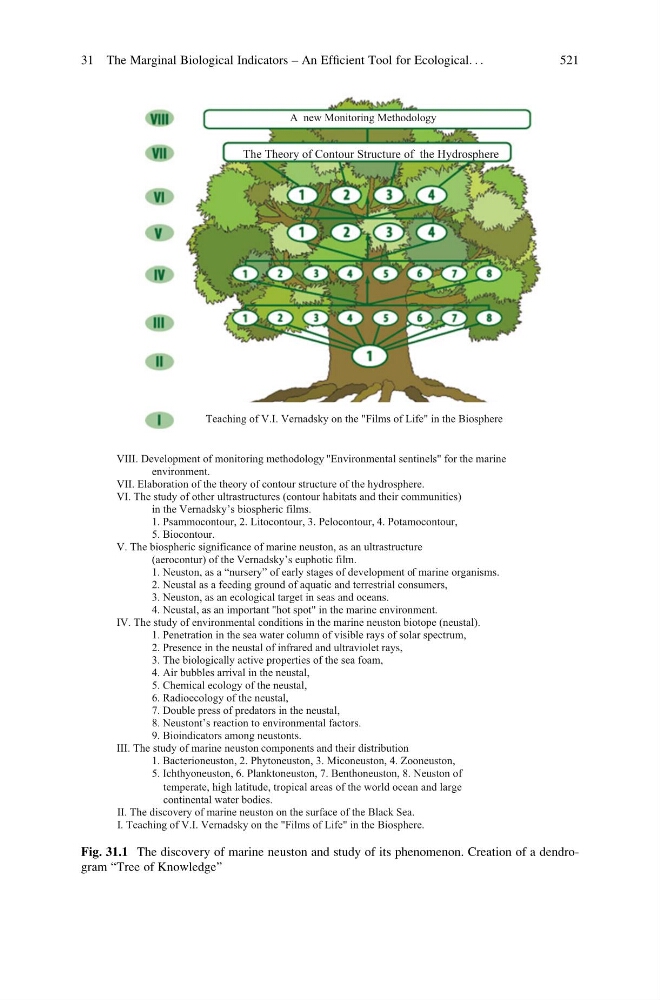
VIII. Development of monitoring methodology "Environmental sentinels" for the marine
environment.
VII. Elaboration of the theory of contour structure of the hydrosphere.
VI. The study of other ultrastructures (contour habitats and their communities)
in the Vernadsky’s biospheric films.
1. Psammocontour, 2. Litocontour, 3. Pelocontour, 4. Potamocontour,
5. Biocontour.
V. The biospheric significance of marine neuston, as an ultrastructure
(aerocontur) of the Vernadsky’s euphotic film.
1. Neuston, as a “nursery” of early stages of development of marine organisms.
2. Neustal as a feeding ground of aquatic and terrestrial consumers,
3. Neuston, as an ecological target in seas and oceans.
4. Neustal, as an important "hot spot" in the marine environment.
IV. The study of environmental conditions in the marine neuston biotope (neustal).
1. Penetration in the sea water column of visible rays of solar spectrum,
2. Presence in the neustal of infrared and ultraviolet rays,
3. The biologically active properties of the sea foam,
4. Air bubbles arrival in the neustal,
5. Chemical ecology of the neustal,
6. Radioecology of the neustal,
7. Double press of predators in the neustal,
8. Neustont’s reaction to environmental factors.
9. Bioindicators among neustonts.
III. The study of marine neuston components and their distribution
1. Bacterioneuston, 2. Phytoneuston, 3. Miconeuston, 4. Zooneuston,
5. Ichthyoneuston, 6. Planktoneuston, 7. Benthoneuston, 8. Neuston of
Teaching of V.I. Vernadsky on the "Films of Life" in the Biosphere
A new Monitoring Methodology
The Theory of Contour Structure of the Hydrosphere
temperate, high latitude, tropical areas of the world ocean and large
continental water bodies.
II. The discovery of marine neuston on the surface of the Black Sea.
I. Teaching of V.I. Vernadsky on the "Films of Life" in the Biosphere.
Fig. 31.1 The discovery of marine neuston and study of its phenomenon. Creation of a dendrogram “Tree of Knowledge”
31 The Marginal Biological Indicators – An Efficient Tool for Ecological. . .
521
environment.
VII. Elaboration of the theory of contour structure of the hydrosphere.
VI. The study of other ultrastructures (contour habitats and their communities)
in the Vernadsky’s biospheric films.
1. Psammocontour, 2. Litocontour, 3. Pelocontour, 4. Potamocontour,
5. Biocontour.
V. The biospheric significance of marine neuston, as an ultrastructure
(aerocontur) of the Vernadsky’s euphotic film.
1. Neuston, as a “nursery” of early stages of development of marine organisms.
2. Neustal as a feeding ground of aquatic and terrestrial consumers,
3. Neuston, as an ecological target in seas and oceans.
4. Neustal, as an important "hot spot" in the marine environment.
IV. The study of environmental conditions in the marine neuston biotope (neustal).
1. Penetration in the sea water column of visible rays of solar spectrum,
2. Presence in the neustal of infrared and ultraviolet rays,
3. The biologically active properties of the sea foam,
4. Air bubbles arrival in the neustal,
5. Chemical ecology of the neustal,
6. Radioecology of the neustal,
7. Double press of predators in the neustal,
8. Neustont’s reaction to environmental factors.
9. Bioindicators among neustonts.
III. The study of marine neuston components and their distribution
1. Bacterioneuston, 2. Phytoneuston, 3. Miconeuston, 4. Zooneuston,
5. Ichthyoneuston, 6. Planktoneuston, 7. Benthoneuston, 8. Neuston of
Teaching of V.I. Vernadsky on the "Films of Life" in the Biosphere
A new Monitoring Methodology
The Theory of Contour Structure of the Hydrosphere
temperate, high latitude, tropical areas of the world ocean and large
continental water bodies.
II. The discovery of marine neuston on the surface of the Black Sea.
I. Teaching of V.I. Vernadsky on the "Films of Life" in the Biosphere.
Fig. 31.1 The discovery of marine neuston and study of its phenomenon. Creation of a dendrogram “Tree of Knowledge”
31 The Marginal Biological Indicators – An Efficient Tool for Ecological. . .
521