

4. Dolphin renal tube is shorter in the intense resorptive activity zone than that of
terrestrial mammals.
5. Dolphins glomerular filtration is more intense (abundant), followed by resorption less intense compared to terrestrial mammals.
In conclusion, in his doctoral thesis held in 1940 at Bucharest University, G. E.
Palade, demonstrated that the excretory system of the dolphin has adapted to life
marine mammal by the several kidney lobules in his anatomy, the large number of
nephrons (2 millions) and by their morphology and physiology (shorter and less
water reabsorption). The thoroughness of the research since then has essentially the
image of the later famous research, from US.
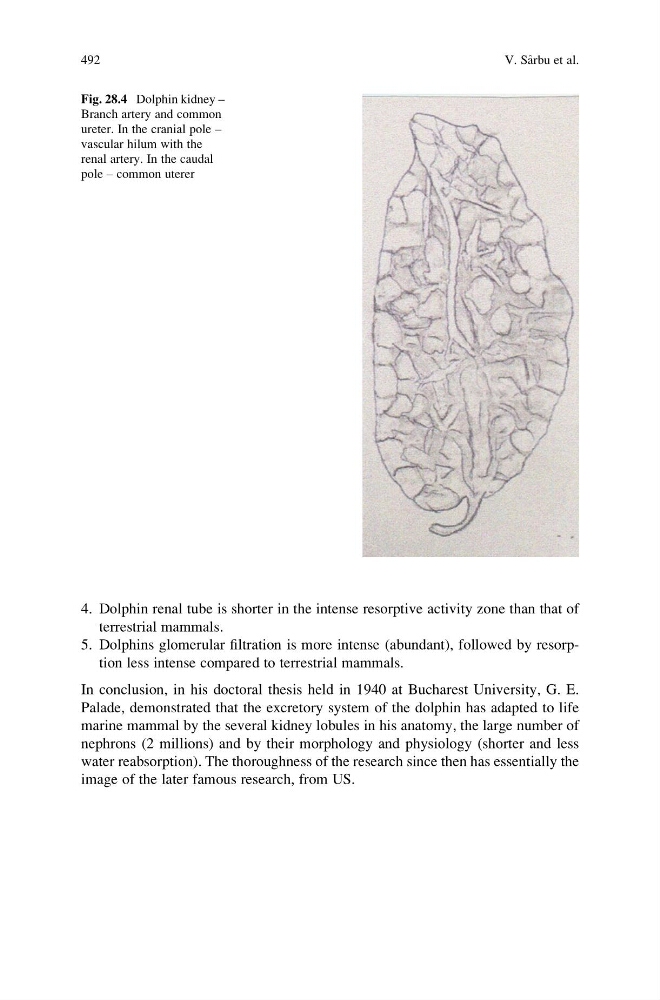
Fig. 28.4 Dolphin kidney –
Branch artery and common
ureter. In the cranial pole –
vascular hilum with the
renal artery. In the caudal
pole – common uterer
492
V. S^ arbu et al.
terrestrial mammals.
5. Dolphins glomerular filtration is more intense (abundant), followed by resorption less intense compared to terrestrial mammals.
In conclusion, in his doctoral thesis held in 1940 at Bucharest University, G. E.
Palade, demonstrated that the excretory system of the dolphin has adapted to life
marine mammal by the several kidney lobules in his anatomy, the large number of
nephrons (2 millions) and by their morphology and physiology (shorter and less
water reabsorption). The thoroughness of the research since then has essentially the
image of the later famous research, from US.
Fig. 28.4 Dolphin kidney –
Branch artery and common
ureter. In the cranial pole –
vascular hilum with the
renal artery. In the caudal
pole – common uterer
492
V. S^ arbu et al.