

On the anterior (front) surface of the left kidney there can be seen several
intertwined renculi and two trigeminal renculi (Palade 1940).
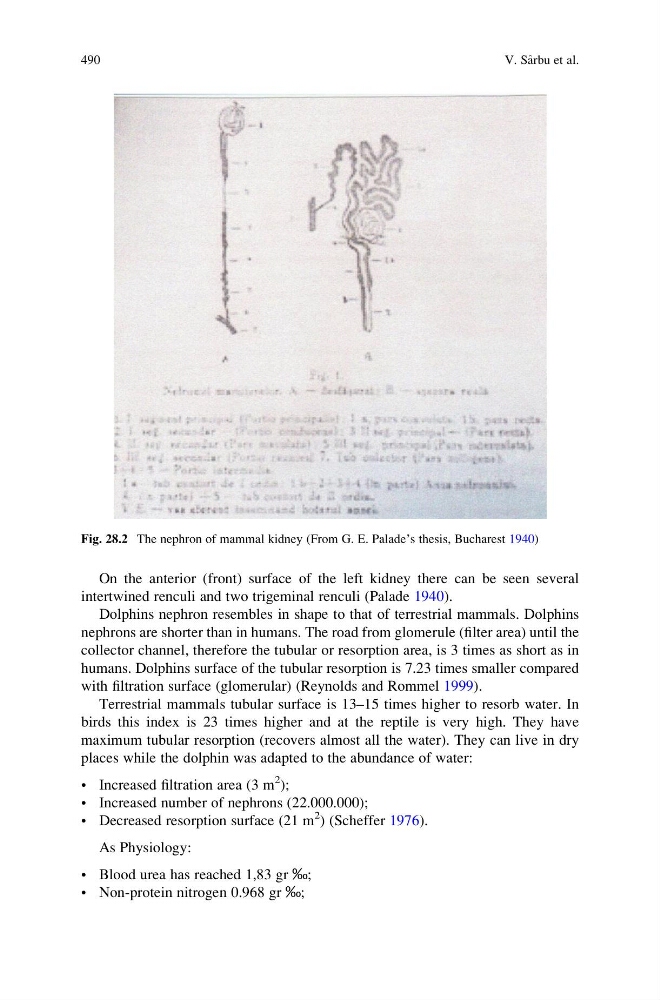
Dolphins nephron resembles in shape to that of terrestrial mammals. Dolphins
nephrons are shorter than in humans. The road from glomerule (filter area) until the
collector channel, therefore the tubular or resorption area, is 3 times as short as in
humans. Dolphins surface of the tubular resorption is 7.23 times smaller compared
with filtration surface (glomerular) (Reynolds and Rommel 1999).
Terrestrial mammals tubular surface is 13–15 times higher to resorb water. In
birds this index is 23 times higher and at the reptile is very high. They have
maximum tubular resorption (recovers almost all the water). They can live in dry
places while the dolphin was adapted to the abundance of water:
• Increased filtration area (3 m
2 );
• Increased number of nephrons (22.000.000);
• Decreased resorption surface (21 m
2 ) (Scheffer 1976).
As Physiology:
• Blood urea has reached 1,83 gr ‰;
• Non-protein nitrogen 0.968 gr ‰;
Fig. 28.2 The nephron of mammal kidney (From G. E. Palade’s thesis, Bucharest 1940)
490
V. S^ arbu et al.
intertwined renculi and two trigeminal renculi (Palade 1940).
Dolphins nephron resembles in shape to that of terrestrial mammals. Dolphins
nephrons are shorter than in humans. The road from glomerule (filter area) until the
collector channel, therefore the tubular or resorption area, is 3 times as short as in
humans. Dolphins surface of the tubular resorption is 7.23 times smaller compared
with filtration surface (glomerular) (Reynolds and Rommel 1999).
Terrestrial mammals tubular surface is 13–15 times higher to resorb water. In
birds this index is 23 times higher and at the reptile is very high. They have
maximum tubular resorption (recovers almost all the water). They can live in dry
places while the dolphin was adapted to the abundance of water:
• Increased filtration area (3 m
2 );
• Increased number of nephrons (22.000.000);
• Decreased resorption surface (21 m
2 ) (Scheffer 1976).
As Physiology:
• Blood urea has reached 1,83 gr ‰;
• Non-protein nitrogen 0.968 gr ‰;
Fig. 28.2 The nephron of mammal kidney (From G. E. Palade’s thesis, Bucharest 1940)
490
V. S^ arbu et al.