

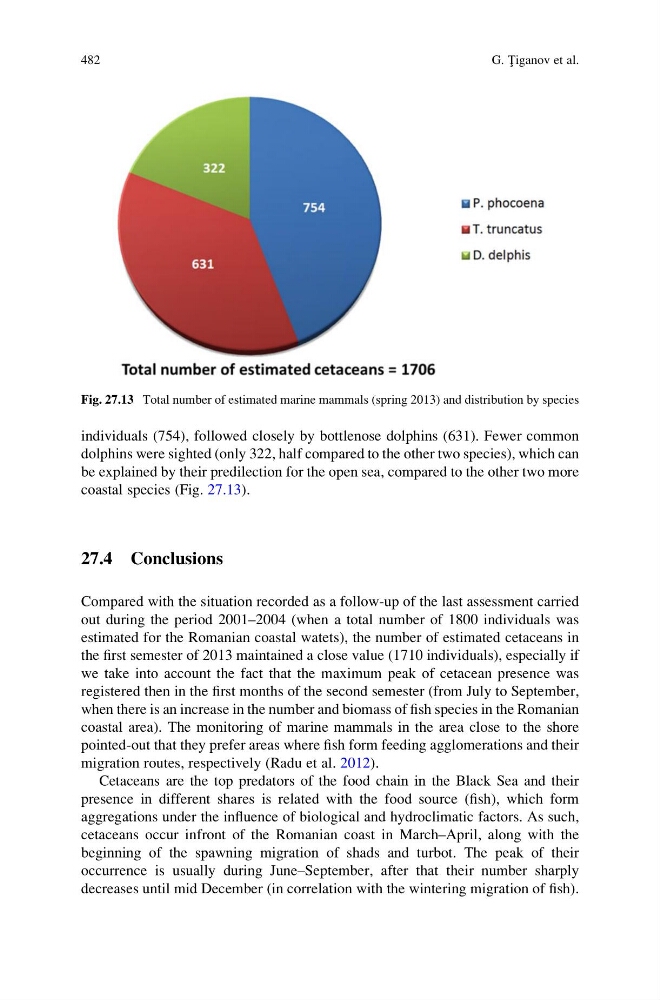
individuals (754), followed closely by bottlenose dolphins (631). Fewer common
dolphins were sighted (only 322, half compared to the other two species), which can
be explained by their predilection for the open sea, compared to the other two more
coastal species (Fig. 27.13).
27.4 Conclusions
Compared with the situation recorded as a follow-up of the last assessment carried
out during the period 2001–2004 (when a total number of 1800 individuals was
estimated for the Romanian coastal watets), the number of estimated cetaceans in
the first semester of 2013 maintained a close value (1710 individuals), especially if
we take into account the fact that the maximum peak of cetacean presence was
registered then in the first months of the second semester (from July to September,
when there is an increase in the number and biomass of fish species in the Romanian
coastal area). The monitoring of marine mammals in the area close to the shore
pointed-out that they prefer areas where fish form feeding agglomerations and their
migration routes, respectively (Radu et al. 2012).
Cetaceans are the top predators of the food chain in the Black Sea and their
presence in different shares is related with the food source (fish), which form
aggregations under the influence of biological and hydroclimatic factors. As such,
cetaceans occur infront of the Romanian coast in March–April, along with the
beginning of the spawning migration of shads and turbot. The peak of their
occurrence is usually during June–September, after that their number sharply
decreases until mid December (in correlation with the wintering migration of fish).
Fig. 27.13 Total number of estimated marine mammals (spring 2013) and distribution by species
482
G. T ¸ iganov et al.
dolphins were sighted (only 322, half compared to the other two species), which can
be explained by their predilection for the open sea, compared to the other two more
coastal species (Fig. 27.13).
27.4 Conclusions
Compared with the situation recorded as a follow-up of the last assessment carried
out during the period 2001–2004 (when a total number of 1800 individuals was
estimated for the Romanian coastal watets), the number of estimated cetaceans in
the first semester of 2013 maintained a close value (1710 individuals), especially if
we take into account the fact that the maximum peak of cetacean presence was
registered then in the first months of the second semester (from July to September,
when there is an increase in the number and biomass of fish species in the Romanian
coastal area). The monitoring of marine mammals in the area close to the shore
pointed-out that they prefer areas where fish form feeding agglomerations and their
migration routes, respectively (Radu et al. 2012).
Cetaceans are the top predators of the food chain in the Black Sea and their
presence in different shares is related with the food source (fish), which form
aggregations under the influence of biological and hydroclimatic factors. As such,
cetaceans occur infront of the Romanian coast in March–April, along with the
beginning of the spawning migration of shads and turbot. The peak of their
occurrence is usually during June–September, after that their number sharply
decreases until mid December (in correlation with the wintering migration of fish).
Fig. 27.13 Total number of estimated marine mammals (spring 2013) and distribution by species
482
G. T ¸ iganov et al.