

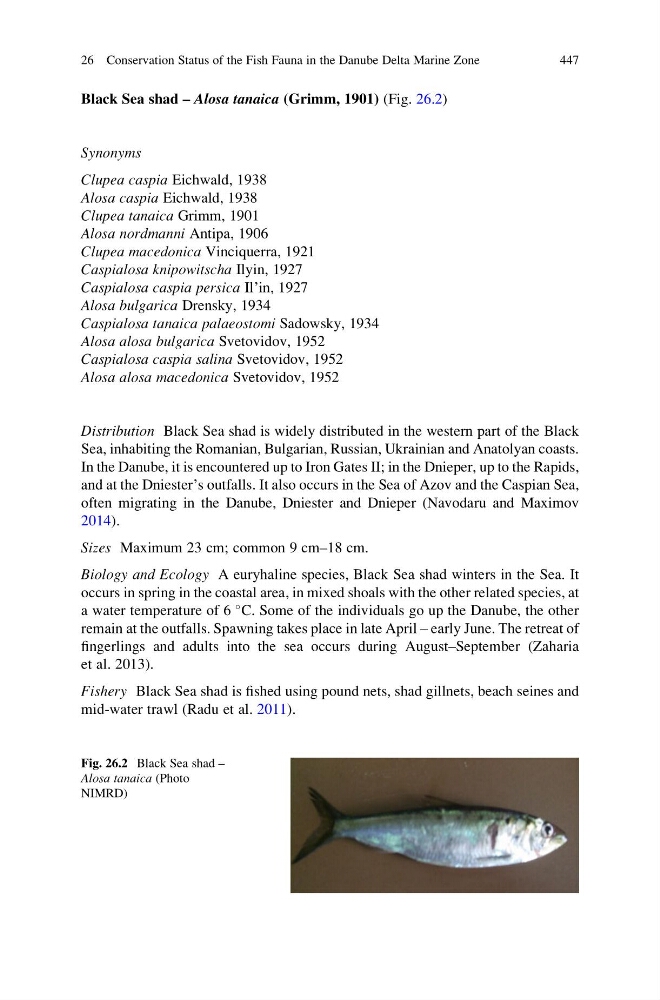
Black Sea shad – Alosa tanaica (Grimm, 1901) (Fig. 26.2)
Synonyms
Clupea caspia Eichwald, 1938
Alosa caspia Eichwald, 1938
Clupea tanaica Grimm, 1901
Alosa nordmanni Antipa, 1906
Clupea macedonica Vinciquerra, 1921
Caspialosa knipowitscha Ilyin, 1927
Caspialosa caspia persica Il’in, 1927
Alosa bulgarica Drensky, 1934
Caspialosa tanaica palaeostomi Sadowsky, 1934
Alosa alosa bulgarica Svetovidov, 1952
Caspialosa caspia salina Svetovidov, 1952
Alosa alosa macedonica Svetovidov, 1952
Distribution Black Sea shad is widely distributed in the western part of the Black
Sea, inhabiting the Romanian, Bulgarian, Russian, Ukrainian and Anatolyan coasts.
In the Danube, it is encountered up to Iron Gates II; in the Dnieper, up to the Rapids,
and at the Dniester’s outfalls. It also occurs in the Sea of Azov and the Caspian Sea,
often migrating in the Danube, Dniester and Dnieper (Navodaru and Maximov
2014).
Sizes Maximum 23 cm; common 9 cm–18 cm.
Biology and Ecology A euryhaline species, Black Sea shad winters in the Sea. It
occurs in spring in the coastal area, in mixed shoals with the other related species, at
a water temperature of 6
C. Some of the individuals go up the Danube, the other
remain at the outfalls. Spawning takes place in late April – early June. The retreat of
fingerlings and adults into the sea occurs during August–September (Zaharia
et al. 2013).
Fishery Black Sea shad is fished using pound nets, shad gillnets, beach seines and
mid-water trawl (Radu et al. 2011).
Fig. 26.2 Black Sea shad –
Alosa tanaica (Photo
NIMRD)
26 Conservation Status of the Fish Fauna in the Danube Delta Marine Zone
447
Synonyms
Clupea caspia Eichwald, 1938
Alosa caspia Eichwald, 1938
Clupea tanaica Grimm, 1901
Alosa nordmanni Antipa, 1906
Clupea macedonica Vinciquerra, 1921
Caspialosa knipowitscha Ilyin, 1927
Caspialosa caspia persica Il’in, 1927
Alosa bulgarica Drensky, 1934
Caspialosa tanaica palaeostomi Sadowsky, 1934
Alosa alosa bulgarica Svetovidov, 1952
Caspialosa caspia salina Svetovidov, 1952
Alosa alosa macedonica Svetovidov, 1952
Distribution Black Sea shad is widely distributed in the western part of the Black
Sea, inhabiting the Romanian, Bulgarian, Russian, Ukrainian and Anatolyan coasts.
In the Danube, it is encountered up to Iron Gates II; in the Dnieper, up to the Rapids,
and at the Dniester’s outfalls. It also occurs in the Sea of Azov and the Caspian Sea,
often migrating in the Danube, Dniester and Dnieper (Navodaru and Maximov
2014).
Sizes Maximum 23 cm; common 9 cm–18 cm.
Biology and Ecology A euryhaline species, Black Sea shad winters in the Sea. It
occurs in spring in the coastal area, in mixed shoals with the other related species, at
a water temperature of 6
C. Some of the individuals go up the Danube, the other
remain at the outfalls. Spawning takes place in late April – early June. The retreat of
fingerlings and adults into the sea occurs during August–September (Zaharia
et al. 2013).
Fishery Black Sea shad is fished using pound nets, shad gillnets, beach seines and
mid-water trawl (Radu et al. 2011).
Fig. 26.2 Black Sea shad –
Alosa tanaica (Photo
NIMRD)
26 Conservation Status of the Fish Fauna in the Danube Delta Marine Zone
447