

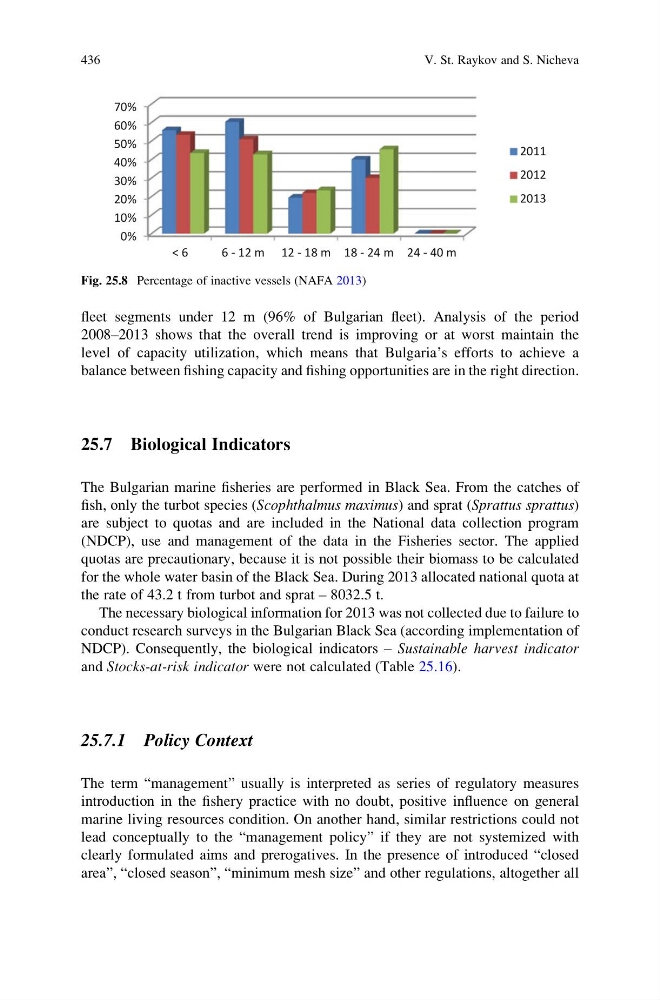
fleet segments under 12 m (96% of Bulgarian fleet). Analysis of the period
2008–2013 shows that the overall trend is improving or at worst maintain the
level of capacity utilization, which means that Bulgaria’s efforts to achieve a
balance between fishing capacity and fishing opportunities are in the right direction.
25.7 Biological Indicators
The Bulgarian marine fisheries are performed in Black Sea. From the catches of
fish, only the turbot species (Scophthalmus maximus) and sprat (Sprattus sprattus)
are subject to quotas and are included in the National data collection program
(NDCP), use and management of the data in the Fisheries sector. The applied
quotas are precautionary, because it is not possible their biomass to be calculated
for the whole water basin of the Black Sea. During 2013 allocated national quota at
the rate of 43.2 t from turbot and sprat – 8032.5 t.
The necessary biological information for 2013 was not collected due to failure to
conduct research surveys in the Bulgarian Black Sea (according implementation of
NDCP). Consequently, the biological indicators – Sustainable harvest indicator
and Stocks-at-risk indicator were not calculated (Table 25.16).
25.7.1 Policy Context
The term “management” usually is interpreted as series of regulatory measures
introduction in the fishery practice with no doubt, positive influence on general
marine living resources condition. On another hand, similar restrictions could not
lead conceptually to the “management policy” if they are not systemized with
clearly formulated aims and prerogatives. In the presence of introduced “closed
area”, “closed season”, “minimum mesh size” and other regulations, altogether all
0%
10%
20%
30%
40%
50%
60%
70%
< 6
6 - 12 m 12 - 18 m 18 - 24 m 24 - 40 m
2011
2012
2013
Fig. 25.8 Percentage of inactive vessels (NAFA 2013)
436
V. St. Raykov and S. Nicheva
2008–2013 shows that the overall trend is improving or at worst maintain the
level of capacity utilization, which means that Bulgaria’s efforts to achieve a
balance between fishing capacity and fishing opportunities are in the right direction.
25.7 Biological Indicators
The Bulgarian marine fisheries are performed in Black Sea. From the catches of
fish, only the turbot species (Scophthalmus maximus) and sprat (Sprattus sprattus)
are subject to quotas and are included in the National data collection program
(NDCP), use and management of the data in the Fisheries sector. The applied
quotas are precautionary, because it is not possible their biomass to be calculated
for the whole water basin of the Black Sea. During 2013 allocated national quota at
the rate of 43.2 t from turbot and sprat – 8032.5 t.
The necessary biological information for 2013 was not collected due to failure to
conduct research surveys in the Bulgarian Black Sea (according implementation of
NDCP). Consequently, the biological indicators – Sustainable harvest indicator
and Stocks-at-risk indicator were not calculated (Table 25.16).
25.7.1 Policy Context
The term “management” usually is interpreted as series of regulatory measures
introduction in the fishery practice with no doubt, positive influence on general
marine living resources condition. On another hand, similar restrictions could not
lead conceptually to the “management policy” if they are not systemized with
clearly formulated aims and prerogatives. In the presence of introduced “closed
area”, “closed season”, “minimum mesh size” and other regulations, altogether all
0%
10%
20%
30%
40%
50%
60%
70%
< 6
6 - 12 m 12 - 18 m 18 - 24 m 24 - 40 m
2011
2012
2013
Fig. 25.8 Percentage of inactive vessels (NAFA 2013)
436
V. St. Raykov and S. Nicheva