

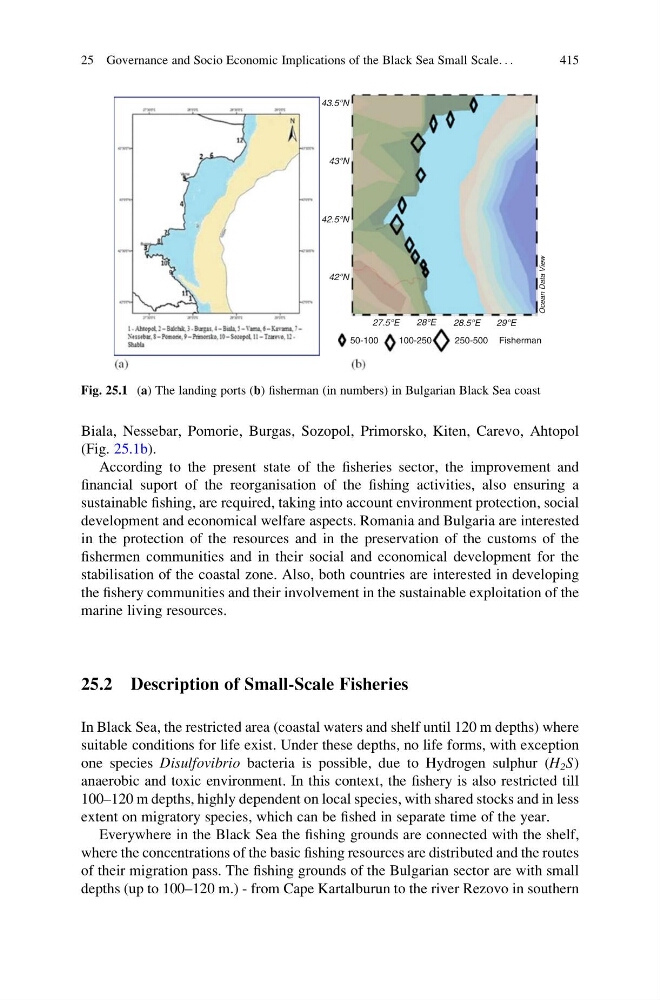
Biala, Nessebar, Pomorie, Burgas, Sozopol, Primorsko, Kiten, Carevo, Ahtopol
(Fig. 25.1b).
According to the present state of the fisheries sector, the improvement and
financial suport of the reorganisation of the fishing activities, also ensuring a
sustainable fishing, are required, taking into account environment protection, social
development and economical welfare aspects. Romania and Bulgaria are interested
in the protection of the resources and in the preservation of the customs of the
fishermen communities and in their social and economical development for the
stabilisation of the coastal zone. Also, both countries are interested in developing
the fishery communities and their involvement in the sustainable exploitation of the
marine living resources.
25.2 Description of Small-Scale Fisheries
In Black Sea, the restricted area (coastal waters and shelf until 120 m depths) where
suitable conditions for life exist. Under these depths, no life forms, with exception
one species Disulfovibrio bacteria is possible, due to Hydrogen sulphur (H 2 S)
anaerobic and toxic environment. In this context, the fishery is also restricted till
100–120 m depths, highly dependent on local species, with shared stocks and in less
extent on migratory species, which can be fished in separate time of the year.
Everywhere in the Black Sea the fishing grounds are connected with the shelf,
where the concentrations of the basic fishing resources are distributed and the routes
of their migration pass. The fishing grounds of the Bulgarian sector are with small
depths (up to 100–120 m.) - from Cape Kartalburun to the river Rezovo in southern
43.5°N
43°N
42.5°N
42°N
27.5°E
28°E
28.5°E
29°E
Ocean Data View
Fisherman
250-500
100-250
50-100
Fig. 25.1 (a) The landing ports (b) fisherman (in numbers) in Bulgarian Black Sea coast
25 Governance and Socio Economic Implications of the Black Sea Small Scale. . .
415
(Fig. 25.1b).
According to the present state of the fisheries sector, the improvement and
financial suport of the reorganisation of the fishing activities, also ensuring a
sustainable fishing, are required, taking into account environment protection, social
development and economical welfare aspects. Romania and Bulgaria are interested
in the protection of the resources and in the preservation of the customs of the
fishermen communities and in their social and economical development for the
stabilisation of the coastal zone. Also, both countries are interested in developing
the fishery communities and their involvement in the sustainable exploitation of the
marine living resources.
25.2 Description of Small-Scale Fisheries
In Black Sea, the restricted area (coastal waters and shelf until 120 m depths) where
suitable conditions for life exist. Under these depths, no life forms, with exception
one species Disulfovibrio bacteria is possible, due to Hydrogen sulphur (H 2 S)
anaerobic and toxic environment. In this context, the fishery is also restricted till
100–120 m depths, highly dependent on local species, with shared stocks and in less
extent on migratory species, which can be fished in separate time of the year.
Everywhere in the Black Sea the fishing grounds are connected with the shelf,
where the concentrations of the basic fishing resources are distributed and the routes
of their migration pass. The fishing grounds of the Bulgarian sector are with small
depths (up to 100–120 m.) - from Cape Kartalburun to the river Rezovo in southern
43.5°N
43°N
42.5°N
42°N
27.5°E
28°E
28.5°E
29°E
Ocean Data View
Fisherman
250-500
100-250
50-100
Fig. 25.1 (a) The landing ports (b) fisherman (in numbers) in Bulgarian Black Sea coast
25 Governance and Socio Economic Implications of the Black Sea Small Scale. . .
415