

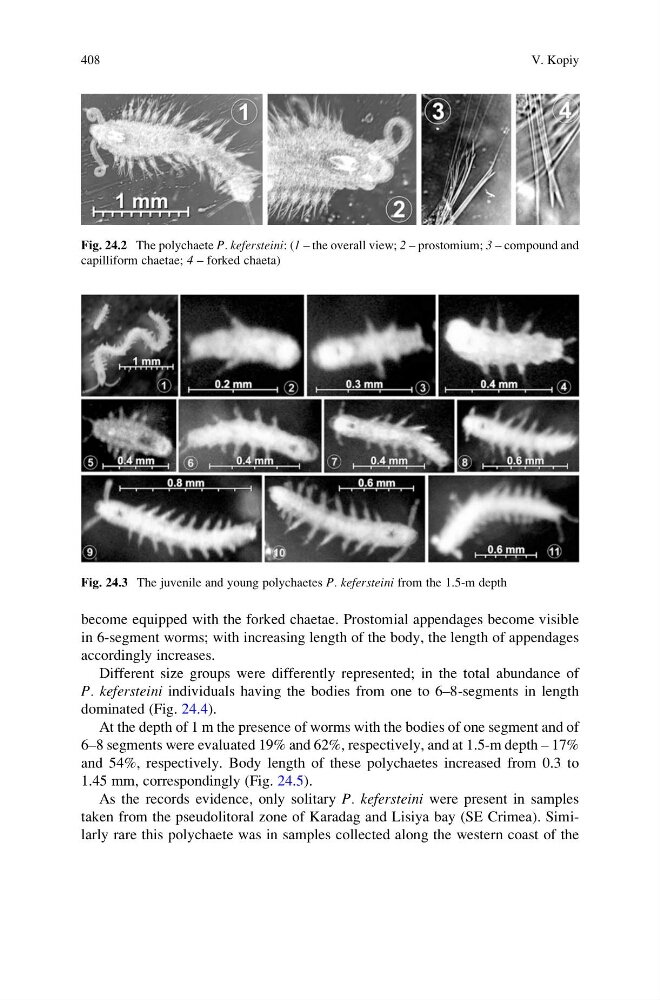
become equipped with the forked chaetae. Prostomial appendages become visible
in 6-segment worms; with increasing length of the body, the length of appendages
accordingly increases.
Different size groups were differently represented; in the total abundance of
P. kefersteini individuals having the bodies from one to 6–8-segments in length
dominated (Fig. 24.4).
At the depth of 1 m the presence of worms with the bodies of one segment and of
6–8 segments were evaluated 19% and 62%, respectively, and at 1.5-m depth – 17%
and 54%, respectively. Body length of these polychaetes increased from 0.3 to
1.45 mm, correspondingly (Fig. 24.5).
As the records evidence, only solitary P. kefersteini were present in samples
taken from the pseudolitoral zone of Karadag and Lisiya bay (SE Crimea). Similarly rare this polychaete was in samples collected along the western coast of the
Fig. 24.2 The polychaete P. kefersteini: (1 – the overall view; 2 – prostomium; 3 – compound and
capilliform chaetae; 4 – forked chaeta)
Fig. 24.3 The juvenile and young polychaetes P. kefersteini from the 1.5-m depth
408
V. Kopiy
in 6-segment worms; with increasing length of the body, the length of appendages
accordingly increases.
Different size groups were differently represented; in the total abundance of
P. kefersteini individuals having the bodies from one to 6–8-segments in length
dominated (Fig. 24.4).
At the depth of 1 m the presence of worms with the bodies of one segment and of
6–8 segments were evaluated 19% and 62%, respectively, and at 1.5-m depth – 17%
and 54%, respectively. Body length of these polychaetes increased from 0.3 to
1.45 mm, correspondingly (Fig. 24.5).
As the records evidence, only solitary P. kefersteini were present in samples
taken from the pseudolitoral zone of Karadag and Lisiya bay (SE Crimea). Similarly rare this polychaete was in samples collected along the western coast of the
Fig. 24.2 The polychaete P. kefersteini: (1 – the overall view; 2 – prostomium; 3 – compound and
capilliform chaetae; 4 – forked chaeta)
Fig. 24.3 The juvenile and young polychaetes P. kefersteini from the 1.5-m depth
408
V. Kopiy