

The seeds of Cenchrus longispinus can remain viable in the soil for up to 5 years
and can germinate after a rainy period. Each plant can contain up to 1000
egg-shaped seeds (www.eppo.int).
Cenchrus longispinus usually grows on sandy soils and in recently disturbed
habitats. It can also be found along roads, railways and in abandoned fields. Burs are
dispersed in many ways, such as clinging to animals, shoes, clothing or car tyres.
The winds are another way in which the burs disseminate in the coastal area.
Cenchrus longispinus has often been mistaken for some closely related congeners such as Cenchrus tribuloides or Cenchrus spinifex. Cenchrus longispinus most
closely resembles Cenchrus spinifex and therefore these species were often confused. Sometimes these species are intermixed in the same areas (Verloove and
Sanchez Gullon 2012).
Cenchrus spinifex (syn. Cenchrus incertus) – coast sandbur, was recorded in
Romania for the first time in 1991 in Vama Veche village (Cioc^ arlan et al. 1991).
Subsequently, it was identified in other locations from Dobrogea region – Constanța
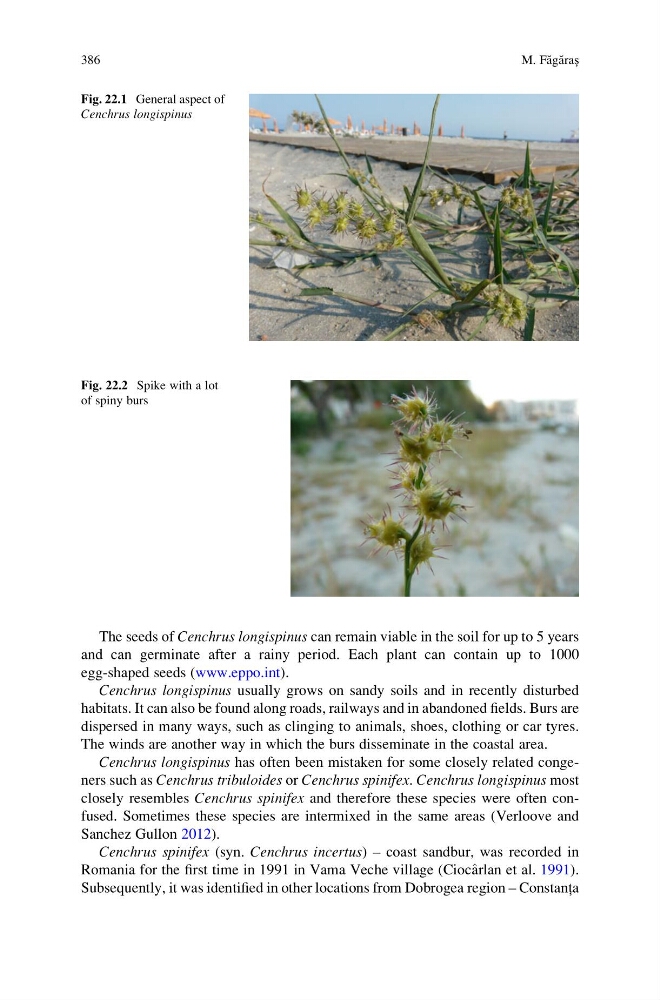
Fig. 22.1 General aspect of
Cenchrus longispinus
Fig. 22.2 Spike with a lot
of spiny burs
386
M. Fa ˘ga ˘raș
and can germinate after a rainy period. Each plant can contain up to 1000
egg-shaped seeds (www.eppo.int).
Cenchrus longispinus usually grows on sandy soils and in recently disturbed
habitats. It can also be found along roads, railways and in abandoned fields. Burs are
dispersed in many ways, such as clinging to animals, shoes, clothing or car tyres.
The winds are another way in which the burs disseminate in the coastal area.
Cenchrus longispinus has often been mistaken for some closely related congeners such as Cenchrus tribuloides or Cenchrus spinifex. Cenchrus longispinus most
closely resembles Cenchrus spinifex and therefore these species were often confused. Sometimes these species are intermixed in the same areas (Verloove and
Sanchez Gullon 2012).
Cenchrus spinifex (syn. Cenchrus incertus) – coast sandbur, was recorded in
Romania for the first time in 1991 in Vama Veche village (Cioc^ arlan et al. 1991).
Subsequently, it was identified in other locations from Dobrogea region – Constanța
Fig. 22.1 General aspect of
Cenchrus longispinus
Fig. 22.2 Spike with a lot
of spiny burs
386
M. Fa ˘ga ˘raș