

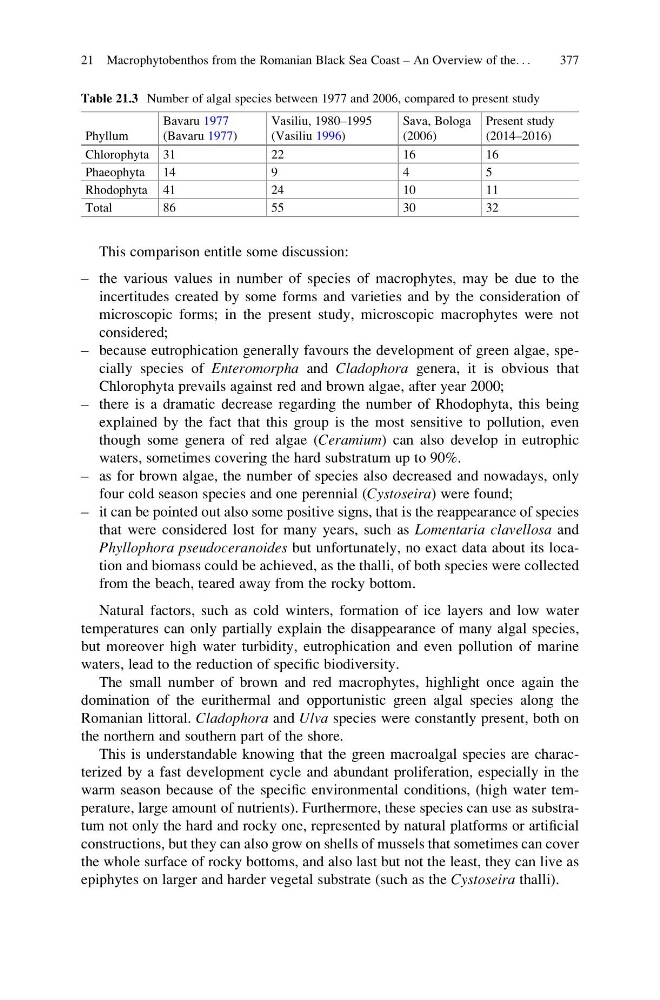
This comparison entitle some discussion:
– the various values in number of species of macrophytes, may be due to the
incertitudes created by some forms and varieties and by the consideration of
microscopic forms; in the present study, microscopic macrophytes were not
considered;
– because eutrophication generally favours the development of green algae, specially species of Enteromorpha and Cladophora genera, it is obvious that
Chlorophyta prevails against red and brown algae, after year 2000;
– there is a dramatic decrease regarding the number of Rhodophyta, this being
explained by the fact that this group is the most sensitive to pollution, even
though some genera of red algae (Ceramium) can also develop in eutrophic
waters, sometimes covering the hard substratum up to 90%.
– as for brown algae, the number of species also decreased and nowadays, only
four cold season species and one perennial (Cystoseira) were found;
– it can be pointed out also some positive signs, that is the reappearance of species
that were considered lost for many years, such as Lomentaria clavellosa and
Phyllophora pseudoceranoides but unfortunately, no exact data about its location and biomass could be achieved, as the thalli, of both species were collected
from the beach, teared away from the rocky bottom.
Natural factors, such as cold winters, formation of ice layers and low water
temperatures can only partially explain the disappearance of many algal species,
but moreover high water turbidity, eutrophication and even pollution of marine
waters, lead to the reduction of specific biodiversity.
The small number of brown and red macrophytes, highlight once again the
domination of the eurithermal and opportunistic green algal species along the
Romanian littoral. Cladophora and Ulva species were constantly present, both on
the northern and southern part of the shore.
This is understandable knowing that the green macroalgal species are characterized by a fast development cycle and abundant proliferation, especially in the
warm season because of the specific environmental conditions, (high water temperature, large amount of nutrients). Furthermore, these species can use as substratum not only the hard and rocky one, represented by natural platforms or artificial
constructions, but they can also grow on shells of mussels that sometimes can cover
the whole surface of rocky bottoms, and also last but not the least, they can live as
epiphytes on larger and harder vegetal substrate (such as the Cystoseira thalli).
Table 21.3 Number of algal species between 1977 and 2006, compared to present study
Phyllum
Bavaru 1977
(Bavaru 1977)
Vasiliu, 1980–1995
(Vasiliu 1996)
Sava, Bologa
(2006)
Present study
(2014–2016)
Chlorophyta 31
22
16
16
Phaeophyta 14
9
4
5
Rhodophyta 41
24
10
11
Total
86
55
30
32
21 Macrophytobenthos from the Romanian Black Sea Coast – An Overview of the. . .
377
– the various values in number of species of macrophytes, may be due to the
incertitudes created by some forms and varieties and by the consideration of
microscopic forms; in the present study, microscopic macrophytes were not
considered;
– because eutrophication generally favours the development of green algae, specially species of Enteromorpha and Cladophora genera, it is obvious that
Chlorophyta prevails against red and brown algae, after year 2000;
– there is a dramatic decrease regarding the number of Rhodophyta, this being
explained by the fact that this group is the most sensitive to pollution, even
though some genera of red algae (Ceramium) can also develop in eutrophic
waters, sometimes covering the hard substratum up to 90%.
– as for brown algae, the number of species also decreased and nowadays, only
four cold season species and one perennial (Cystoseira) were found;
– it can be pointed out also some positive signs, that is the reappearance of species
that were considered lost for many years, such as Lomentaria clavellosa and
Phyllophora pseudoceranoides but unfortunately, no exact data about its location and biomass could be achieved, as the thalli, of both species were collected
from the beach, teared away from the rocky bottom.
Natural factors, such as cold winters, formation of ice layers and low water
temperatures can only partially explain the disappearance of many algal species,
but moreover high water turbidity, eutrophication and even pollution of marine
waters, lead to the reduction of specific biodiversity.
The small number of brown and red macrophytes, highlight once again the
domination of the eurithermal and opportunistic green algal species along the
Romanian littoral. Cladophora and Ulva species were constantly present, both on
the northern and southern part of the shore.
This is understandable knowing that the green macroalgal species are characterized by a fast development cycle and abundant proliferation, especially in the
warm season because of the specific environmental conditions, (high water temperature, large amount of nutrients). Furthermore, these species can use as substratum not only the hard and rocky one, represented by natural platforms or artificial
constructions, but they can also grow on shells of mussels that sometimes can cover
the whole surface of rocky bottoms, and also last but not the least, they can live as
epiphytes on larger and harder vegetal substrate (such as the Cystoseira thalli).
Table 21.3 Number of algal species between 1977 and 2006, compared to present study
Phyllum
Bavaru 1977
(Bavaru 1977)
Vasiliu, 1980–1995
(Vasiliu 1996)
Sava, Bologa
(2006)
Present study
(2014–2016)
Chlorophyta 31
22
16
16
Phaeophyta 14
9
4
5
Rhodophyta 41
24
10
11
Total
86
55
30
32
21 Macrophytobenthos from the Romanian Black Sea Coast – An Overview of the. . .
377