

21.3 Material and Methods
The selection of the study sites considered as principal criteria the presence of a
rocky, natural or artificial bottom, because one of the most important conditions for
the development of macrophytes is the presence of a hard substratum. The sampling
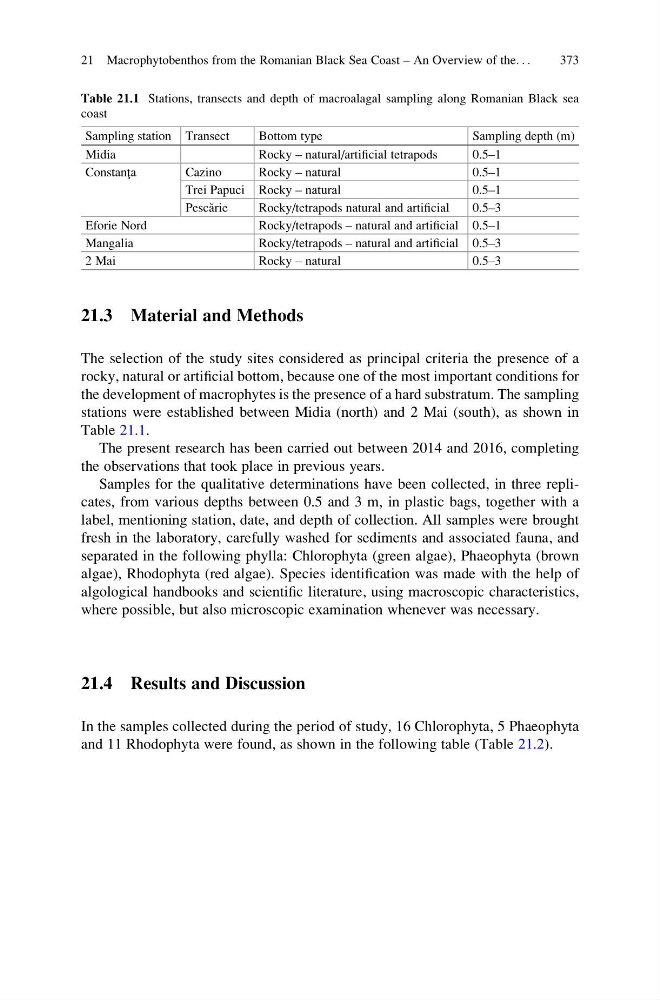
stations were established between Midia (north) and 2 Mai (south), as shown in
Table 21.1.
The present research has been carried out between 2014 and 2016, completing
the observations that took place in previous years.
Samples for the qualitative determinations have been collected, in three replicates, from various depths between 0.5 and 3 m, in plastic bags, together with a
label, mentioning station, date, and depth of collection. All samples were brought
fresh in the laboratory, carefully washed for sediments and associated fauna, and
separated in the following phylla: Chlorophyta (green algae), Phaeophyta (brown
algae), Rhodophyta (red algae). Species identification was made with the help of
algological handbooks and scientific literature, using macroscopic characteristics,
where possible, but also microscopic examination whenever was necessary.
21.4 Results and Discussion
In the samples collected during the period of study, 16 Chlorophyta, 5 Phaeophyta
and 11 Rhodophyta were found, as shown in the following table (Table 21.2).
Table 21.1 Stations, transects and depth of macroalagal sampling along Romanian Black sea
coast
Sampling station Transect
Bottom type
Sampling depth (m)
Midia
Rocky – natural/artificial tetrapods
0.5–1
Constant ¸a
Cazino
Rocky – natural
0.5–1
Trei Papuci Rocky – natural
0.5–1
Pesca ˘rie
Rocky/tetrapods natural and artificial
0.5–3
Eforie Nord
Rocky/tetrapods – natural and artificial 0.5–1
Mangalia
Rocky/tetrapods – natural and artificial 0.5–3
2 Mai
Rocky – natural
0.5–3
21 Macrophytobenthos from the Romanian Black Sea Coast – An Overview of the. . .
373
The selection of the study sites considered as principal criteria the presence of a
rocky, natural or artificial bottom, because one of the most important conditions for
the development of macrophytes is the presence of a hard substratum. The sampling
stations were established between Midia (north) and 2 Mai (south), as shown in
Table 21.1.
The present research has been carried out between 2014 and 2016, completing
the observations that took place in previous years.
Samples for the qualitative determinations have been collected, in three replicates, from various depths between 0.5 and 3 m, in plastic bags, together with a
label, mentioning station, date, and depth of collection. All samples were brought
fresh in the laboratory, carefully washed for sediments and associated fauna, and
separated in the following phylla: Chlorophyta (green algae), Phaeophyta (brown
algae), Rhodophyta (red algae). Species identification was made with the help of
algological handbooks and scientific literature, using macroscopic characteristics,
where possible, but also microscopic examination whenever was necessary.
21.4 Results and Discussion
In the samples collected during the period of study, 16 Chlorophyta, 5 Phaeophyta
and 11 Rhodophyta were found, as shown in the following table (Table 21.2).
Table 21.1 Stations, transects and depth of macroalagal sampling along Romanian Black sea
coast
Sampling station Transect
Bottom type
Sampling depth (m)
Midia
Rocky – natural/artificial tetrapods
0.5–1
Constant ¸a
Cazino
Rocky – natural
0.5–1
Trei Papuci Rocky – natural
0.5–1
Pesca ˘rie
Rocky/tetrapods natural and artificial
0.5–3
Eforie Nord
Rocky/tetrapods – natural and artificial 0.5–1
Mangalia
Rocky/tetrapods – natural and artificial 0.5–3
2 Mai
Rocky – natural
0.5–3
21 Macrophytobenthos from the Romanian Black Sea Coast – An Overview of the. . .
373