

19.2 Evaluation of Sediment Flux of Particulate Organic
Phosphorus from the Photic Layer of the Pelagial
of the Black Sea
Sedimentation flow of particulate organic phosphorus is an important component of
biogeochemical phosphorus cycle, ensuring its balance in the marine and freshwater environment. In recent decades on the shelf and in the open part of the Black
Sea, large-scale studies using different methods (traditional sampling method
(filtration on glass fiber filters BOB), sediment traps and uranium-thorium method)
were carried out, that allowed us to obtain a large amount of spatial data by
temporal and vertical distribution of the content of particulate organic carbon
(С POM ), nitrogen (N POM ), phosphorus and their fluxes (Izdar et al. 1987; Hay
et al. 1990; Karl and Knauer 1991; Gulin et al. 1995; Burlakova et al. 1998,
2003; Samyshev 2009; Kukushkin 2012). However, due to the methodological
difficulties of using sediment traps at shallow depths (40–60 m) and timeconsuming determination of particulate organic carbon (С POM ), nitrogen (N POM )
and phosphorus (P POM ) in field conditions (Yakushev and Korzhikova 1990; Gulin
et al. 1995; Burlakova et al. 1998;) fluxes studies C VOV flows of N VOV , have been
limited. Analysis of the available data in the literature showed that mainly they
reflect the assessment of C POM flows and N POM (Karl and Knauer 1991; Gulin et al.
1995; Burlakova et al. 2003; Samyshev 2009). Estimates of annual variability of
sedimentation flow of deep water area of the Black Sea in zone of photosynthesis
are absent, with the exception of model calculations the average annual value of this
flux in the western part of the sea (Yegorov 2001). To solve this problem we used
the results of studies on spatial and vertical distribution of the content of particulate
organic carbon were used (C POM ), nitrogen (N POM ) and phosphorus (P VOV ) in the
layer (0–150 m), obtained in 10 scientific expeditions on the 51 stations in the
period 1985–1994 in the deepwater area of the Black Sea (Kukushkin and
Parkhomenko 2015). The methods, of algorithm calculation and study of monthly
and annual average values of sedimentation flux of particulate organic phosphorus
are described in the work (Parkhomenko and Kukushkin 2015).
1 2 3 4 5 6 7 8 9 10 11 12
Months
0
200
400
600
800
PP, mgC m -2
day -1
1
2
3
4
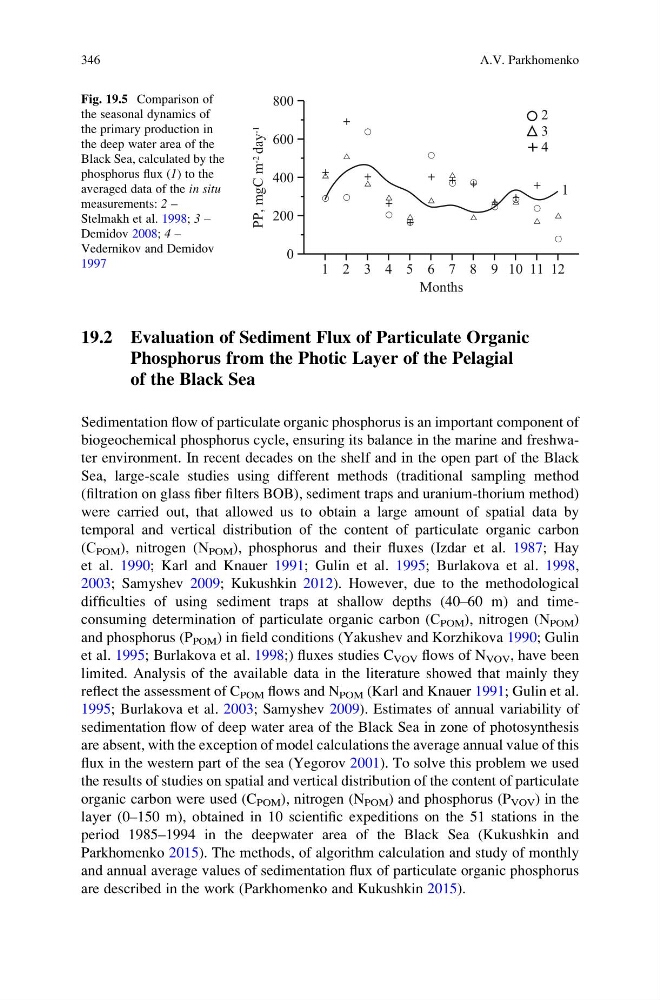
Fig. 19.5 Comparison of
the seasonal dynamics of
the primary production in
the deep water area of the
Black Sea, calculated by the
phosphorus flux (1) to the
averaged data of the in situ
measurements: 2 –
Stelmakh et al. 1998; 3 –
Demidov 2008; 4 –
Vedernikov and Demidov
1997
346
A.V. Parkhomenko
Phosphorus from the Photic Layer of the Pelagial
of the Black Sea
Sedimentation flow of particulate organic phosphorus is an important component of
biogeochemical phosphorus cycle, ensuring its balance in the marine and freshwater environment. In recent decades on the shelf and in the open part of the Black
Sea, large-scale studies using different methods (traditional sampling method
(filtration on glass fiber filters BOB), sediment traps and uranium-thorium method)
were carried out, that allowed us to obtain a large amount of spatial data by
temporal and vertical distribution of the content of particulate organic carbon
(С POM ), nitrogen (N POM ), phosphorus and their fluxes (Izdar et al. 1987; Hay
et al. 1990; Karl and Knauer 1991; Gulin et al. 1995; Burlakova et al. 1998,
2003; Samyshev 2009; Kukushkin 2012). However, due to the methodological
difficulties of using sediment traps at shallow depths (40–60 m) and timeconsuming determination of particulate organic carbon (С POM ), nitrogen (N POM )
and phosphorus (P POM ) in field conditions (Yakushev and Korzhikova 1990; Gulin
et al. 1995; Burlakova et al. 1998;) fluxes studies C VOV flows of N VOV , have been
limited. Analysis of the available data in the literature showed that mainly they
reflect the assessment of C POM flows and N POM (Karl and Knauer 1991; Gulin et al.
1995; Burlakova et al. 2003; Samyshev 2009). Estimates of annual variability of
sedimentation flow of deep water area of the Black Sea in zone of photosynthesis
are absent, with the exception of model calculations the average annual value of this
flux in the western part of the sea (Yegorov 2001). To solve this problem we used
the results of studies on spatial and vertical distribution of the content of particulate
organic carbon were used (C POM ), nitrogen (N POM ) and phosphorus (P VOV ) in the
layer (0–150 m), obtained in 10 scientific expeditions on the 51 stations in the
period 1985–1994 in the deepwater area of the Black Sea (Kukushkin and
Parkhomenko 2015). The methods, of algorithm calculation and study of monthly
and annual average values of sedimentation flux of particulate organic phosphorus
are described in the work (Parkhomenko and Kukushkin 2015).
1 2 3 4 5 6 7 8 9 10 11 12
Months
0
200
400
600
800
PP, mgC m -2
day -1
1
2
3
4
Fig. 19.5 Comparison of
the seasonal dynamics of
the primary production in
the deep water area of the
Black Sea, calculated by the
phosphorus flux (1) to the
averaged data of the in situ
measurements: 2 –
Stelmakh et al. 1998; 3 –
Demidov 2008; 4 –
Vedernikov and Demidov
1997
346
A.V. Parkhomenko