

The performed correlation analysis for three consecutive season, for each type of
sediment at all locations shows, that there is no clear season dependence of isotope
concentrations – the calculated correlation coefficients between different seasons
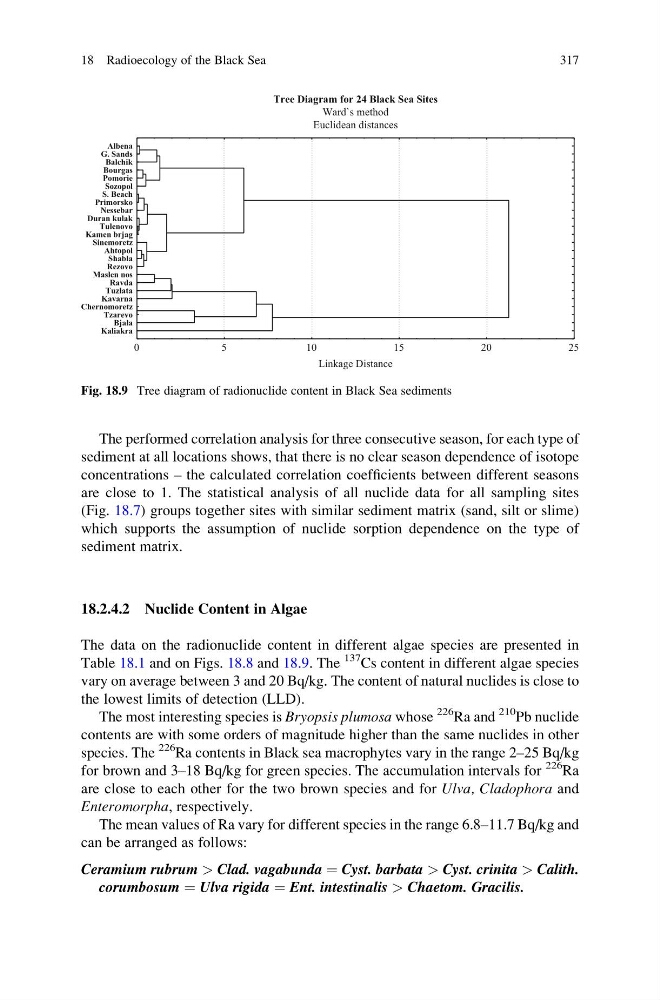
are close to 1. The statistical analysis of all nuclide data for all sampling sites
(Fig. 18.7) groups together sites with similar sediment matrix (sand, silt or slime)
which supports the assumption of nuclide sorption dependence on the type of
sediment matrix.
18.2.4.2 Nuclide Content in Algae
The data on the radionuclide content in different algae species are presented in
Table 18.1 and on Figs. 18.8 and 18.9. The
137 Cs content in different algae species
vary on average between 3 and 20 Bq/kg. The content of natural nuclides is close to
the lowest limits of detection (LLD).
The most interesting species is Bryopsis plumosa whose
226 Ra and
210 Pb nuclide
contents are with some orders of magnitude higher than the same nuclides in other
species. The
226
Ra contents in Black sea macrophytes vary in the range 2–25 Bq/kg
for brown and 3–18 Bq/kg for green species. The accumulation intervals for
226 Ra
are close to each other for the two brown species and for Ulva, Cladophora and
Enteromorpha, respectively.
The mean values of Ra vary for different species in the range 6.8–11.7 Bq/kg and
can be arranged as follows:
Ceramium rubrum > Clad. vagabunda ¼ Cyst. barbata > Cyst. crinita > Calith.
corumbosum ¼ Ulva rigida ¼ Ent. intestinalis > Chaetom. Gracilis.
Tree Diagram for 24 Black Sea Sites
Ward`s method
Euclidean distances
Linkage Distance
0
5
10
15
20
25
Kaliakra
Bjala
Tzarevo
Chernomoretz
Kavarna
Tuzlata
Ravda
Maslen nos
Rezovo
Shabla
Ahtopol
Sinemoretz
Kamen brjag
Tulenovo
Duran kulak
Nessebar
Primorsko
S. Beach
Sozopol
Pomorie
Bourgas
Balchik
G. Sands
Albena
Fig. 18.9 Tree diagram of radionuclide content in Black Sea sediments
18 Radioecology of the Black Sea
317
sediment at all locations shows, that there is no clear season dependence of isotope
concentrations – the calculated correlation coefficients between different seasons
are close to 1. The statistical analysis of all nuclide data for all sampling sites
(Fig. 18.7) groups together sites with similar sediment matrix (sand, silt or slime)
which supports the assumption of nuclide sorption dependence on the type of
sediment matrix.
18.2.4.2 Nuclide Content in Algae
The data on the radionuclide content in different algae species are presented in
Table 18.1 and on Figs. 18.8 and 18.9. The
137 Cs content in different algae species
vary on average between 3 and 20 Bq/kg. The content of natural nuclides is close to
the lowest limits of detection (LLD).
The most interesting species is Bryopsis plumosa whose
226 Ra and
210 Pb nuclide
contents are with some orders of magnitude higher than the same nuclides in other
species. The
226
Ra contents in Black sea macrophytes vary in the range 2–25 Bq/kg
for brown and 3–18 Bq/kg for green species. The accumulation intervals for
226 Ra
are close to each other for the two brown species and for Ulva, Cladophora and
Enteromorpha, respectively.
The mean values of Ra vary for different species in the range 6.8–11.7 Bq/kg and
can be arranged as follows:
Ceramium rubrum > Clad. vagabunda ¼ Cyst. barbata > Cyst. crinita > Calith.
corumbosum ¼ Ulva rigida ¼ Ent. intestinalis > Chaetom. Gracilis.
Tree Diagram for 24 Black Sea Sites
Ward`s method
Euclidean distances
Linkage Distance
0
5
10
15
20
25
Kaliakra
Bjala
Tzarevo
Chernomoretz
Kavarna
Tuzlata
Ravda
Maslen nos
Rezovo
Shabla
Ahtopol
Sinemoretz
Kamen brjag
Tulenovo
Duran kulak
Nessebar
Primorsko
S. Beach
Sozopol
Pomorie
Bourgas
Balchik
G. Sands
Albena
Fig. 18.9 Tree diagram of radionuclide content in Black Sea sediments
18 Radioecology of the Black Sea
317