

The coast of Bulgaria, extending 270 km is mainly soft sedimentary limestone or
sandstone, overlaid in many areas with beach or wind-blown sand. In the north,
suspended material from the Danube delta has settled, carrying a lot of intertidal
mud. The association of radionuclides with sediments in coastal and estuary areas
makes sediments a large reservoir for radionuclides affecting significantly specific
marine ecosystems. As the seawater is constantly in contact with organic and
inorganic matter from sea shelf, the first necessary step in the estimation of
radionuclide migration is the measurement of radionuclide content in sea bed
sediments and setting up a radioecological data base. Receiving relevant information for radionuclide concentrations in coastal waters and sediments is an important
stage in realization of monitoring and control of marine ecosystems at the coast
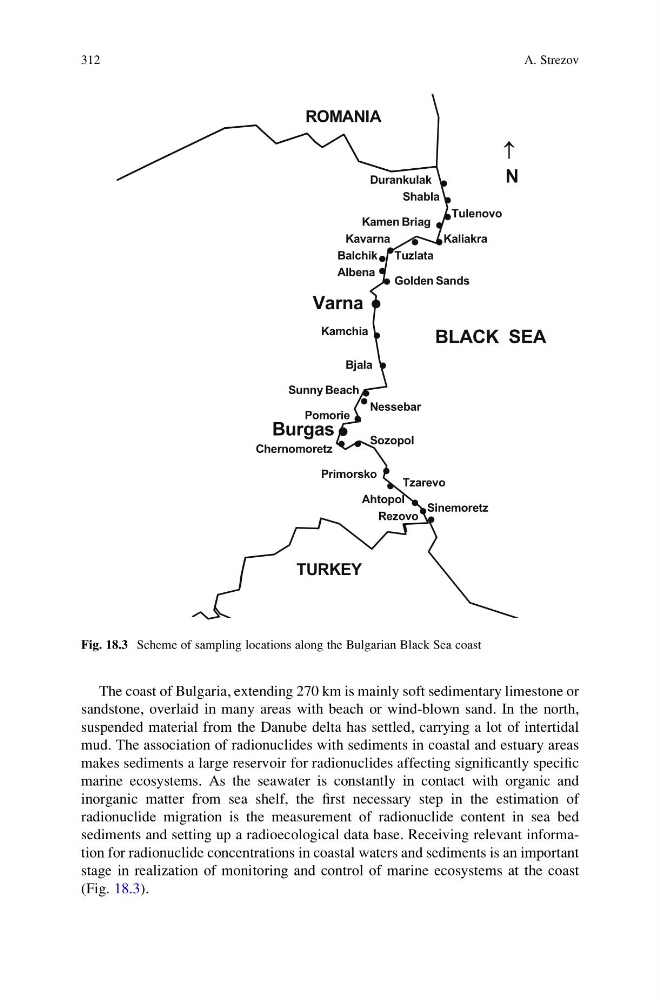
(Fig. 18.3).
•
•
•
•
•
•
•
•
•
•
•
•
•
•
•
•
•
•
•
•
TURKEY
BLACK SEA
ROMANIA
N
↑
Durankulak
Shabla
Kamen Briag
Golden Sands
Varna
Bjala
Burgas
Rezovo
Sinemoretz
Ahtopol
Tzarevo
Sozopol
Chernomoretz
Primorsko
Pomorie
Nessebar
Sunny Beach
Kamchia
Albena
Tuzlata
Kavarna
Kaliakra
Tulenovo
•
•
•
Balchik •
Fig. 18.3 Scheme of sampling locations along the Bulgarian Black Sea coast
312
A. Strezov
sandstone, overlaid in many areas with beach or wind-blown sand. In the north,
suspended material from the Danube delta has settled, carrying a lot of intertidal
mud. The association of radionuclides with sediments in coastal and estuary areas
makes sediments a large reservoir for radionuclides affecting significantly specific
marine ecosystems. As the seawater is constantly in contact with organic and
inorganic matter from sea shelf, the first necessary step in the estimation of
radionuclide migration is the measurement of radionuclide content in sea bed
sediments and setting up a radioecological data base. Receiving relevant information for radionuclide concentrations in coastal waters and sediments is an important
stage in realization of monitoring and control of marine ecosystems at the coast
(Fig. 18.3).
•
•
•
•
•
•
•
•
•
•
•
•
•
•
•
•
•
•
•
•
TURKEY
BLACK SEA
ROMANIA
N
↑
Durankulak
Shabla
Kamen Briag
Golden Sands
Varna
Bjala
Burgas
Rezovo
Sinemoretz
Ahtopol
Tzarevo
Sozopol
Chernomoretz
Primorsko
Pomorie
Nessebar
Sunny Beach
Kamchia
Albena
Tuzlata
Kavarna
Kaliakra
Tulenovo
•
•
•
Balchik •
Fig. 18.3 Scheme of sampling locations along the Bulgarian Black Sea coast
312
A. Strezov