

Zaitsev 1998). The calculated indexes of large-scale circulation of water of oxygen
and hydrogen-sulphidous zones of the Black Sea (Table 17.3) suggest that as a
result of complex influence of hydrodynamic processes the water flow through the
border of oxygen and hydrogen-sulphidous zones of the sea in large-scale averaging
can vary from 3120 to 10,920 km
3 /year.
At the same time the period of water exchange of the oxidation zone can be
estimated at 6.5–23 years, and for hydrogen sulfide zone – in 43–152 years, which is
generally correspond to the previously published integral estimates of rate of the
vertical circulation water of the Black Sea water rate (Vodyanitskiy 1948;
Bogdanova 1959; Skopincev 1975). Calculations made using data from
Table 17.4, was showed that in the Black Sea in 2013 contained 1670 TBq of
90
Sr, of which 547.7 TBq were in his oxygen, and 1123.3 TBq in the hydrogensulphidous zones.
Comparison of these data with the quantity of
90 Sr, entered at the period from
1986 to 2000 (260–460 TBq) showed that by 2013 the content of this radionuclide
increased 3.6–6.4 times due to its accumulation in the hydrogen-sulphidous zone of
the Black Sea. Similar calculations show that by 2013 the concentration of
137 Cs in
the Black Sea waters increased 1.2–1.6 times (up to 2843 TBq), of which 953 TBq
was deposited in an oxygen zone and 1890 TBq in the hydrogen-sulphidous zone of
the sea. Thus, an analysis of the shown data revealed a higher rate of pollution by
90
Sr and
137 Cs of the deep waters of the Black Sea, that, apparently, caused by
significant entrance of these radionuclides by runoff of rivers.
17.3.2 Bottom Sediments
The distribution of
137 Cs in the surface layer of bottom sediments of the northwestern and western (NW-W) part of the Black Sea, received by the results of more
than 150 measurements of
137 Cs concentration in sediments sampled in 1990–1994
in different areas of the shelf, continental slope and in the deep part of the sea is
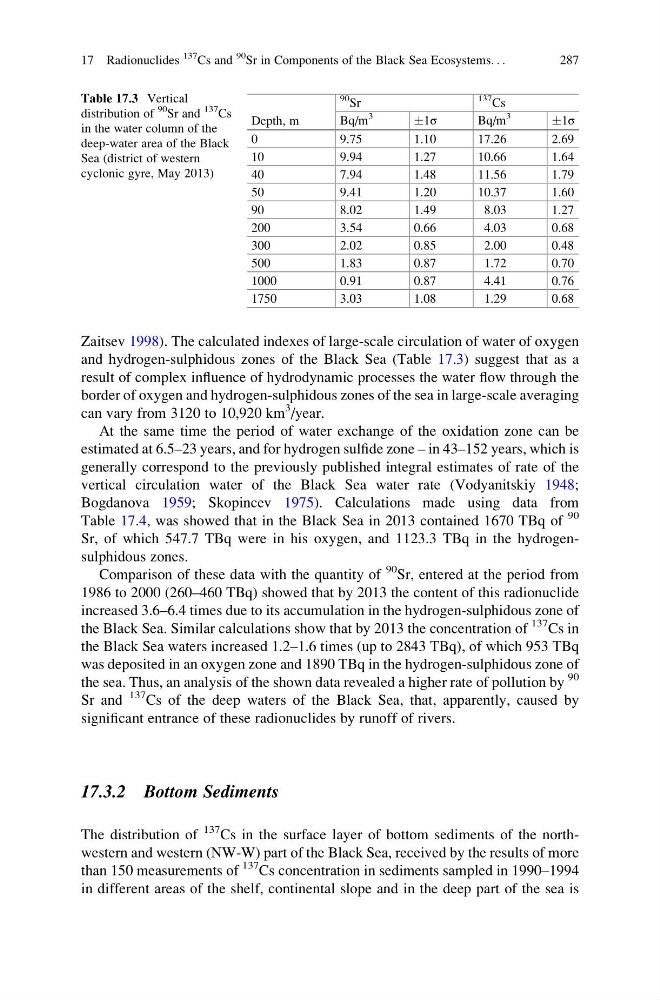
Table 17.3 Vertical
distribution of
90
Sr and
137
Cs
in the water column of the
deep-water area of the Black
Sea (district of western
cyclonic gyre, May 2013)
Depth, m
90
Sr
137 Cs
Bq/m
3
Æ1σ
Bq/m
3
Æ1σ
0
9.75
1.10
17.26
2.69
10
9.94
1.27
10.66
1.64
40
7.94
1.48
11.56
1.79
50
9.41
1.20
10.37
1.60
90
8.02
1.49
8.03
1.27
200
3.54
0.66
4.03
0.68
300
2.02
0.85
2.00
0.48
500
1.83
0.87
1.72
0.70
1000
0.91
0.87
4.41
0.76
1750
3.03
1.08
1.29
0.68
17 Radionuclides
137
Cs and
90
Sr in Components of the Black Sea Ecosystems. . .
287
and hydrogen-sulphidous zones of the Black Sea (Table 17.3) suggest that as a
result of complex influence of hydrodynamic processes the water flow through the
border of oxygen and hydrogen-sulphidous zones of the sea in large-scale averaging
can vary from 3120 to 10,920 km
3 /year.
At the same time the period of water exchange of the oxidation zone can be
estimated at 6.5–23 years, and for hydrogen sulfide zone – in 43–152 years, which is
generally correspond to the previously published integral estimates of rate of the
vertical circulation water of the Black Sea water rate (Vodyanitskiy 1948;
Bogdanova 1959; Skopincev 1975). Calculations made using data from
Table 17.4, was showed that in the Black Sea in 2013 contained 1670 TBq of
90
Sr, of which 547.7 TBq were in his oxygen, and 1123.3 TBq in the hydrogensulphidous zones.
Comparison of these data with the quantity of
90 Sr, entered at the period from
1986 to 2000 (260–460 TBq) showed that by 2013 the content of this radionuclide
increased 3.6–6.4 times due to its accumulation in the hydrogen-sulphidous zone of
the Black Sea. Similar calculations show that by 2013 the concentration of
137 Cs in
the Black Sea waters increased 1.2–1.6 times (up to 2843 TBq), of which 953 TBq
was deposited in an oxygen zone and 1890 TBq in the hydrogen-sulphidous zone of
the sea. Thus, an analysis of the shown data revealed a higher rate of pollution by
90
Sr and
137 Cs of the deep waters of the Black Sea, that, apparently, caused by
significant entrance of these radionuclides by runoff of rivers.
17.3.2 Bottom Sediments
The distribution of
137 Cs in the surface layer of bottom sediments of the northwestern and western (NW-W) part of the Black Sea, received by the results of more
than 150 measurements of
137 Cs concentration in sediments sampled in 1990–1994
in different areas of the shelf, continental slope and in the deep part of the sea is
Table 17.3 Vertical
distribution of
90
Sr and
137
Cs
in the water column of the
deep-water area of the Black
Sea (district of western
cyclonic gyre, May 2013)
Depth, m
90
Sr
137 Cs
Bq/m
3
Æ1σ
Bq/m
3
Æ1σ
0
9.75
1.10
17.26
2.69
10
9.94
1.27
10.66
1.64
40
7.94
1.48
11.56
1.79
50
9.41
1.20
10.37
1.60
90
8.02
1.49
8.03
1.27
200
3.54
0.66
4.03
0.68
300
2.02
0.85
2.00
0.48
500
1.83
0.87
1.72
0.70
1000
0.91
0.87
4.41
0.76
1750
3.03
1.08
1.29
0.68
17 Radionuclides
137
Cs and
90
Sr in Components of the Black Sea Ecosystems. . .
287