

system Knudsen and “Neil Brown Mark III” (12 Â 10 l), type “Go-Flo”. The
precipitation of pollutants from the water samples was carried out in plastic
containers and cubes of organic glass volume 50 and 100 l, as well as in flexible
polyethylene containers 20–25 l. The high-capacity cylindrical membrane filters
“CUNO” (United States), type “MICRO-WYND-II”, mark DPPPZ (0.5 μm) or
DPPPY, DCCPY (1 μm) and “AQUA” (Italy) generally were used for separation of
suspended matter in the water samples up to 5000 l for determining in them the
radionuclides of cesium or plutonium. The cylindrical high-performance membrane
filters FVKN-0.2-0.25 with pore diameter 0.2 μm, filters “Blue Ribbon” and the
Petryanov filter cloth were used also.
Sampling of the bottom sediments was carried out by corer“Ocean-0.25”
(0.25 m disclosure area), the “BC-0.025”, Reineck (Germany) and box corer design
firm slung Shelf” (United States), which was used mainly in offshore areas. The
modernized tube sampler in diameter of 210 mm, equipped with sphincteric locks
(production of the Woods Hole Oceanographic Institution, United States) and
multicorer “Bowers & Connelly Mark-II-400” (United Kingdom) were used for
the precise sampling of the columns of the bottom sediments. Using of the
multicorer was allowed to receive at the same time the four soft sediment columns
at a diameter of 9 cm with a maximum undamaged state of levels. Sampling of
bottom sediments from the above equipments was made by barking with fixed of
thickness and square of the surface layer.
Sampling of mollusks and macroalgae was realized in the coastal biotopes and
the deep water zone of the Black Sea by the Sigsbee bottom trawl and fish-fishtraditional gear.
During the research was carried out more than 3330 definitions of
90 Sr,
137 Cs
(Table 17.1).
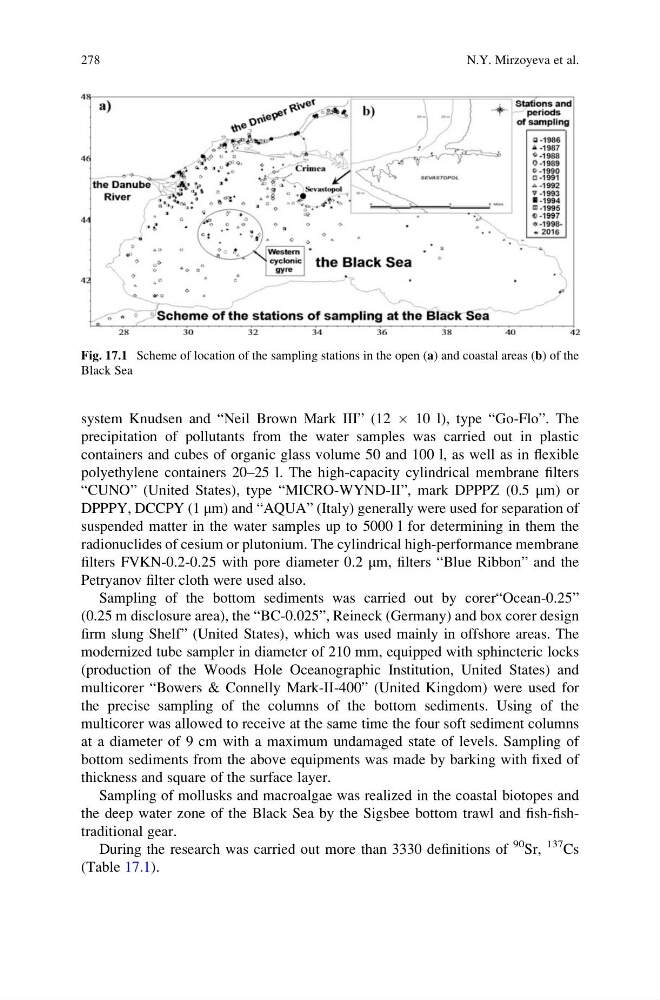
Fig. 17.1 Scheme of location of the sampling stations in the open (a) and coastal areas (b) of the
Black Sea
278
N.Y. Mirzoyeva et al.
precipitation of pollutants from the water samples was carried out in plastic
containers and cubes of organic glass volume 50 and 100 l, as well as in flexible
polyethylene containers 20–25 l. The high-capacity cylindrical membrane filters
“CUNO” (United States), type “MICRO-WYND-II”, mark DPPPZ (0.5 μm) or
DPPPY, DCCPY (1 μm) and “AQUA” (Italy) generally were used for separation of
suspended matter in the water samples up to 5000 l for determining in them the
radionuclides of cesium or plutonium. The cylindrical high-performance membrane
filters FVKN-0.2-0.25 with pore diameter 0.2 μm, filters “Blue Ribbon” and the
Petryanov filter cloth were used also.
Sampling of the bottom sediments was carried out by corer“Ocean-0.25”
(0.25 m disclosure area), the “BC-0.025”, Reineck (Germany) and box corer design
firm slung Shelf” (United States), which was used mainly in offshore areas. The
modernized tube sampler in diameter of 210 mm, equipped with sphincteric locks
(production of the Woods Hole Oceanographic Institution, United States) and
multicorer “Bowers & Connelly Mark-II-400” (United Kingdom) were used for
the precise sampling of the columns of the bottom sediments. Using of the
multicorer was allowed to receive at the same time the four soft sediment columns
at a diameter of 9 cm with a maximum undamaged state of levels. Sampling of
bottom sediments from the above equipments was made by barking with fixed of
thickness and square of the surface layer.
Sampling of mollusks and macroalgae was realized in the coastal biotopes and
the deep water zone of the Black Sea by the Sigsbee bottom trawl and fish-fishtraditional gear.
During the research was carried out more than 3330 definitions of
90 Sr,
137 Cs
(Table 17.1).
Fig. 17.1 Scheme of location of the sampling stations in the open (a) and coastal areas (b) of the
Black Sea
278
N.Y. Mirzoyeva et al.