

out from the water were isolated in a timespan under 10 s from the moment they are
exposed to the air.
The sediment samples, dried at constant mass of about 150 g, were placed in
cylindrical hermetically closed boxes. The water samples, about 500 g, were placed
in 130 g hermetically closed Marinelli beakers. The samples were stored for 28 days
for radioactive equilibrium.
The activity concentrations of
232 Th,
226 Ra,
137 Cs and the
40 K radionuclides
were determined using a CANBERRA system consisting of a n-type, 0.6 mm epoxy
carbon HPGe detector with ISOXCALL characterization, a DSA 1000
multichannel analyzer and 747 type lead shield. The detector has a relative efficiency of 40% and the resolution is 1.96 keV at
60 Co 1332 keV and 0.89 keV at
57
Co 122 keV line. GENIE 2000 software was used for data acquisition and
processing while the efficiency calibration, self-absorption and coincidence summing correction were performed by using a CANBERRA LabSOCS software. The
background contribution was obtained as the average of three independent measurements, each of them of 200,000 s. The nuclear data were those provided by Chu
et al. (1999) while the spectral lines overlapping were corrected by the method
presented in (Tugulan and Duliu 2014).
The
232 Th natural series was investigated by means of gamma spectra of
descending radionuclides
228 Ac (209.25 keV, 794.95 keV, 911.20 keV and
968.97 keV),
212 Pb (238.63 keV),
212 Bi (with energy 727.33 keV and
1620.50 keV) and
208 Tl (583.19 keV and 860.56 keV). In the case of
226 Ra series,
was used the gamma spectra of
214 Pb (295.22 keV and 351.93 keV) and
214 B
(609.31 keV, 768.36 keV, 934.06 keV, 1120.29 keV, 1661.28 keV, 1729.60 keV
and 1847.42 keV).
40 K has single gamma emission energy of 1460.83 keV.
For the spectrometric system, the accuracy of radiometric measurements was
checked by using the IAEA certified materials IAEA-RGTh-1 (Thorium Ore),
IAEA-384 (Fangataufa Sediment) and IAEA-385 (Irish Sea sediment). Differences
between the measured and certified values were less than 5%.
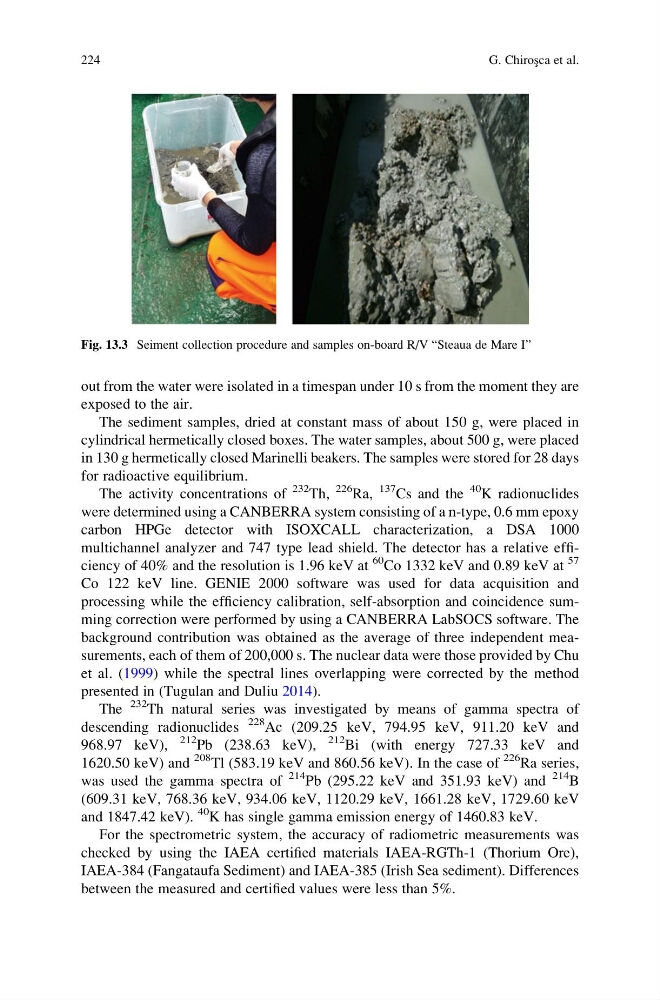
Fig. 13.3 Seiment collection procedure and samples on-board R/V “Steaua de Mare I”
224
G. Chiros ¸ca et al.
exposed to the air.
The sediment samples, dried at constant mass of about 150 g, were placed in
cylindrical hermetically closed boxes. The water samples, about 500 g, were placed
in 130 g hermetically closed Marinelli beakers. The samples were stored for 28 days
for radioactive equilibrium.
The activity concentrations of
232 Th,
226 Ra,
137 Cs and the
40 K radionuclides
were determined using a CANBERRA system consisting of a n-type, 0.6 mm epoxy
carbon HPGe detector with ISOXCALL characterization, a DSA 1000
multichannel analyzer and 747 type lead shield. The detector has a relative efficiency of 40% and the resolution is 1.96 keV at
60 Co 1332 keV and 0.89 keV at
57
Co 122 keV line. GENIE 2000 software was used for data acquisition and
processing while the efficiency calibration, self-absorption and coincidence summing correction were performed by using a CANBERRA LabSOCS software. The
background contribution was obtained as the average of three independent measurements, each of them of 200,000 s. The nuclear data were those provided by Chu
et al. (1999) while the spectral lines overlapping were corrected by the method
presented in (Tugulan and Duliu 2014).
The
232 Th natural series was investigated by means of gamma spectra of
descending radionuclides
228 Ac (209.25 keV, 794.95 keV, 911.20 keV and
968.97 keV),
212 Pb (238.63 keV),
212 Bi (with energy 727.33 keV and
1620.50 keV) and
208 Tl (583.19 keV and 860.56 keV). In the case of
226 Ra series,
was used the gamma spectra of
214 Pb (295.22 keV and 351.93 keV) and
214 B
(609.31 keV, 768.36 keV, 934.06 keV, 1120.29 keV, 1661.28 keV, 1729.60 keV
and 1847.42 keV).
40 K has single gamma emission energy of 1460.83 keV.
For the spectrometric system, the accuracy of radiometric measurements was
checked by using the IAEA certified materials IAEA-RGTh-1 (Thorium Ore),
IAEA-384 (Fangataufa Sediment) and IAEA-385 (Irish Sea sediment). Differences
between the measured and certified values were less than 5%.
Fig. 13.3 Seiment collection procedure and samples on-board R/V “Steaua de Mare I”
224
G. Chiros ¸ca et al.