

sediment ranged from 3 to 2000 Bq/kg, the maximum being measured in the fine
sediment from the lake upstream the Iron Gate Dam (Portile de Fier) (Oncescu
1994).
12.3.6 Black Sea Radioactivity Monitoring
The Black Sea has been the second most contaminated marine basin, after the Baltic
Sea, contaminated with artificial radioactivity following the Chernobyl accident
(IAEA 1995). The pre-Chernobyl Black Sea
137 Cs inventory was estimated at
1.4 Æ 0.3 PBq (Egorov et al. 2010). Chernobyl-origin radionuclides reached the
Black Sea mainly through direct deposition on the sea surface and through inputs to
the NW shelf area by major rivers Dnieper and Danube.
ERL measurements before the Chernobyl accident, in the near-shore Black Sea
surface water, indicate for
137
Cs an average specific activity of 10.4 Æ 2.9 Bq/m
3 . It
is considered that 1.7–2.4 PBq of
137
Cs, which corresponded to nearly 4% of the
total
137 Cs release into the environment following the Chernobyl accident was
deposited in the form of atmospheric fallout on the Black Sea surface (Egorov
et al. 2010). The estimated
137 Cs input of 26 TBq from the Danube and the Dnieper
Rivers over the period 1986–2000 was negligible in comparison with the direct
contribution of atmospheric fallout.
Coastal surface seawater monitoring data (Fig. 12.4) obtained in the period
between 1984 and 1994, was used to describe the dynamics of
137 Cs in the NorthWestern part of the Black Sea basin. Using data series of
137 Cs in surface waters
from 1987 to 1994 a value of 7.5 years was obtained for the environmental half-life
of
137 Cs (unpublished data, Dovlete and Osvath).
This value is comparable with the average environmental half-life of 5–7 years
proposed in (Egorov et al. 2010) for a longer data series of
137 Cs, more precisely for
the period of time 1987–2004.
Maxima in the range of 500 Bq/kg d.w.
137 Cs were reported for bottom sediment
offshore the Danube mouths in September 1986 (Osvath et al. 1988).
1
10
100
0
2
4
6
8
Bq/m^3
Years aŌer Chernobyl
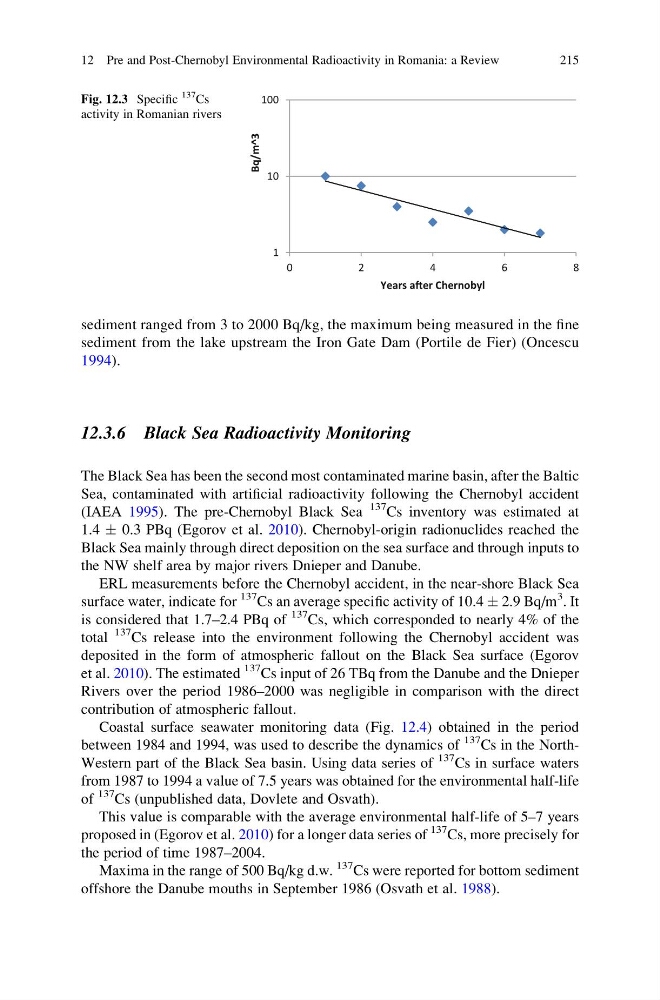
Fig. 12.3 Specific
137
Cs
activity in Romanian rivers
12 Pre and Post-Chernobyl Environmental Radioactivity in Romania: a Review
215
sediment from the lake upstream the Iron Gate Dam (Portile de Fier) (Oncescu
1994).
12.3.6 Black Sea Radioactivity Monitoring
The Black Sea has been the second most contaminated marine basin, after the Baltic
Sea, contaminated with artificial radioactivity following the Chernobyl accident
(IAEA 1995). The pre-Chernobyl Black Sea
137 Cs inventory was estimated at
1.4 Æ 0.3 PBq (Egorov et al. 2010). Chernobyl-origin radionuclides reached the
Black Sea mainly through direct deposition on the sea surface and through inputs to
the NW shelf area by major rivers Dnieper and Danube.
ERL measurements before the Chernobyl accident, in the near-shore Black Sea
surface water, indicate for
137
Cs an average specific activity of 10.4 Æ 2.9 Bq/m
3 . It
is considered that 1.7–2.4 PBq of
137
Cs, which corresponded to nearly 4% of the
total
137 Cs release into the environment following the Chernobyl accident was
deposited in the form of atmospheric fallout on the Black Sea surface (Egorov
et al. 2010). The estimated
137 Cs input of 26 TBq from the Danube and the Dnieper
Rivers over the period 1986–2000 was negligible in comparison with the direct
contribution of atmospheric fallout.
Coastal surface seawater monitoring data (Fig. 12.4) obtained in the period
between 1984 and 1994, was used to describe the dynamics of
137 Cs in the NorthWestern part of the Black Sea basin. Using data series of
137 Cs in surface waters
from 1987 to 1994 a value of 7.5 years was obtained for the environmental half-life
of
137 Cs (unpublished data, Dovlete and Osvath).
This value is comparable with the average environmental half-life of 5–7 years
proposed in (Egorov et al. 2010) for a longer data series of
137 Cs, more precisely for
the period of time 1987–2004.
Maxima in the range of 500 Bq/kg d.w.
137 Cs were reported for bottom sediment
offshore the Danube mouths in September 1986 (Osvath et al. 1988).
1
10
100
0
2
4
6
8
Bq/m^3
Years aŌer Chernobyl
Fig. 12.3 Specific
137
Cs
activity in Romanian rivers
12 Pre and Post-Chernobyl Environmental Radioactivity in Romania: a Review
215