

The aerosol and/or deposition dynamics after the Chernobyl accident was
presented in the studies (H€ otzl et al. 1989; Rosner et al. 1990; Ioannidou and
Papastefanou 2006); and statistical analysis of fluctuations of concentrations were
presented in (Hatano and Hatano 1997; Viswanathan et al. 2000). The results of the
studies show that atmospheric resuspension processes are tightly coupled to the
surrounding ecosystems.
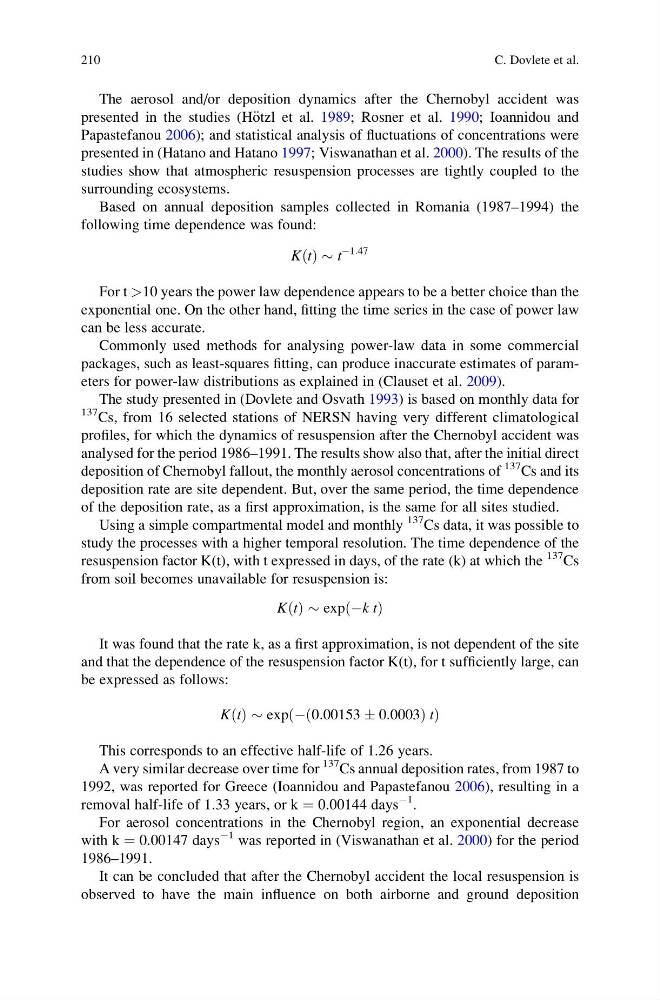
Based on annual deposition samples collected in Romania (1987–1994) the
following time dependence was found:
K t
ð Þ $ t
À1:47
For t >10 years the power law dependence appears to be a better choice than the
exponential one. On the other hand, fitting the time series in the case of power law
can be less accurate.
Commonly used methods for analysing power-law data in some commercial
packages, such as least-squares fitting, can produce inaccurate estimates of parameters for power-law distributions as explained in (Clauset et al. 2009).
The study presented in (Dovlete and Osvath 1993) is based on monthly data for
137 Cs, from 16 selected stations of NERSN having very different climatological
profiles, for which the dynamics of resuspension after the Chernobyl accident was
analysed for the period 1986–1991. The results show also that, after the initial direct
deposition of Chernobyl fallout, the monthly aerosol concentrations of
137 Cs and its
deposition rate are site dependent. But, over the same period, the time dependence
of the deposition rate, as a first approximation, is the same for all sites studied.
Using a simple compartmental model and monthly
137 Cs data, it was possible to
study the processes with a higher temporal resolution. The time dependence of the
resuspension factor K(t), with t expressed in days, of the rate (k) at which the
137 Cs
from soil becomes unavailable for resuspension is:
KðtÞ $ expðÀk tÞ
It was found that the rate k, as a first approximation, is not dependent of the site
and that the dependence of the resuspension factor K(t), for t sufficiently large, can
be expressed as follows:
KðtÞ $ expðÀð0:00153 Æ 0:0003Þ tÞ
This corresponds to an effective half-life of 1.26 years.
A very similar decrease over time for
137 Cs annual deposition rates, from 1987 to
1992, was reported for Greece (Ioannidou and Papastefanou 2006), resulting in a
removal half-life of 1.33 years, or k ¼ 0.00144 days
À1 .
For aerosol concentrations in the Chernobyl region, an exponential decrease
with k ¼ 0.00147 days
À1 was reported in (Viswanathan et al. 2000) for the period
1986–1991.
It can be concluded that after the Chernobyl accident the local resuspension is
observed to have the main influence on both airborne and ground deposition
210
C. Dovlete et al.
presented in the studies (H€ otzl et al. 1989; Rosner et al. 1990; Ioannidou and
Papastefanou 2006); and statistical analysis of fluctuations of concentrations were
presented in (Hatano and Hatano 1997; Viswanathan et al. 2000). The results of the
studies show that atmospheric resuspension processes are tightly coupled to the
surrounding ecosystems.
Based on annual deposition samples collected in Romania (1987–1994) the
following time dependence was found:
K t
ð Þ $ t
À1:47
For t >10 years the power law dependence appears to be a better choice than the
exponential one. On the other hand, fitting the time series in the case of power law
can be less accurate.
Commonly used methods for analysing power-law data in some commercial
packages, such as least-squares fitting, can produce inaccurate estimates of parameters for power-law distributions as explained in (Clauset et al. 2009).
The study presented in (Dovlete and Osvath 1993) is based on monthly data for
137 Cs, from 16 selected stations of NERSN having very different climatological
profiles, for which the dynamics of resuspension after the Chernobyl accident was
analysed for the period 1986–1991. The results show also that, after the initial direct
deposition of Chernobyl fallout, the monthly aerosol concentrations of
137 Cs and its
deposition rate are site dependent. But, over the same period, the time dependence
of the deposition rate, as a first approximation, is the same for all sites studied.
Using a simple compartmental model and monthly
137 Cs data, it was possible to
study the processes with a higher temporal resolution. The time dependence of the
resuspension factor K(t), with t expressed in days, of the rate (k) at which the
137 Cs
from soil becomes unavailable for resuspension is:
KðtÞ $ expðÀk tÞ
It was found that the rate k, as a first approximation, is not dependent of the site
and that the dependence of the resuspension factor K(t), for t sufficiently large, can
be expressed as follows:
KðtÞ $ expðÀð0:00153 Æ 0:0003Þ tÞ
This corresponds to an effective half-life of 1.26 years.
A very similar decrease over time for
137 Cs annual deposition rates, from 1987 to
1992, was reported for Greece (Ioannidou and Papastefanou 2006), resulting in a
removal half-life of 1.33 years, or k ¼ 0.00144 days
À1 .
For aerosol concentrations in the Chernobyl region, an exponential decrease
with k ¼ 0.00147 days
À1 was reported in (Viswanathan et al. 2000) for the period
1986–1991.
It can be concluded that after the Chernobyl accident the local resuspension is
observed to have the main influence on both airborne and ground deposition
210
C. Dovlete et al.