

structures (category II sensu Fl€ ogel et al. 2014). The Cantabrian margin has a
narrow shelf (5–40 km wide) with a very steep continental slope (17
) between
500 and 4500 mbsl. A few marginal shelves with a steep slope of 10
–12
have been
identified (A ´ lvarez-Marro ´n et al. 1995). The Cantabrian margin hosts one of the
sites described by Le Danois (1948), known as “Le Danois Bank” from where
living CWCs where reported by Sa ´nchez et al. 2014. CWC occurrences on the
Galician margin were reported by e.g. Herna ´ndez-Molina et al. (2011) and Somoza
et al. (2014).
METEOR cruise M84/5 sailed through the Bay of Biscay in 2011 investigating
selected spots of possible CWC occurrences. Here we present our oceanographic
observations on an escarpment located west of the much larger structure of Le
Danois Bank, which we named Page `s Escarpment in memory of the marine
biologist Francesc Page `s (1962–2007).
11.1.1 Oceanographic Setting
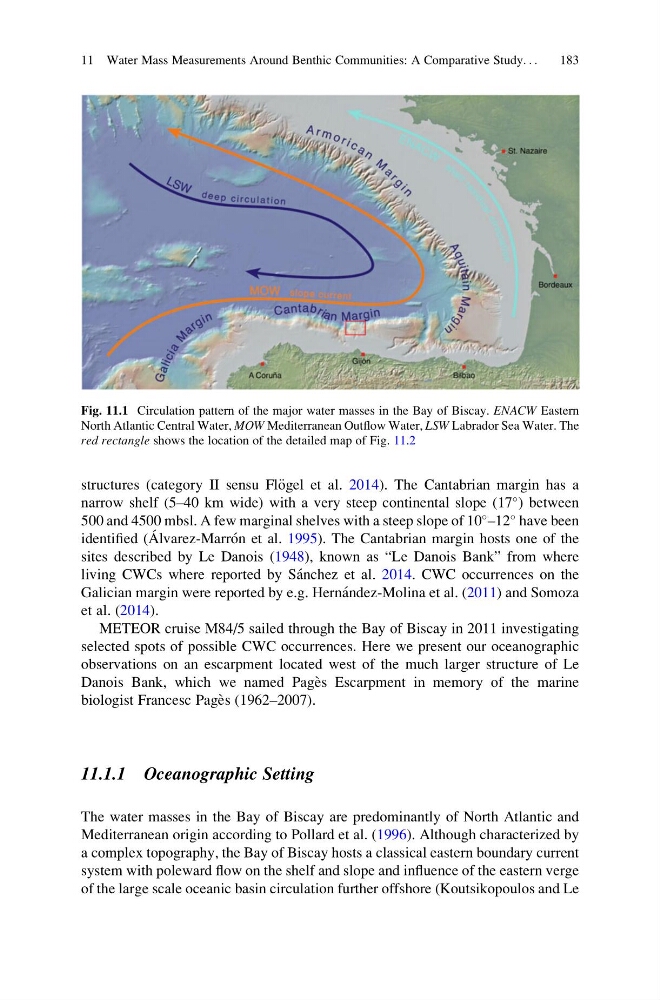
The water masses in the Bay of Biscay are predominantly of North Atlantic and
Mediterranean origin according to Pollard et al. (1996). Although characterized by
a complex topography, the Bay of Biscay hosts a classical eastern boundary current
system with poleward flow on the shelf and slope and influence of the eastern verge
of the large scale oceanic basin circulation further offshore (Koutsikopoulos and Le
Fig. 11.1 Circulation pattern of the major water masses in the Bay of Biscay. ENACW Eastern
North Atlantic Central Water, MOW Mediterranean Outflow Water, LSW Labrador Sea Water. The
red rectangle shows the location of the detailed map of Fig. 11.2
11 Water Mass Measurements Around Benthic Communities: A Comparative Study. . .
183
narrow shelf (5–40 km wide) with a very steep continental slope (17
) between
500 and 4500 mbsl. A few marginal shelves with a steep slope of 10
–12
have been
identified (A ´ lvarez-Marro ´n et al. 1995). The Cantabrian margin hosts one of the
sites described by Le Danois (1948), known as “Le Danois Bank” from where
living CWCs where reported by Sa ´nchez et al. 2014. CWC occurrences on the
Galician margin were reported by e.g. Herna ´ndez-Molina et al. (2011) and Somoza
et al. (2014).
METEOR cruise M84/5 sailed through the Bay of Biscay in 2011 investigating
selected spots of possible CWC occurrences. Here we present our oceanographic
observations on an escarpment located west of the much larger structure of Le
Danois Bank, which we named Page `s Escarpment in memory of the marine
biologist Francesc Page `s (1962–2007).
11.1.1 Oceanographic Setting
The water masses in the Bay of Biscay are predominantly of North Atlantic and
Mediterranean origin according to Pollard et al. (1996). Although characterized by
a complex topography, the Bay of Biscay hosts a classical eastern boundary current
system with poleward flow on the shelf and slope and influence of the eastern verge
of the large scale oceanic basin circulation further offshore (Koutsikopoulos and Le
Fig. 11.1 Circulation pattern of the major water masses in the Bay of Biscay. ENACW Eastern
North Atlantic Central Water, MOW Mediterranean Outflow Water, LSW Labrador Sea Water. The
red rectangle shows the location of the detailed map of Fig. 11.2
11 Water Mass Measurements Around Benthic Communities: A Comparative Study. . .
183