

10.3 Conclusion
The results of analyzing the multi-year (1978–1995) data array made it possible to
obtain the basic features of the spatial-temporal variability in the distribution
pattern of the SOM components’ concentration in the surface and photosynthetic
layers in four NWBS areas (northern, western, central and eastern), which differed
from each other due to degree of influence both of the riverine discharge and the
open sea water masses. The peculiarities of the satellite-derived distribution of the
bio-optical parameters in 1997–2015 in NWBS and in the western part of the sea,
i.e. the Romanian, Bulgarian and Bosporus areas are also considered.
As compared to other areas, the western and the northern NWBS ones, which are
constantly affected by the nutrient-rich transformed riverine water masses, are
characterized by high concentrations of the SOM components in course of the
whole. Their main peak is observed in spring. In all the seasons SOM is mostly
consists of phytoplankton and detritus. In winter and spring, detritus weakly
transformed. In summer its portion in SOM increases. In autumn detritus is at
different stages of biochemical transformation. In the central and eastern areas, the
1997 2000 2003 2006 2009 2012 2015
-1
0
1
2
-1
-0.5
0
0.5
1
-1
-0.5
0
0.5
1
1997 2000 2003 2006 2009 2012 2015
-1
0
1
2
-1
-0.5
0
0.5
1
-1
-0.5
0
0.5
1
a
b
c
d
e
f
1
2
3
4
T
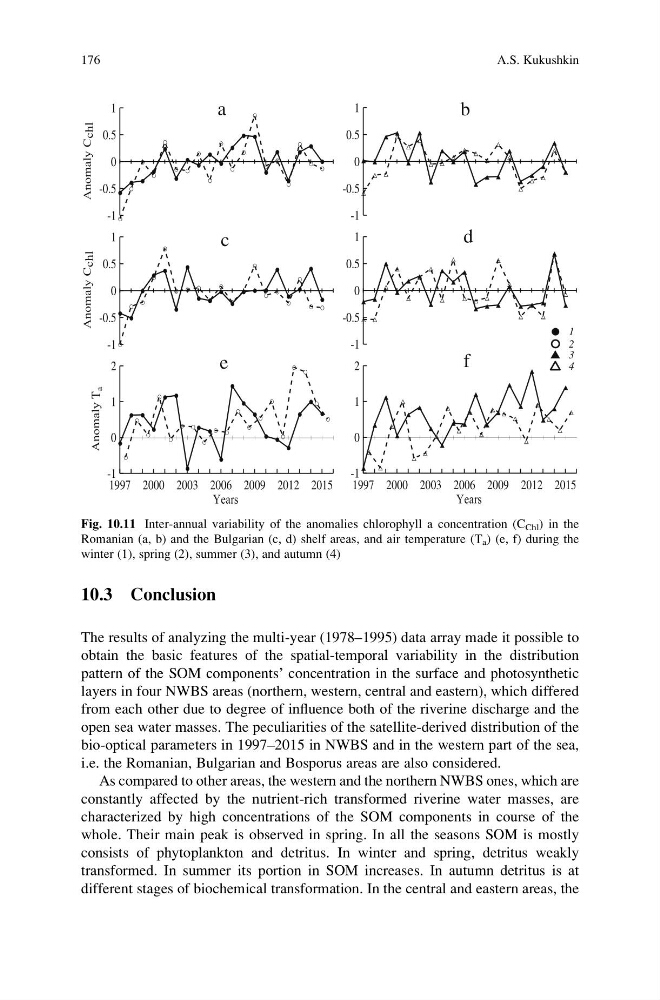
Fig. 10.11 Inter-annual variability of the anomalies chlorophyll a concentration (C Chl ) in the
Romanian (a, b) and the Bulgarian (c, d) shelf areas, and air temperature (T a ) (e, f) during the
winter (1), spring (2), summer (3), and autumn (4)
176
A.S. Kukushkin
The results of analyzing the multi-year (1978–1995) data array made it possible to
obtain the basic features of the spatial-temporal variability in the distribution
pattern of the SOM components’ concentration in the surface and photosynthetic
layers in four NWBS areas (northern, western, central and eastern), which differed
from each other due to degree of influence both of the riverine discharge and the
open sea water masses. The peculiarities of the satellite-derived distribution of the
bio-optical parameters in 1997–2015 in NWBS and in the western part of the sea,
i.e. the Romanian, Bulgarian and Bosporus areas are also considered.
As compared to other areas, the western and the northern NWBS ones, which are
constantly affected by the nutrient-rich transformed riverine water masses, are
characterized by high concentrations of the SOM components in course of the
whole. Their main peak is observed in spring. In all the seasons SOM is mostly
consists of phytoplankton and detritus. In winter and spring, detritus weakly
transformed. In summer its portion in SOM increases. In autumn detritus is at
different stages of biochemical transformation. In the central and eastern areas, the
1997 2000 2003 2006 2009 2012 2015
-1
0
1
2
-1
-0.5
0
0.5
1
-1
-0.5
0
0.5
1
1997 2000 2003 2006 2009 2012 2015
-1
0
1
2
-1
-0.5
0
0.5
1
-1
-0.5
0
0.5
1
a
b
c
d
e
f
1
2
3
4
T
Fig. 10.11 Inter-annual variability of the anomalies chlorophyll a concentration (C Chl ) in the
Romanian (a, b) and the Bulgarian (c, d) shelf areas, and air temperature (T a ) (e, f) during the
winter (1), spring (2), summer (3), and autumn (4)
176
A.S. Kukushkin