

of coastal lakes (Lake Tabacarie and Lake Siutghiol) which were used to rebuild the
beach Mamaia in the backshore, swash and surf zone (south of Mamaia resort). The
most important terrigenous source is bed load of rivers that flow into the northwestern Black Sea (Danube, Bug, Dniester, Dnieper). This sediments (Panin 1996),
consist, in general, in sands, silts, clays. Sands are gray, consisting usually of quartz
fragments, mice, feldspat, lithoclasts, heavy minerals (granite, amphibole, pyroxene, opaque minerals etc.). The Danube with its three branches (Chilia, Sulina,
St. George) is the most important source of terrigenous contribution to the Romanian shore. Sands predominantly of terrigenous material are specific to the Danube
Delta, which are transported southward, mainly to the Mamaia Bay.
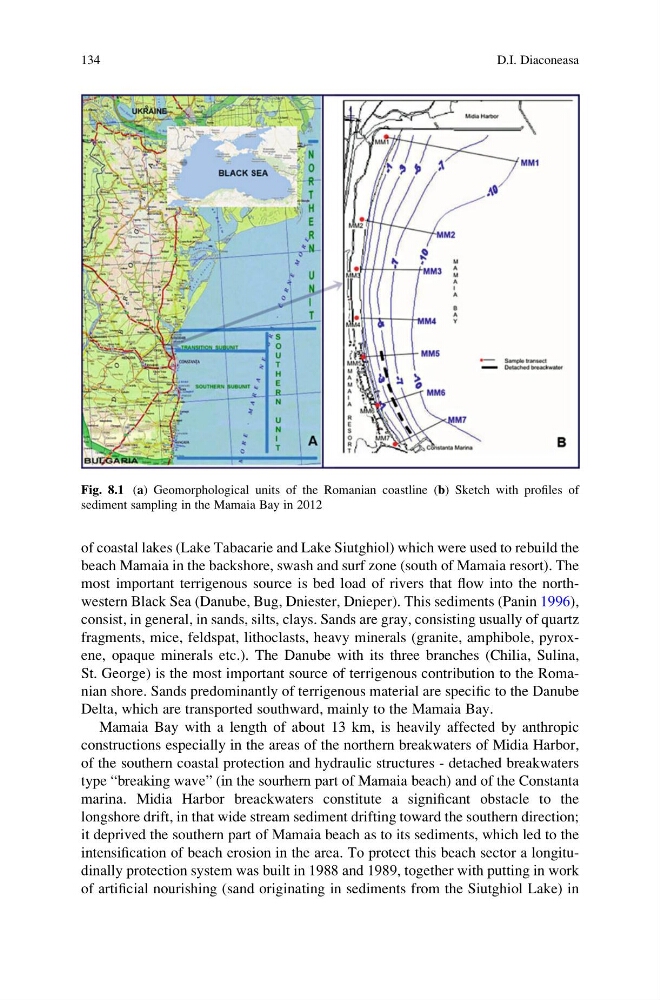
Mamaia Bay with a length of about 13 km, is heavily affected by anthropic
constructions especially in the areas of the northern breakwaters of Midia Harbor,
of the southern coastal protection and hydraulic structures - detached breakwaters
type “breaking wave” (in the sourhern part of Mamaia beach) and of the Constanta
marina. Midia Harbor breackwaters constitute a significant obstacle to the
longshore drift, in that wide stream sediment drifting toward the southern direction;
it deprived the southern part of Mamaia beach as to its sediments, which led to the
intensification of beach erosion in the area. To protect this beach sector a longitudinally protection system was built in 1988 and 1989, together with putting in work
of artificial nourishing (sand originating in sediments from the Siutghiol Lake) in
Fig. 8.1 (a) Geomorphological units of the Romanian coastline (b) Sketch with profiles of
sediment sampling in the Mamaia Bay in 2012
134
D.I. Diaconeasa
beach Mamaia in the backshore, swash and surf zone (south of Mamaia resort). The
most important terrigenous source is bed load of rivers that flow into the northwestern Black Sea (Danube, Bug, Dniester, Dnieper). This sediments (Panin 1996),
consist, in general, in sands, silts, clays. Sands are gray, consisting usually of quartz
fragments, mice, feldspat, lithoclasts, heavy minerals (granite, amphibole, pyroxene, opaque minerals etc.). The Danube with its three branches (Chilia, Sulina,
St. George) is the most important source of terrigenous contribution to the Romanian shore. Sands predominantly of terrigenous material are specific to the Danube
Delta, which are transported southward, mainly to the Mamaia Bay.
Mamaia Bay with a length of about 13 km, is heavily affected by anthropic
constructions especially in the areas of the northern breakwaters of Midia Harbor,
of the southern coastal protection and hydraulic structures - detached breakwaters
type “breaking wave” (in the sourhern part of Mamaia beach) and of the Constanta
marina. Midia Harbor breackwaters constitute a significant obstacle to the
longshore drift, in that wide stream sediment drifting toward the southern direction;
it deprived the southern part of Mamaia beach as to its sediments, which led to the
intensification of beach erosion in the area. To protect this beach sector a longitudinally protection system was built in 1988 and 1989, together with putting in work
of artificial nourishing (sand originating in sediments from the Siutghiol Lake) in
Fig. 8.1 (a) Geomorphological units of the Romanian coastline (b) Sketch with profiles of
sediment sampling in the Mamaia Bay in 2012
134
D.I. Diaconeasa