

6.2.2 The OGS-BS (Black Sea) Dataset
The multichannel seismic lines were collected by OGS with the research vessel
Marsili in 1975.
During the surveys, 3702 km of 6–12-fold MCS data were acquired, along
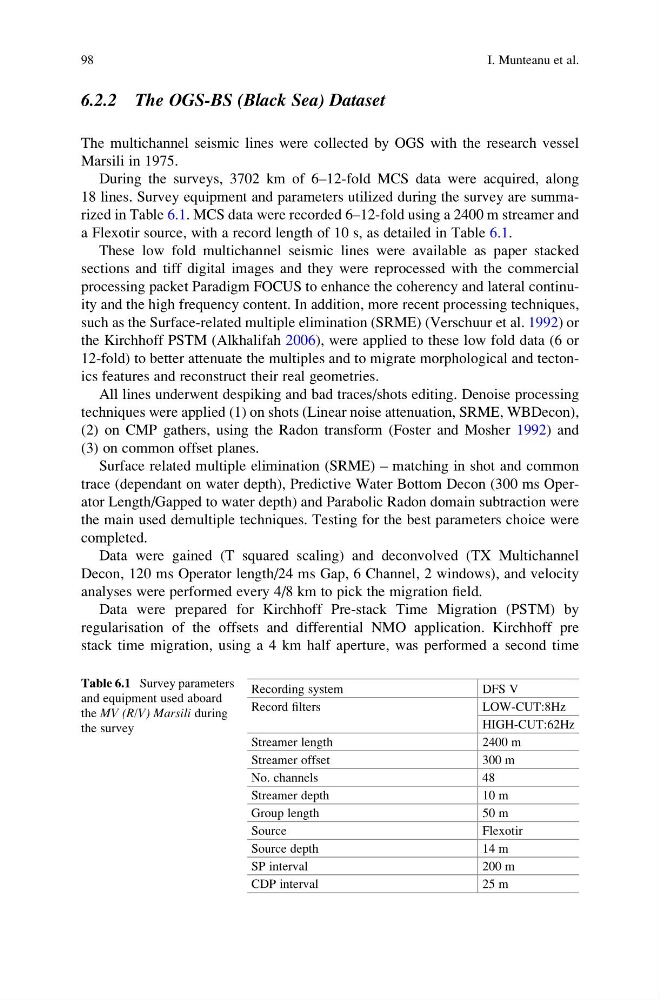
18 lines. Survey equipment and parameters utilized during the survey are summarized in Table 6.1. MCS data were recorded 6–12-fold using a 2400 m streamer and
a Flexotir source, with a record length of 10 s, as detailed in Table 6.1.
These low fold multichannel seismic lines were available as paper stacked
sections and tiff digital images and they were reprocessed with the commercial
processing packet Paradigm FOCUS to enhance the coherency and lateral continuity and the high frequency content. In addition, more recent processing techniques,
such as the Surface-related multiple elimination (SRME) (Verschuur et al. 1992) or
the Kirchhoff PSTM (Alkhalifah 2006), were applied to these low fold data (6 or
12-fold) to better attenuate the multiples and to migrate morphological and tectonics features and reconstruct their real geometries.
All lines underwent despiking and bad traces/shots editing. Denoise processing
techniques were applied (1) on shots (Linear noise attenuation, SRME, WBDecon),
(2) on CMP gathers, using the Radon transform (Foster and Mosher 1992) and
(3) on common offset planes.
Surface related multiple elimination (SRME) – matching in shot and common
trace (dependant on water depth), Predictive Water Bottom Decon (300 ms Operator Length/Gapped to water depth) and Parabolic Radon domain subtraction were
the main used demultiple techniques. Testing for the best parameters choice were
completed.
Data were gained (T squared scaling) and deconvolved (TX Multichannel
Decon, 120 ms Operator length/24 ms Gap, 6 Channel, 2 windows), and velocity
analyses were performed every 4/8 km to pick the migration field.
Data were prepared for Kirchhoff Pre-stack Time Migration (PSTM) by
regularisation of the offsets and differential NMO application. Kirchhoff pre
stack time migration, using a 4 km half aperture, was performed a second time
Table 6.1 Survey parameters
and equipment used aboard
the MV (R/V) Marsili during
the survey
Recording system
DFS V
Record filters
LOW-CUT:8Hz
HIGH-CUT:62Hz
Streamer length
2400 m
Streamer offset
300 m
No. channels
48
Streamer depth
10 m
Group length
50 m
Source
Flexotir
Source depth
14 m
SP interval
200 m
CDP interval
25 m
98
I. Munteanu et al.
The multichannel seismic lines were collected by OGS with the research vessel
Marsili in 1975.
During the surveys, 3702 km of 6–12-fold MCS data were acquired, along
18 lines. Survey equipment and parameters utilized during the survey are summarized in Table 6.1. MCS data were recorded 6–12-fold using a 2400 m streamer and
a Flexotir source, with a record length of 10 s, as detailed in Table 6.1.
These low fold multichannel seismic lines were available as paper stacked
sections and tiff digital images and they were reprocessed with the commercial
processing packet Paradigm FOCUS to enhance the coherency and lateral continuity and the high frequency content. In addition, more recent processing techniques,
such as the Surface-related multiple elimination (SRME) (Verschuur et al. 1992) or
the Kirchhoff PSTM (Alkhalifah 2006), were applied to these low fold data (6 or
12-fold) to better attenuate the multiples and to migrate morphological and tectonics features and reconstruct their real geometries.
All lines underwent despiking and bad traces/shots editing. Denoise processing
techniques were applied (1) on shots (Linear noise attenuation, SRME, WBDecon),
(2) on CMP gathers, using the Radon transform (Foster and Mosher 1992) and
(3) on common offset planes.
Surface related multiple elimination (SRME) – matching in shot and common
trace (dependant on water depth), Predictive Water Bottom Decon (300 ms Operator Length/Gapped to water depth) and Parabolic Radon domain subtraction were
the main used demultiple techniques. Testing for the best parameters choice were
completed.
Data were gained (T squared scaling) and deconvolved (TX Multichannel
Decon, 120 ms Operator length/24 ms Gap, 6 Channel, 2 windows), and velocity
analyses were performed every 4/8 km to pick the migration field.
Data were prepared for Kirchhoff Pre-stack Time Migration (PSTM) by
regularisation of the offsets and differential NMO application. Kirchhoff pre
stack time migration, using a 4 km half aperture, was performed a second time
Table 6.1 Survey parameters
and equipment used aboard
the MV (R/V) Marsili during
the survey
Recording system
DFS V
Record filters
LOW-CUT:8Hz
HIGH-CUT:62Hz
Streamer length
2400 m
Streamer offset
300 m
No. channels
48
Streamer depth
10 m
Group length
50 m
Source
Flexotir
Source depth
14 m
SP interval
200 m
CDP interval
25 m
98
I. Munteanu et al.