

since 2009 – by a team of researchers from the Massachusetts Institute of Technology, which will be a disaster for life on Earth (Brown 2011b). A group
of scientists was therefore constituted and, by 2018, they must bring concrete
proposals for all countries so that temperatures do not rise more than 1.5
C.
5.2 Discussion
In order to combat global warming the appropriate measures must be analyzed. One
the one hand, there is a need to assess the evolution of climate in the near and distant
future and, on the other hand, there is a need for the analysis of the proposed
measures (Houghton et al. 1997). In order to do these things, different climate
models have been developed and they were accepted by the scientific community
and considered relevant by the Intergovernmental Panel on Climate Change
(IPCC), through which the evolution of temperatures throughout the twentieth
century could be simulated. Using such models it was estimated that the global
climate will grow hot by 1.1–6.4
C over the twenty-first century (Houghton et al.
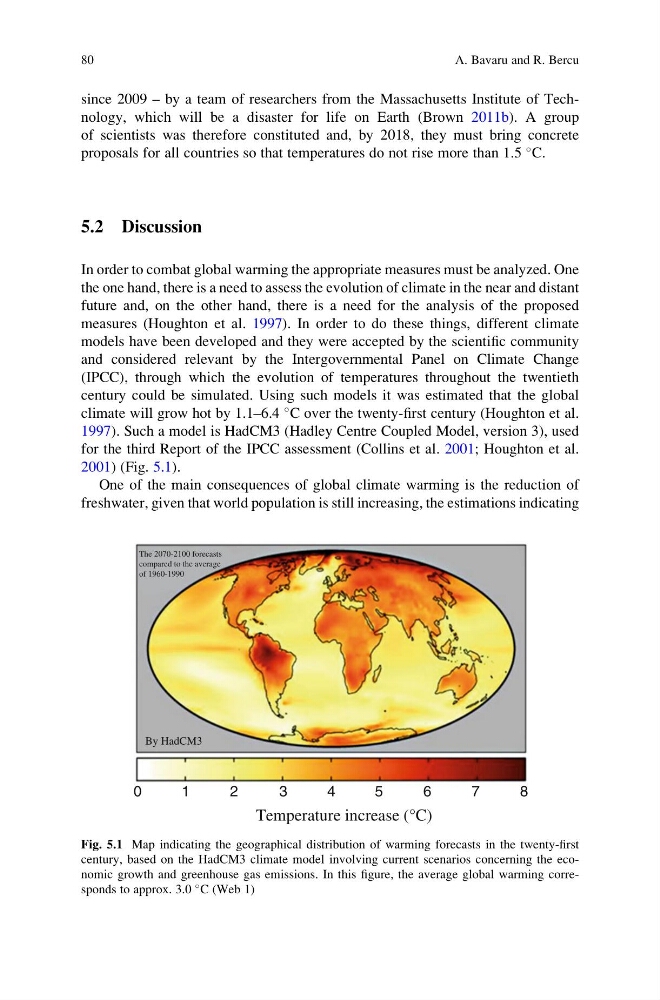
1997). Such a model is HadCM3 (Hadley Centre Coupled Model, version 3), used
for the third Report of the IPCC assessment (Collins et al. 2001; Houghton et al.
2001) (Fig. 5.1).
One of the main consequences of global climate warming is the reduction of
freshwater, given that world population is still increasing, the estimations indicating
0
1
2
3
4
Temperature increase (°C)
By HadCM3
The 2070-2100 forecasts
compared to the average
of 1960-1990
5
6
7
8
Fig. 5.1 Map indicating the geographical distribution of warming forecasts in the twenty-first
century, based on the HadCM3 climate model involving current scenarios concerning the economic growth and greenhouse gas emissions. In this figure, the average global warming corresponds to approx. 3.0
C (Web 1)
80
A. Bavaru and R. Bercu
of scientists was therefore constituted and, by 2018, they must bring concrete
proposals for all countries so that temperatures do not rise more than 1.5
C.
5.2 Discussion
In order to combat global warming the appropriate measures must be analyzed. One
the one hand, there is a need to assess the evolution of climate in the near and distant
future and, on the other hand, there is a need for the analysis of the proposed
measures (Houghton et al. 1997). In order to do these things, different climate
models have been developed and they were accepted by the scientific community
and considered relevant by the Intergovernmental Panel on Climate Change
(IPCC), through which the evolution of temperatures throughout the twentieth
century could be simulated. Using such models it was estimated that the global
climate will grow hot by 1.1–6.4
C over the twenty-first century (Houghton et al.
1997). Such a model is HadCM3 (Hadley Centre Coupled Model, version 3), used
for the third Report of the IPCC assessment (Collins et al. 2001; Houghton et al.
2001) (Fig. 5.1).
One of the main consequences of global climate warming is the reduction of
freshwater, given that world population is still increasing, the estimations indicating
0
1
2
3
4
Temperature increase (°C)
By HadCM3
The 2070-2100 forecasts
compared to the average
of 1960-1990
5
6
7
8
Fig. 5.1 Map indicating the geographical distribution of warming forecasts in the twenty-first
century, based on the HadCM3 climate model involving current scenarios concerning the economic growth and greenhouse gas emissions. In this figure, the average global warming corresponds to approx. 3.0
C (Web 1)
80
A. Bavaru and R. Bercu