

5.3 Drainage Management
81
open to the sea have changing water levels due to high and low tide. During high tide
the (sea) water level is flowing upstream into the rivers or small tidal channels (Fig. 1.3).
The construction of a closed dike line reduced or even prevented the free flow of the
tides. Infrastructure has been installed to control the inflow and the outflow of the water
into the protected areas. The first drainage means in the dike were wooden gates or tubes
(Brandt, 1984). The wooden gates opened and closed automatically with the increasing
or decreasing water level of the sea. Thus, a certain amount of time exists where the
surface water can be discharged into the sea (in German: Sielzugzeit, in English: time
period of discharge, see Fig. 4.12). This way of drainage is strongly depending on the
topography, thus, it is only possible where the topography allows gravity driven discharge.
If the topography is lower than the sea water level technical solutions have to be installed
to actively pump the water into a canal or river (see Fig. 5.13).
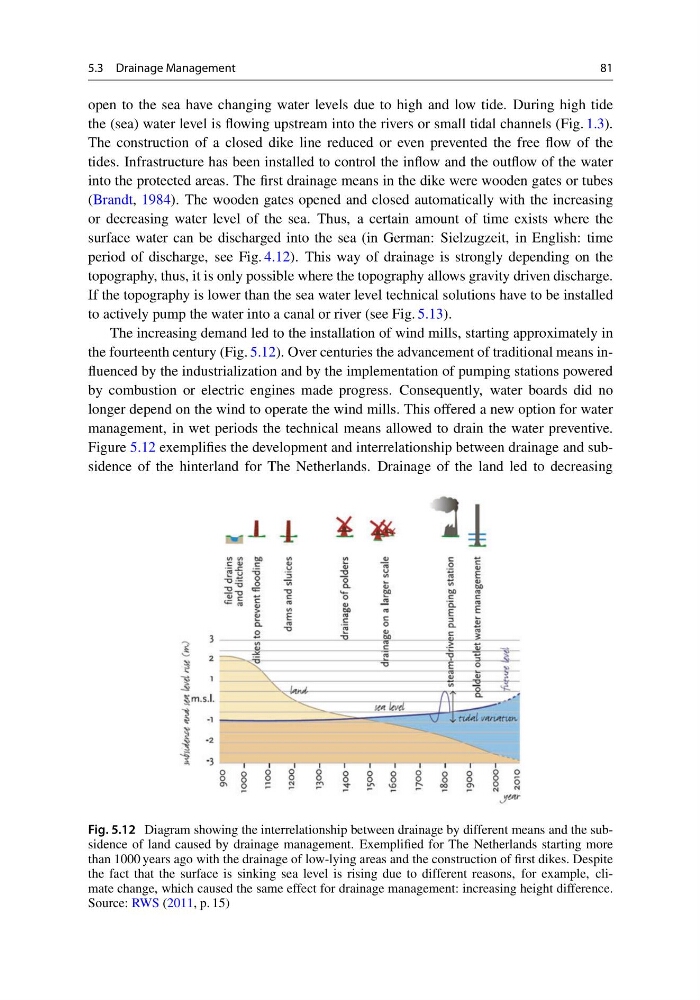
The increasing demand led to the installation of wind mills, starting approximately in
the fourteenth century (Fig. 5.12). Over centuries the advancement of traditional means influenced by the industrialization and by the implementation of pumping stations powered
by combustion or electric engines made progress. Consequently, water boards did no
longer depend on the wind to operate the wind mills. This offered a new option for water
management, in wet periods the technical means allowed to drain the water preventive.
Figure 5.12 exemplifies the development and interrelationship between drainage and subsidence of the hinterland for The Netherlands. Drainage of the land led to decreasing
Fig. 5.12 Diagram showing the interrelationship between drainage by different means and the subsidence of land caused by drainage management. Exemplified for The Netherlands starting more
than 1000 years ago with the drainage of low-lying areas and the construction of first dikes. Despite
the fact that the surface is sinking sea level is rising due to different reasons, for example, climate change, which caused the same effect for drainage management: increasing height difference.
Source: RWS (2011, p. 15)
81
open to the sea have changing water levels due to high and low tide. During high tide
the (sea) water level is flowing upstream into the rivers or small tidal channels (Fig. 1.3).
The construction of a closed dike line reduced or even prevented the free flow of the
tides. Infrastructure has been installed to control the inflow and the outflow of the water
into the protected areas. The first drainage means in the dike were wooden gates or tubes
(Brandt, 1984). The wooden gates opened and closed automatically with the increasing
or decreasing water level of the sea. Thus, a certain amount of time exists where the
surface water can be discharged into the sea (in German: Sielzugzeit, in English: time
period of discharge, see Fig. 4.12). This way of drainage is strongly depending on the
topography, thus, it is only possible where the topography allows gravity driven discharge.
If the topography is lower than the sea water level technical solutions have to be installed
to actively pump the water into a canal or river (see Fig. 5.13).
The increasing demand led to the installation of wind mills, starting approximately in
the fourteenth century (Fig. 5.12). Over centuries the advancement of traditional means influenced by the industrialization and by the implementation of pumping stations powered
by combustion or electric engines made progress. Consequently, water boards did no
longer depend on the wind to operate the wind mills. This offered a new option for water
management, in wet periods the technical means allowed to drain the water preventive.
Figure 5.12 exemplifies the development and interrelationship between drainage and subsidence of the hinterland for The Netherlands. Drainage of the land led to decreasing
Fig. 5.12 Diagram showing the interrelationship between drainage by different means and the subsidence of land caused by drainage management. Exemplified for The Netherlands starting more
than 1000 years ago with the drainage of low-lying areas and the construction of first dikes. Despite
the fact that the surface is sinking sea level is rising due to different reasons, for example, climate change, which caused the same effect for drainage management: increasing height difference.
Source: RWS (2011, p. 15)