

4.3 Implications for (and of ) Drainage Management
59
into the ground water. As a consequence of salt water infiltrations, ground water resources
need decades for regeneration.
4.3 Implications for (and of) Drainage Management
The diurnal oscillations of the water level, including inundations and tidal storm floods,
make use of those areas, which are influenced by this dynamic, very difficult. In the past,
the human strategy therefore was – and in large parts still is – to prevent the natural hydrological dynamics, including regular inundations and wet conditions, and to control the
hydrological processes of such regions. In the North Sea Region, sea walls have been
built for 1000 years, and due to the positive water balance, drainage systems have been
developed (see Chap. 5).
Implications for drainage management, in direct connection with coastal protection
measures, are to protect the respective areas against tides and storm tides while ensuring
water drainage through technical solutions. Possible technical solutions are:
• Constructing dikes (sea walls) to prevent the landscape against tidal inundations
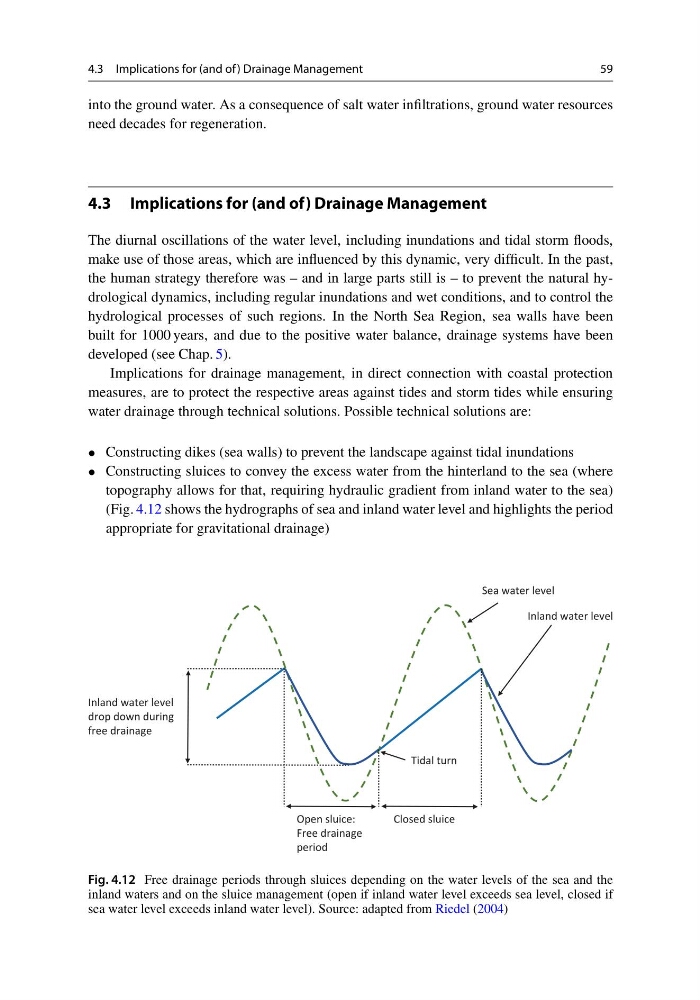
• Constructing sluices to convey the excess water from the hinterland to the sea (where
topography allows for that, requiring hydraulic gradient from inland water to the sea)
(Fig. 4.12 shows the hydrographs of sea and inland water level and highlights the period
appropriate for gravitational drainage)
Sea water level
Inland water level
Inland water level
drop down during
free drainage
Open sluice:
Free drainage
period
Closed sluice
Tidal turn
Fig. 4.12 Free drainage periods through sluices depending on the water levels of the sea and the
inland waters and on the sluice management (open if inland water level exceeds sea level, closed if
sea water level exceeds inland water level). Source: adapted from Riedel (2004)
59
into the ground water. As a consequence of salt water infiltrations, ground water resources
need decades for regeneration.
4.3 Implications for (and of) Drainage Management
The diurnal oscillations of the water level, including inundations and tidal storm floods,
make use of those areas, which are influenced by this dynamic, very difficult. In the past,
the human strategy therefore was – and in large parts still is – to prevent the natural hydrological dynamics, including regular inundations and wet conditions, and to control the
hydrological processes of such regions. In the North Sea Region, sea walls have been
built for 1000 years, and due to the positive water balance, drainage systems have been
developed (see Chap. 5).
Implications for drainage management, in direct connection with coastal protection
measures, are to protect the respective areas against tides and storm tides while ensuring
water drainage through technical solutions. Possible technical solutions are:
• Constructing dikes (sea walls) to prevent the landscape against tidal inundations
• Constructing sluices to convey the excess water from the hinterland to the sea (where
topography allows for that, requiring hydraulic gradient from inland water to the sea)
(Fig. 4.12 shows the hydrographs of sea and inland water level and highlights the period
appropriate for gravitational drainage)
Sea water level
Inland water level
Inland water level
drop down during
free drainage
Open sluice:
Free drainage
period
Closed sluice
Tidal turn
Fig. 4.12 Free drainage periods through sluices depending on the water levels of the sea and the
inland waters and on the sluice management (open if inland water level exceeds sea level, closed if
sea water level exceeds inland water level). Source: adapted from Riedel (2004)