

56
4 Hydrology of (Shallow) Coastal Regions
4.2.2 Impacts on Water Quality
Estuaries and Coastal Rivers
Estuaries and coastal rivers are the locations where salt and fresh water meet. The transition zone between fresh water in the rivers and salt water in the ocean is typically located
in the estuaries. Due to mixing processes, the transition zone consists of brackish water.
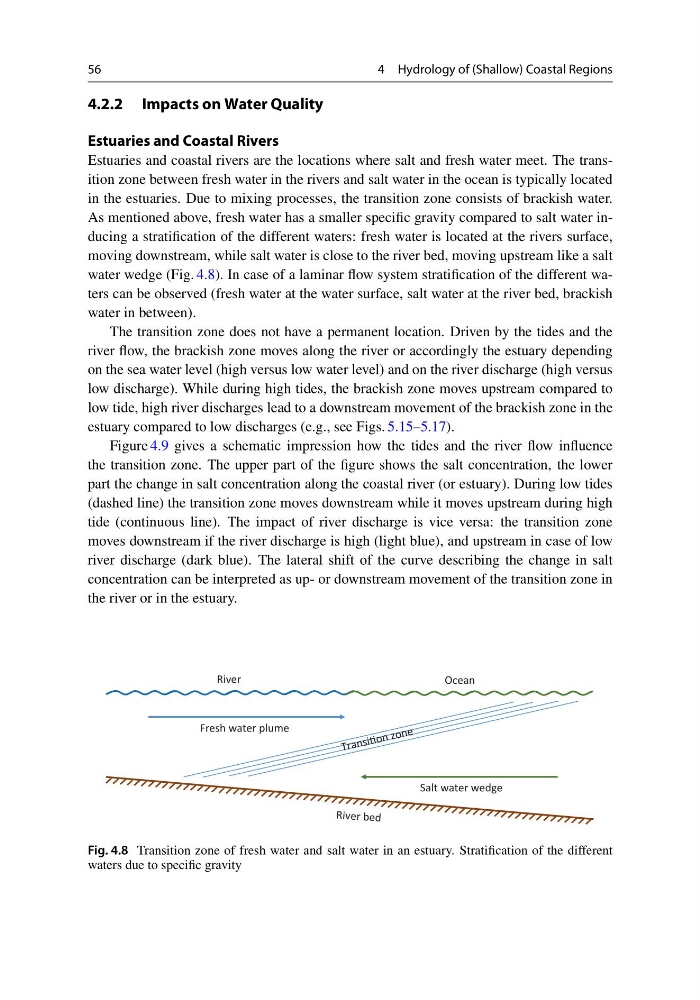
As mentioned above, fresh water has a smaller specific gravity compared to salt water inducing a stratification of the different waters: fresh water is located at the rivers surface,
moving downstream, while salt water is close to the river bed, moving upstream like a salt
water wedge (Fig. 4.8). In case of a laminar flow system stratification of the different waters can be observed (fresh water at the water surface, salt water at the river bed, brackish
water in between).
The transition zone does not have a permanent location. Driven by the tides and the
river flow, the brackish zone moves along the river or accordingly the estuary depending
on the sea water level (high versus low water level) and on the river discharge (high versus
low discharge). While during high tides, the brackish zone moves upstream compared to
low tide, high river discharges lead to a downstream movement of the brackish zone in the
estuary compared to low discharges (e.g., see Figs. 5.15–5.17).
Figure 4.9 gives a schematic impression how the tides and the river flow influence
the transition zone. The upper part of the figure shows the salt concentration, the lower
part the change in salt concentration along the coastal river (or estuary). During low tides
(dashed line) the transition zone moves downstream while it moves upstream during high
tide (continuous line). The impact of river discharge is vice versa: the transition zone
moves downstream if the river discharge is high (light blue), and upstream in case of low
river discharge (dark blue). The lateral shift of the curve describing the change in salt
concentration can be interpreted as up- or downstream movement of the transition zone in
the river or in the estuary.
River
Ocean
Fresh water plume
Salt water wedge
River bed
Tr an si o n zo ne
Fig. 4.8 Transition zone of fresh water and salt water in an estuary. Stratification of the different
waters due to specific gravity
4 Hydrology of (Shallow) Coastal Regions
4.2.2 Impacts on Water Quality
Estuaries and Coastal Rivers
Estuaries and coastal rivers are the locations where salt and fresh water meet. The transition zone between fresh water in the rivers and salt water in the ocean is typically located
in the estuaries. Due to mixing processes, the transition zone consists of brackish water.
As mentioned above, fresh water has a smaller specific gravity compared to salt water inducing a stratification of the different waters: fresh water is located at the rivers surface,
moving downstream, while salt water is close to the river bed, moving upstream like a salt
water wedge (Fig. 4.8). In case of a laminar flow system stratification of the different waters can be observed (fresh water at the water surface, salt water at the river bed, brackish
water in between).
The transition zone does not have a permanent location. Driven by the tides and the
river flow, the brackish zone moves along the river or accordingly the estuary depending
on the sea water level (high versus low water level) and on the river discharge (high versus
low discharge). While during high tides, the brackish zone moves upstream compared to
low tide, high river discharges lead to a downstream movement of the brackish zone in the
estuary compared to low discharges (e.g., see Figs. 5.15–5.17).
Figure 4.9 gives a schematic impression how the tides and the river flow influence
the transition zone. The upper part of the figure shows the salt concentration, the lower
part the change in salt concentration along the coastal river (or estuary). During low tides
(dashed line) the transition zone moves downstream while it moves upstream during high
tide (continuous line). The impact of river discharge is vice versa: the transition zone
moves downstream if the river discharge is high (light blue), and upstream in case of low
river discharge (dark blue). The lateral shift of the curve describing the change in salt
concentration can be interpreted as up- or downstream movement of the transition zone in
the river or in the estuary.
River
Ocean
Fresh water plume
Salt water wedge
River bed
Tr an si o n zo ne
Fig. 4.8 Transition zone of fresh water and salt water in an estuary. Stratification of the different
waters due to specific gravity