

8
1 The Coast
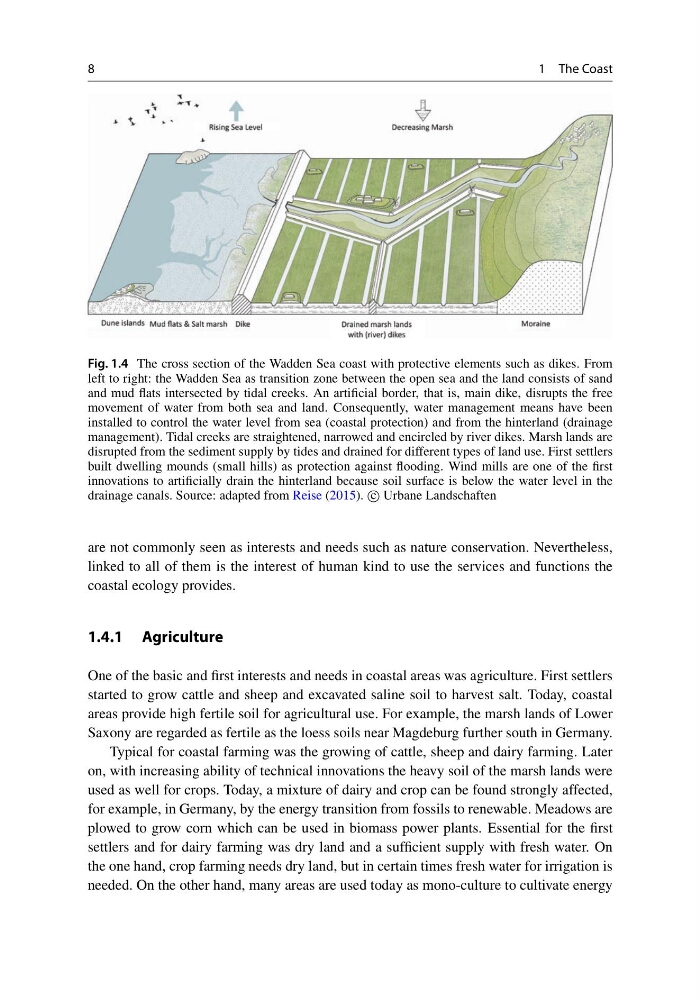
Fig. 1.4 The cross section of the Wadden Sea coast with protective elements such as dikes. From
left to right: the Wadden Sea as transition zone between the open sea and the land consists of sand
and mud flats intersected by tidal creeks. An artificial border, that is, main dike, disrupts the free
movement of water from both sea and land. Consequently, water management means have been
installed to control the water level from sea (coastal protection) and from the hinterland (drainage
management). Tidal creeks are straightened, narrowed and encircled by river dikes. Marsh lands are
disrupted from the sediment supply by tides and drained for different types of land use. First settlers
built dwelling mounds (small hills) as protection against flooding. Wind mills are one of the first
innovations to artificially drain the hinterland because soil surface is below the water level in the
drainage canals. Source: adapted from Reise (2015). c
Urbane Landschaften
are not commonly seen as interests and needs such as nature conservation. Nevertheless,
linked to all of them is the interest of human kind to use the services and functions the
coastal ecology provides.
1.4.1 Agriculture
One of the basic and first interests and needs in coastal areas was agriculture. First settlers
started to grow cattle and sheep and excavated saline soil to harvest salt. Today, coastal
areas provide high fertile soil for agricultural use. For example, the marsh lands of Lower
Saxony are regarded as fertile as the loess soils near Magdeburg further south in Germany.
Typical for coastal farming was the growing of cattle, sheep and dairy farming. Later
on, with increasing ability of technical innovations the heavy soil of the marsh lands were
used as well for crops. Today, a mixture of dairy and crop can be found strongly affected,
for example, in Germany, by the energy transition from fossils to renewable. Meadows are
plowed to grow corn which can be used in biomass power plants. Essential for the first
settlers and for dairy farming was dry land and a sufficient supply with fresh water. On
the one hand, crop farming needs dry land, but in certain times fresh water for irrigation is
needed. On the other hand, many areas are used today as mono-culture to cultivate energy
1 The Coast
Fig. 1.4 The cross section of the Wadden Sea coast with protective elements such as dikes. From
left to right: the Wadden Sea as transition zone between the open sea and the land consists of sand
and mud flats intersected by tidal creeks. An artificial border, that is, main dike, disrupts the free
movement of water from both sea and land. Consequently, water management means have been
installed to control the water level from sea (coastal protection) and from the hinterland (drainage
management). Tidal creeks are straightened, narrowed and encircled by river dikes. Marsh lands are
disrupted from the sediment supply by tides and drained for different types of land use. First settlers
built dwelling mounds (small hills) as protection against flooding. Wind mills are one of the first
innovations to artificially drain the hinterland because soil surface is below the water level in the
drainage canals. Source: adapted from Reise (2015). c
Urbane Landschaften
are not commonly seen as interests and needs such as nature conservation. Nevertheless,
linked to all of them is the interest of human kind to use the services and functions the
coastal ecology provides.
1.4.1 Agriculture
One of the basic and first interests and needs in coastal areas was agriculture. First settlers
started to grow cattle and sheep and excavated saline soil to harvest salt. Today, coastal
areas provide high fertile soil for agricultural use. For example, the marsh lands of Lower
Saxony are regarded as fertile as the loess soils near Magdeburg further south in Germany.
Typical for coastal farming was the growing of cattle, sheep and dairy farming. Later
on, with increasing ability of technical innovations the heavy soil of the marsh lands were
used as well for crops. Today, a mixture of dairy and crop can be found strongly affected,
for example, in Germany, by the energy transition from fossils to renewable. Meadows are
plowed to grow corn which can be used in biomass power plants. Essential for the first
settlers and for dairy farming was dry land and a sufficient supply with fresh water. On
the one hand, crop farming needs dry land, but in certain times fresh water for irrigation is
needed. On the other hand, many areas are used today as mono-culture to cultivate energy