

172
7 Prospects: Methodologies of Integration
Benefit Analysis of the Special Plan Coastal Protection for Sylt by Klaus (1986), Economic
Appraisal for the Potential Flood prone Area in Schleswig-Holstein by Klug et al. (1998),
Sea Level Rise and Socio-Economic Consequences by Behnen (2000) and the investigation
about micro scale evaluation of risk of flood prone coastal zones by Reese et al. (2002).
Only Klaus (1986) conducted a CBA, the other investigations focus on different items,
which contributes to a CBA. For water management and coastal protection in Germany to
some extent utility analysis and cost-effectiveness analysis were conducted, but are met
with skepticism (Hartje et al., 2002).
The fundamental point of CBA is to try to make assessments transparent and fit for
decisions because most decisions in our world are mainly taken on the basis of economic
benefit. That means that evaluation methods should contribute to demonstrate the relevance
of non-economical aspects, for example, biosphere or nature (WBGU, 1999). Therefore,
the aim of such methods is not to provide an exact figure, but to strive for the integration
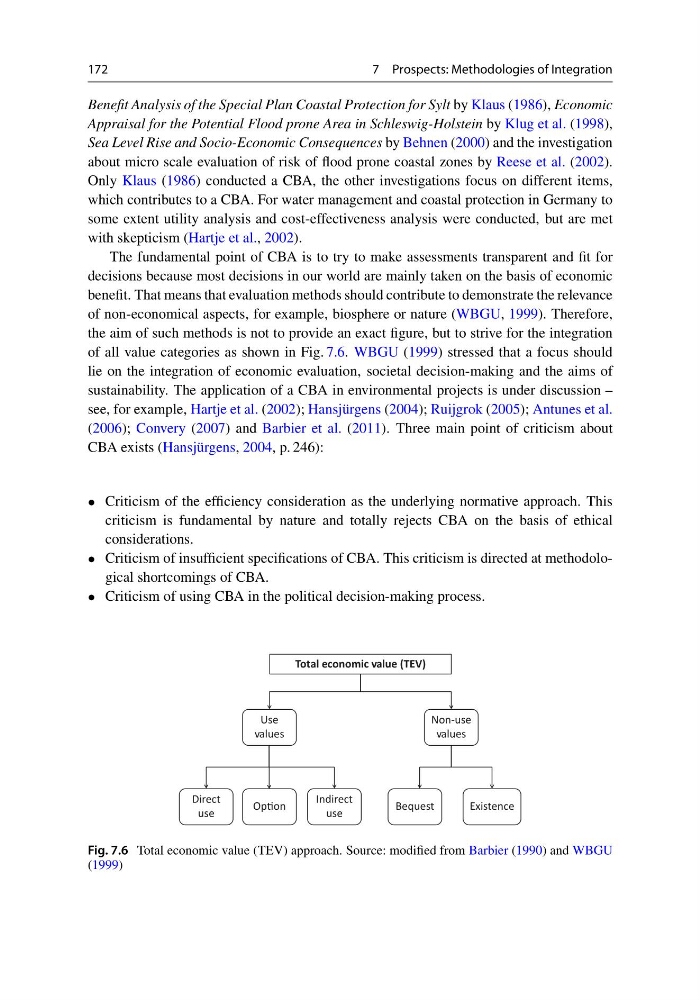
of all value categories as shown in Fig. 7.6. WBGU (1999) stressed that a focus should
lie on the integration of economic evaluation, societal decision-making and the aims of
sustainability. The application of a CBA in environmental projects is under discussion –
see, for example, Hartje et al. (2002); Hansjürgens (2004); Ruijgrok (2005); Antunes et al.
(2006); Convery (2007) and Barbier et al. (2011). Three main point of criticism about
CBA exists (Hansjürgens, 2004, p. 246):
• Criticism of the efficiency consideration as the underlying normative approach. This
criticism is fundamental by nature and totally rejects CBA on the basis of ethical
considerations.
• Criticism of insufficient specifications of CBA. This criticism is directed at methodological shortcomings of CBA.
• Criticism of using CBA in the political decision-making process.
Total economic value (TEV)
Use
values
Non-use
values
Direct
use
Indirect
use
Bequest
Opon
Existence
Fig. 7.6 Total economic value (TEV) approach. Source: modified from Barbier (1990) and WBGU
(1999)
7 Prospects: Methodologies of Integration
Benefit Analysis of the Special Plan Coastal Protection for Sylt by Klaus (1986), Economic
Appraisal for the Potential Flood prone Area in Schleswig-Holstein by Klug et al. (1998),
Sea Level Rise and Socio-Economic Consequences by Behnen (2000) and the investigation
about micro scale evaluation of risk of flood prone coastal zones by Reese et al. (2002).
Only Klaus (1986) conducted a CBA, the other investigations focus on different items,
which contributes to a CBA. For water management and coastal protection in Germany to
some extent utility analysis and cost-effectiveness analysis were conducted, but are met
with skepticism (Hartje et al., 2002).
The fundamental point of CBA is to try to make assessments transparent and fit for
decisions because most decisions in our world are mainly taken on the basis of economic
benefit. That means that evaluation methods should contribute to demonstrate the relevance
of non-economical aspects, for example, biosphere or nature (WBGU, 1999). Therefore,
the aim of such methods is not to provide an exact figure, but to strive for the integration
of all value categories as shown in Fig. 7.6. WBGU (1999) stressed that a focus should
lie on the integration of economic evaluation, societal decision-making and the aims of
sustainability. The application of a CBA in environmental projects is under discussion –
see, for example, Hartje et al. (2002); Hansjürgens (2004); Ruijgrok (2005); Antunes et al.
(2006); Convery (2007) and Barbier et al. (2011). Three main point of criticism about
CBA exists (Hansjürgens, 2004, p. 246):
• Criticism of the efficiency consideration as the underlying normative approach. This
criticism is fundamental by nature and totally rejects CBA on the basis of ethical
considerations.
• Criticism of insufficient specifications of CBA. This criticism is directed at methodological shortcomings of CBA.
• Criticism of using CBA in the political decision-making process.
Total economic value (TEV)
Use
values
Non-use
values
Direct
use
Indirect
use
Bequest
Opon
Existence
Fig. 7.6 Total economic value (TEV) approach. Source: modified from Barbier (1990) and WBGU
(1999)