

170
7 Prospects: Methodologies of Integration
participation process, so that every participant is clear about the rules, also in case of a
dispute.
Commitment The degree of compulsion of the collaborative (decision-making, governance) process has to be as clear as possible from the beginning. For the further process
phases and subsequent implementation phase it is important for the stakeholders to know
how binding the jointly developed results are.
Motivation of participants The motivation of stakeholders might be influenced by a
variety of reasons and circumstances, the description of the societal resources might help
as guideline.
Compensation between short- and long-term interests The process should take care of
the ability to balance the interests of some stakeholders or stakeholder groups to strive for
short-term solution of problems (own interest) and the desired long-term effects of broader
solution approaches (social implications, e.g., taking into account future generations as for
sustainable development).
7.2.3 Principal Process
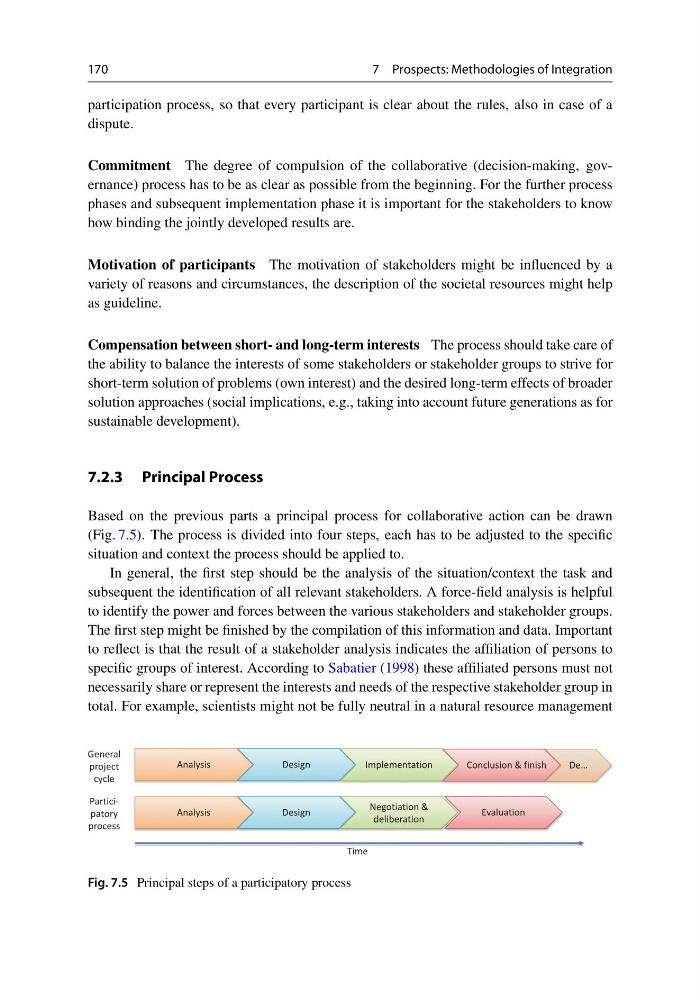
Based on the previous parts a principal process for collaborative action can be drawn
(Fig. 7.5). The process is divided into four steps, each has to be adjusted to the specific
situation and context the process should be applied to.
In general, the first step should be the analysis of the situation/context the task and
subsequent the identification of all relevant stakeholders. A force-field analysis is helpful
to identify the power and forces between the various stakeholders and stakeholder groups.
The first step might be finished by the compilation of this information and data. Important
to reflect is that the result of a stakeholder analysis indicates the affiliation of persons to
specific groups of interest. According to Sabatier (1998) these affiliated persons must not
necessarily share or represent the interests and needs of the respective stakeholder group in
total. For example, scientists might not be fully neutral in a natural resource management
Design
Implementation
Conclusion & finish
Analysis
De…
General
project
cycle
Participatory
process
Analysis
Evaluation
Negotiation &
deliberation
Design
Time
Fig. 7.5 Principal steps of a participatory process
7 Prospects: Methodologies of Integration
participation process, so that every participant is clear about the rules, also in case of a
dispute.
Commitment The degree of compulsion of the collaborative (decision-making, governance) process has to be as clear as possible from the beginning. For the further process
phases and subsequent implementation phase it is important for the stakeholders to know
how binding the jointly developed results are.
Motivation of participants The motivation of stakeholders might be influenced by a
variety of reasons and circumstances, the description of the societal resources might help
as guideline.
Compensation between short- and long-term interests The process should take care of
the ability to balance the interests of some stakeholders or stakeholder groups to strive for
short-term solution of problems (own interest) and the desired long-term effects of broader
solution approaches (social implications, e.g., taking into account future generations as for
sustainable development).
7.2.3 Principal Process
Based on the previous parts a principal process for collaborative action can be drawn
(Fig. 7.5). The process is divided into four steps, each has to be adjusted to the specific
situation and context the process should be applied to.
In general, the first step should be the analysis of the situation/context the task and
subsequent the identification of all relevant stakeholders. A force-field analysis is helpful
to identify the power and forces between the various stakeholders and stakeholder groups.
The first step might be finished by the compilation of this information and data. Important
to reflect is that the result of a stakeholder analysis indicates the affiliation of persons to
specific groups of interest. According to Sabatier (1998) these affiliated persons must not
necessarily share or represent the interests and needs of the respective stakeholder group in
total. For example, scientists might not be fully neutral in a natural resource management
Design
Implementation
Conclusion & finish
Analysis
De…
General
project
cycle
Participatory
process
Analysis
Evaluation
Negotiation &
deliberation
Design
Time
Fig. 7.5 Principal steps of a participatory process