

6.1 Integrated Water Management for Quality and Quantity
125
The second reason concerns enforceability. The greater the transparency in the establishment of objectives, the implementation of measures, and the reporting of standards by
responsible governmental bodies the greater the support of all affected or at least interested
parties.
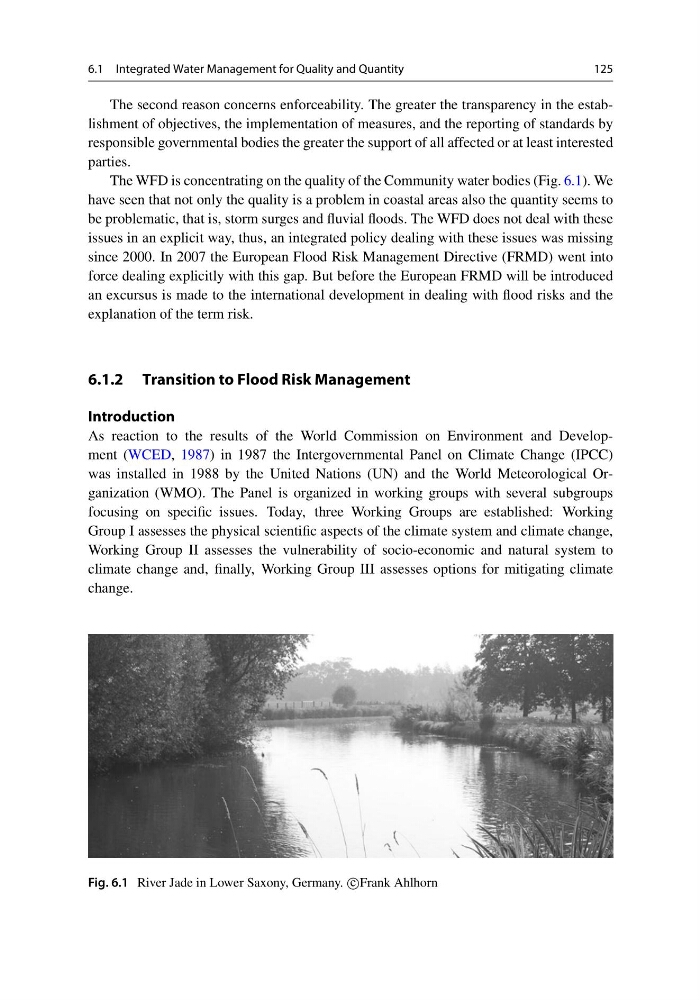
The WFD is concentrating on the quality of the Community water bodies (Fig. 6.1). We
have seen that not only the quality is a problem in coastal areas also the quantity seems to
be problematic, that is, storm surges and fluvial floods. The WFD does not deal with these
issues in an explicit way, thus, an integrated policy dealing with these issues was missing
since 2000. In 2007 the European Flood Risk Management Directive (FRMD) went into
force dealing explicitly with this gap. But before the European FRMD will be introduced
an excursus is made to the international development in dealing with flood risks and the
explanation of the term risk.
6.1.2 Transition to Flood Risk Management
Introduction
As reaction to the results of the World Commission on Environment and Development (WCED, 1987) in 1987 the Intergovernmental Panel on Climate Change (IPCC)
was installed in 1988 by the United Nations (UN) and the World Meteorological Organization (WMO). The Panel is organized in working groups with several subgroups
focusing on specific issues. Today, three Working Groups are established: Working
Group I assesses the physical scientific aspects of the climate system and climate change,
Working Group II assesses the vulnerability of socio-economic and natural system to
climate change and, finally, Working Group III assesses options for mitigating climate
change.
Fig. 6.1 River Jade in Lower Saxony, Germany. c
Ahlhorn
125
The second reason concerns enforceability. The greater the transparency in the establishment of objectives, the implementation of measures, and the reporting of standards by
responsible governmental bodies the greater the support of all affected or at least interested
parties.
The WFD is concentrating on the quality of the Community water bodies (Fig. 6.1). We
have seen that not only the quality is a problem in coastal areas also the quantity seems to
be problematic, that is, storm surges and fluvial floods. The WFD does not deal with these
issues in an explicit way, thus, an integrated policy dealing with these issues was missing
since 2000. In 2007 the European Flood Risk Management Directive (FRMD) went into
force dealing explicitly with this gap. But before the European FRMD will be introduced
an excursus is made to the international development in dealing with flood risks and the
explanation of the term risk.
6.1.2 Transition to Flood Risk Management
Introduction
As reaction to the results of the World Commission on Environment and Development (WCED, 1987) in 1987 the Intergovernmental Panel on Climate Change (IPCC)
was installed in 1988 by the United Nations (UN) and the World Meteorological Organization (WMO). The Panel is organized in working groups with several subgroups
focusing on specific issues. Today, three Working Groups are established: Working
Group I assesses the physical scientific aspects of the climate system and climate change,
Working Group II assesses the vulnerability of socio-economic and natural system to
climate change and, finally, Working Group III assesses options for mitigating climate
change.
Fig. 6.1 River Jade in Lower Saxony, Germany. c
Ahlhorn