

Inorganic Nutrients
87
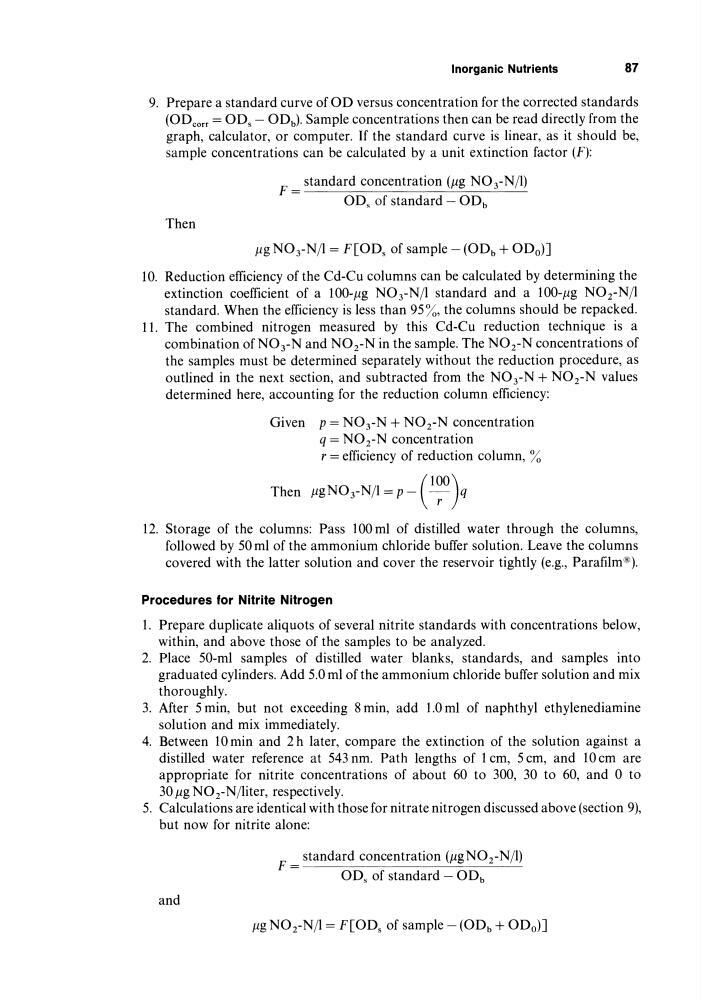
9. Prepare a standard curve of 00 versus concentration for the corrected standards
(ODcorr = ODs - OOb)' Sample concentrations then can be read directly from the
graph, calculator, or computer. If the standard curve is linear, as it should be,
sample concentrations can be calculated by a unit extinction factor (F):
Then
F = _st_a_n_da_r_d_c_o_n_c_en_t_r_at_io_n_(j1--=g_N_O--=3c--_ N-,--/I)
ODs of standard - OOb
j1g N0 3 -N/I = F[OOs of sample - (OOb + 000)]
10. Reduction efficiency of the Cd-Cu columns can be calculated by determining the
extinction coefficient of a 100-j1g N0 3 -N/I standard and a 100-j1g N0 2-N/I
standard. When the efficiency is less than 95%, the columns should be repacked.
11. The combined nitrogen measured by this Cd-Cu reduction technique is a
combination ofNOrN and N0 2 -N in the sample. The N0 2 -N concentrations of
the samples must be determined separately without the reduction procedure, as
outlined in the next section, and subtracted from the N0 3-N + N0 2-N values
determined here, accounting for the reduction column efficiency:
Given p = N0 3 -N + N0 2 -N concentration
q = N0 2 -N concentration
r = efficiency of reduction column, %
Then j1gNOr N/1 = p - C~O)q
12. Storage of the columns: Pass 100 ml of distilled water through the columns,
followed by SOml of the ammonium chloride buffer solution. Leave the columns
covered with the latter solution and cover the reservoir tightly (e.g., Parafilm(ll)).
Procedures for Nitrite Nitrogen
1. Prepare duplicate aliquots of several nitrite standards with concentrations below,
within, and above those of the samples to be analyzed.
2. Place SO-ml samples of distilled water blanks, standards, and samples into
graduated cylinders. Add 5.0 ml of the ammonium chloride buffer solution and mix
thoroughly.
3. After 5 min, but not exceeding 8 min, add 1.0 ml of naphthyl ethylenediamine
solution and mix immediately.
4. Between 10 min and 2 h later, compare the extinction of the solution against a
distilled water reference at 543 nm. Path lengths of 1 cm, 5 cm, and 10 cm are
appropriate for nitrite concentrations of about 60 to 300, 30 to 60, and 0 to
30 j1g N0 2 -N/liter, respectively.
5. Calculations are identical with those for nitrate nitrogen discussed above (section 9),
but now for nitrite alone:
and
F = _st_a_n_da_r_d_c_o_n_c_en_t_r_at_io_n--....::(j1~g~N_0.=:.2_- N_/~I)
ODs of standard - OD b
j1g NOz-N/1 = F[OOs of sample - (ODb + 000 )]
87
9. Prepare a standard curve of 00 versus concentration for the corrected standards
(ODcorr = ODs - OOb)' Sample concentrations then can be read directly from the
graph, calculator, or computer. If the standard curve is linear, as it should be,
sample concentrations can be calculated by a unit extinction factor (F):
Then
F = _st_a_n_da_r_d_c_o_n_c_en_t_r_at_io_n_(j1--=g_N_O--=3c--_ N-,--/I)
ODs of standard - OOb
j1g N0 3 -N/I = F[OOs of sample - (OOb + 000)]
10. Reduction efficiency of the Cd-Cu columns can be calculated by determining the
extinction coefficient of a 100-j1g N0 3 -N/I standard and a 100-j1g N0 2-N/I
standard. When the efficiency is less than 95%, the columns should be repacked.
11. The combined nitrogen measured by this Cd-Cu reduction technique is a
combination ofNOrN and N0 2 -N in the sample. The N0 2 -N concentrations of
the samples must be determined separately without the reduction procedure, as
outlined in the next section, and subtracted from the N0 3-N + N0 2-N values
determined here, accounting for the reduction column efficiency:
Given p = N0 3 -N + N0 2 -N concentration
q = N0 2 -N concentration
r = efficiency of reduction column, %
Then j1gNOr N/1 = p - C~O)q
12. Storage of the columns: Pass 100 ml of distilled water through the columns,
followed by SOml of the ammonium chloride buffer solution. Leave the columns
covered with the latter solution and cover the reservoir tightly (e.g., Parafilm(ll)).
Procedures for Nitrite Nitrogen
1. Prepare duplicate aliquots of several nitrite standards with concentrations below,
within, and above those of the samples to be analyzed.
2. Place SO-ml samples of distilled water blanks, standards, and samples into
graduated cylinders. Add 5.0 ml of the ammonium chloride buffer solution and mix
thoroughly.
3. After 5 min, but not exceeding 8 min, add 1.0 ml of naphthyl ethylenediamine
solution and mix immediately.
4. Between 10 min and 2 h later, compare the extinction of the solution against a
distilled water reference at 543 nm. Path lengths of 1 cm, 5 cm, and 10 cm are
appropriate for nitrite concentrations of about 60 to 300, 30 to 60, and 0 to
30 j1g N0 2 -N/liter, respectively.
5. Calculations are identical with those for nitrate nitrogen discussed above (section 9),
but now for nitrite alone:
and
F = _st_a_n_da_r_d_c_o_n_c_en_t_r_at_io_n--....::(j1~g~N_0.=:.2_- N_/~I)
ODs of standard - OD b
j1g NOz-N/1 = F[OOs of sample - (ODb + 000 )]