

76
Exercise 6
7. Measure 100ml of the sample with a volumetric pipet (a graduated cylinder is
much too inaccurate and volumetric flasks are not designed to deliver accurately)
and then transfer to a 250-ml Erlenmeyer flask or porcelain casserole dish. Touch
the tip of the pipet to the side of the flask during delivery.
8. With a 50-ml burette filled with 0.005M standardized sodium thiosulfate solution,
titrate with mixing until a very pale yellow ("straw") color is observed and then
proceed with the next step.
9. Add 2 drops of stabilized starch mixture, mix to get a uniform blue color, and titrate
carefully but rapidly to a colorless end point. The blue coloration should return
upon standing in 15 to 20 sec and can be ignored. When the blue coloration does
not return, the end point has been overshot. Record the volume oftitrant used in ml
to two decimal places.
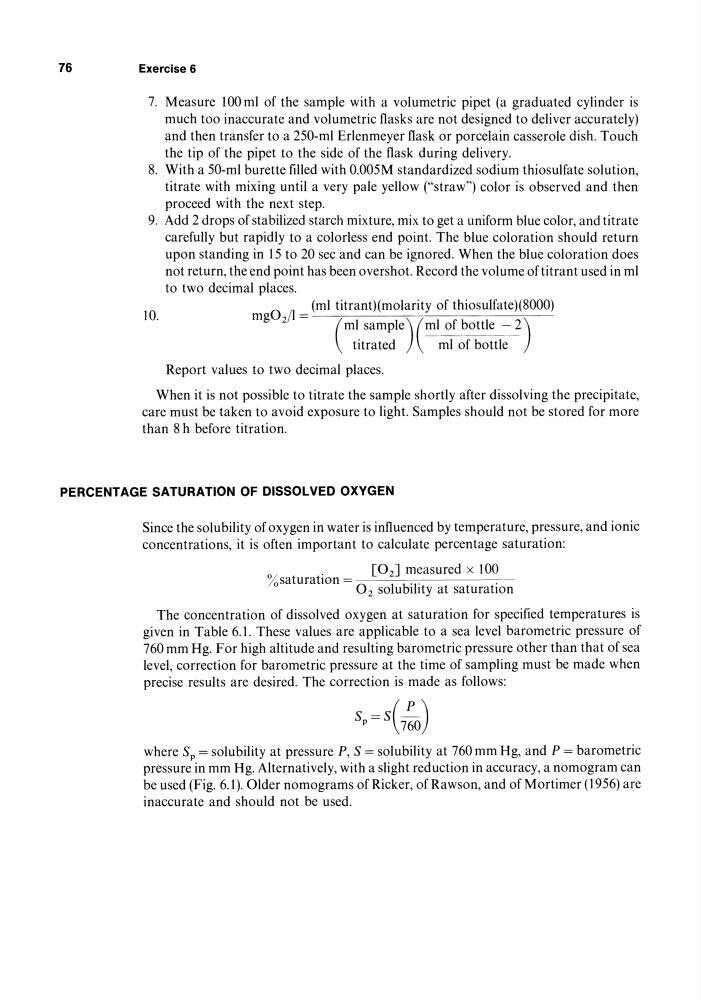
10.
mgO,fi ~ (ml tant)(mnYt of thinSuffate)()OOOI
ml sample
ml~bottIe--=-2
titrated
ml of bottle
Report values to two decimal places.
When it is not possible to titrate the sample shortly after dissolving the precipitate,
care must be taken to avoid exposure to light. Samples should not be stored for more
than 8 h before titration.
PERCENTAGE SATURATION OF DISSOLVED OXYGEN
Since the solubility of oxygen in water is influenced by temperature, pressure, and ionic
concentrations, it is often important to calculate percentage saturation:
o
.
[02J measured x 100
%saturatlon =
.
. .
O 2 solubIlity at saturatIOn
The concentration of dissolved oxygen at saturation for specified temperatures is
given in Table 6.1. These values are applicable to a sea level barometric pressure of
760 mm Hg. For high altitude and resulting barometric pressure other than that of sea
level, correction for barometric pressure at the time of sampling must be made when
precise results are desired. The correction is made as follows:
Sp=S(7:0)
where Sp = solubility at pressure P, S = solubility at 760 mm Hg, and P = barometric
pressure in mm Hg. Alternatively, with a slight reduction in accuracy, a nomogram can
be used (Fig. 6.1). Older nomograms of Ricker, of Rawson, and of Mortimer (1956) are
inaccurate and should not be used.
Exercise 6
7. Measure 100ml of the sample with a volumetric pipet (a graduated cylinder is
much too inaccurate and volumetric flasks are not designed to deliver accurately)
and then transfer to a 250-ml Erlenmeyer flask or porcelain casserole dish. Touch
the tip of the pipet to the side of the flask during delivery.
8. With a 50-ml burette filled with 0.005M standardized sodium thiosulfate solution,
titrate with mixing until a very pale yellow ("straw") color is observed and then
proceed with the next step.
9. Add 2 drops of stabilized starch mixture, mix to get a uniform blue color, and titrate
carefully but rapidly to a colorless end point. The blue coloration should return
upon standing in 15 to 20 sec and can be ignored. When the blue coloration does
not return, the end point has been overshot. Record the volume oftitrant used in ml
to two decimal places.
10.
mgO,fi ~ (ml tant)(mnYt of thinSuffate)()OOOI
ml sample
ml~bottIe--=-2
titrated
ml of bottle
Report values to two decimal places.
When it is not possible to titrate the sample shortly after dissolving the precipitate,
care must be taken to avoid exposure to light. Samples should not be stored for more
than 8 h before titration.
PERCENTAGE SATURATION OF DISSOLVED OXYGEN
Since the solubility of oxygen in water is influenced by temperature, pressure, and ionic
concentrations, it is often important to calculate percentage saturation:
o
.
[02J measured x 100
%saturatlon =
.
. .
O 2 solubIlity at saturatIOn
The concentration of dissolved oxygen at saturation for specified temperatures is
given in Table 6.1. These values are applicable to a sea level barometric pressure of
760 mm Hg. For high altitude and resulting barometric pressure other than that of sea
level, correction for barometric pressure at the time of sampling must be made when
precise results are desired. The correction is made as follows:
Sp=S(7:0)
where Sp = solubility at pressure P, S = solubility at 760 mm Hg, and P = barometric
pressure in mm Hg. Alternatively, with a slight reduction in accuracy, a nomogram can
be used (Fig. 6.1). Older nomograms of Ricker, of Rawson, and of Mortimer (1956) are
inaccurate and should not be used.