

368
Appendix 2
x 2 TEST FOR RANDOMNESS
In a random distribution, there is a lack of regularity; individuals are distributed in
groups and unequally spaced, some close together and others far apart. Agreement
with a Poisson series is an accepted test for randomness. The / test analyzes the
equality of variance and mean in a Poisson series. The ratio of variance to mean, or
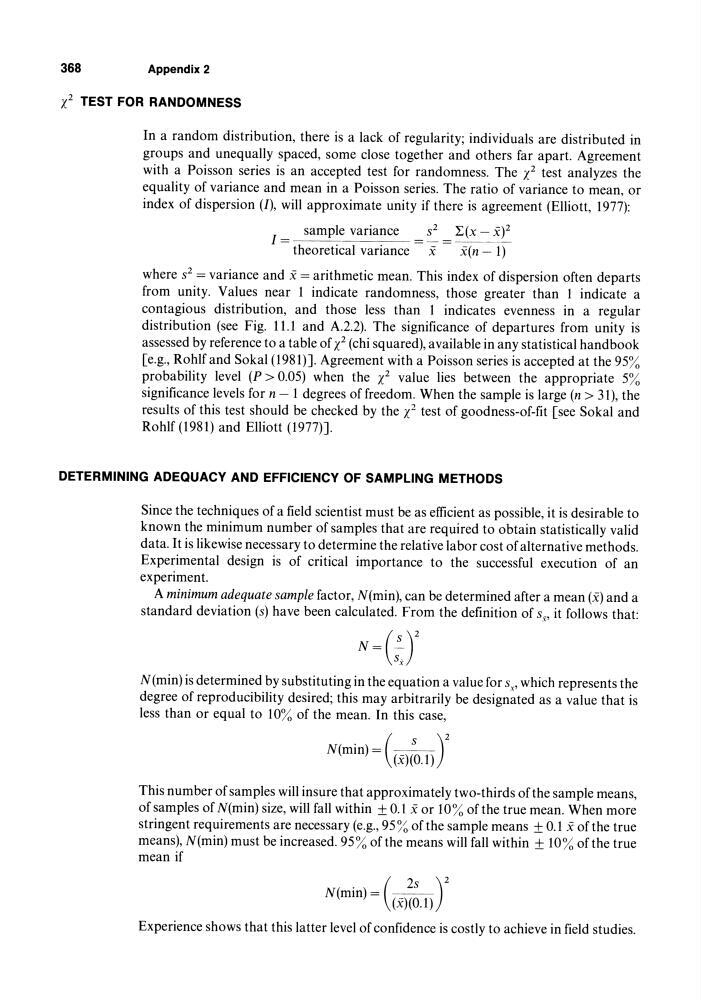
index of dispersion (I), will approximate unity if there is agreement (Elliott, 1977):
sample variance
S2
L(X - X)2
1=
--~--theoretical variance x x(n - 1)
where S2 = variance and x = arithmetic mean. This index of dispersion often departs
from unity. Values near 1 indicate randomness, those greater than 1 indicate a
contagious distribution, and those less than 1 indicates evenness in a regular
distribution (see Fig. 11.1 and A.2.2). The significance of departures from unity is
assessed by reference to a table of X 2 (chi squared), available in any statistical handbook
[e.g., Rohlf and Sokal (1981)]. Agreement with a Poisson series is accepted at the 95%
probability level (P > 0.05) when the X2 value lies between the appropriate 5%
significance levels for n - 1 degrees of freedom. When the sample is large (n > 31), the
results of this test should be checked by the X 2 test of goodness-of-fit [see Sokal and
Rohlf (1981) and Elliott (1977)].
DETERMINING ADEQUACY AND EFFICIENCY OF SAMPLING METHODS
Since the techniques of a field scientist must be as efficient as possible, it is desirable to
known the minimum number of samples that are required to obtain statistically valid
data. It is likewise necessary to determine the relative labor cost of alternative methods.
Experimental design is of critical importance to the successful execution of an
experiment.
A minimum adequate sample factor, N(min), can be determined after a mean (i) and a
standard deviation (s) have been calculated. From the definition of s,' it follows that:
N(min) is determined by substituting in the equation a value for Sx' which represents the
degree of reproducibility desired; this may arbitrarily be designated as a value that is
less than or equal to 10% of the mean. In this case,
N(min) = ( _ _
S _)2
(i)(O.l )
This number of samples will insure that approximately two-thirds of the sample means,
of samples of N(min) size, will fall within ± 0.1 x or 10% of the true mean. When more
stringent requirements are necessary (e.g., 95~~ of the sample means ± 0.1 i of the true
means), N(min) must be increased. 95% of the means will fall within ± 10% of the true
mean if
( 2s )2
N(min) = (i)(0.1)
Experience shows that this latter level of confidence is costly to achieve in field studies.
Appendix 2
x 2 TEST FOR RANDOMNESS
In a random distribution, there is a lack of regularity; individuals are distributed in
groups and unequally spaced, some close together and others far apart. Agreement
with a Poisson series is an accepted test for randomness. The / test analyzes the
equality of variance and mean in a Poisson series. The ratio of variance to mean, or
index of dispersion (I), will approximate unity if there is agreement (Elliott, 1977):
sample variance
S2
L(X - X)2
1=
--~--theoretical variance x x(n - 1)
where S2 = variance and x = arithmetic mean. This index of dispersion often departs
from unity. Values near 1 indicate randomness, those greater than 1 indicate a
contagious distribution, and those less than 1 indicates evenness in a regular
distribution (see Fig. 11.1 and A.2.2). The significance of departures from unity is
assessed by reference to a table of X 2 (chi squared), available in any statistical handbook
[e.g., Rohlf and Sokal (1981)]. Agreement with a Poisson series is accepted at the 95%
probability level (P > 0.05) when the X2 value lies between the appropriate 5%
significance levels for n - 1 degrees of freedom. When the sample is large (n > 31), the
results of this test should be checked by the X 2 test of goodness-of-fit [see Sokal and
Rohlf (1981) and Elliott (1977)].
DETERMINING ADEQUACY AND EFFICIENCY OF SAMPLING METHODS
Since the techniques of a field scientist must be as efficient as possible, it is desirable to
known the minimum number of samples that are required to obtain statistically valid
data. It is likewise necessary to determine the relative labor cost of alternative methods.
Experimental design is of critical importance to the successful execution of an
experiment.
A minimum adequate sample factor, N(min), can be determined after a mean (i) and a
standard deviation (s) have been calculated. From the definition of s,' it follows that:
N(min) is determined by substituting in the equation a value for Sx' which represents the
degree of reproducibility desired; this may arbitrarily be designated as a value that is
less than or equal to 10% of the mean. In this case,
N(min) = ( _ _
S _)2
(i)(O.l )
This number of samples will insure that approximately two-thirds of the sample means,
of samples of N(min) size, will fall within ± 0.1 x or 10% of the true mean. When more
stringent requirements are necessary (e.g., 95~~ of the sample means ± 0.1 i of the true
means), N(min) must be increased. 95% of the means will fall within ± 10% of the true
mean if
( 2s )2
N(min) = (i)(0.1)
Experience shows that this latter level of confidence is costly to achieve in field studies.