

362
SOME UNITS
Appendix 1
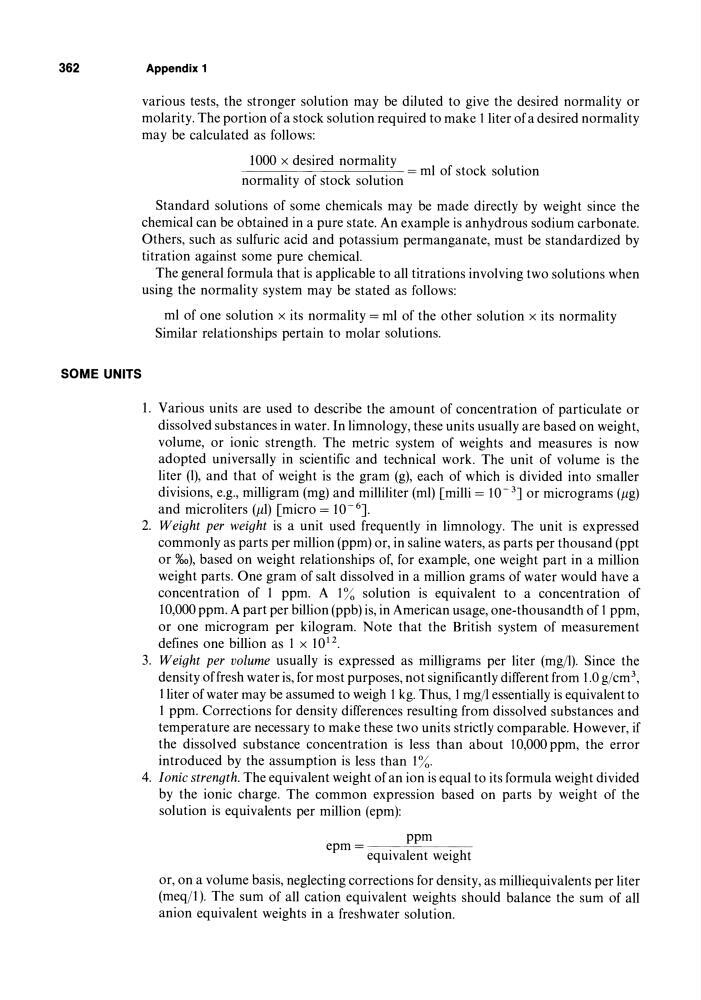
various tests, the stronger solution may be diluted to give the desired normality or
molarity. The portion of a stock solution required to make 1 liter of a desired normality
may be calculated as follows:
1000 x desired normality
1 f
k
.
.
. = m 0 stoc solutIOn
normahty of stock solutIOn
Standard solutions of some chemicals may be made directly by weight since the
chemical can be obtained in a pure state. An example is anhydrous sodium carbonate.
Others, such as sulfuric acid and potassium permanganate, must be standardized by
titration against some pure chemical.
The general formula that is applicable to all titrations involving two solutions when
using the normality system may be stated as follows:
ml of one solution x its normality = ml of the other solution x its normality
Similar relationships pertain to molar solutions.
1. Various units are used to describe the amount of concentration of particulate or
dissolved substances in water. In limnology, these units usually are based on weight,
volume, or ionic strength. The metric system of weights and measures is now
adopted universally in scientific and technical work. The unit of volume is the
liter (1), and that of weight is the gram (g), each of which is divided into smaller
divisions, e.g., milligram (mg) and milliliter (ml) [milli = 10-3] or micrograms (Ilg)
and microliters (Ill) [micro = 10 - 6].
2. Weight per weight is a unit used frequently in limnology. The unit is expressed
commonly as parts per million (ppm) or, in saline waters, as parts per thousand (ppt
or %0), based on weight relationships of, for example, one weight part in a million
weight parts. One gram of salt dissolved in a million grams of water would have a
concentration of 1 ppm. A 1 % solution is equivalent to a concentration of
10,000 ppm. A part per billion (ppb) is, in American usage, one-thousandth of 1 ppm,
or one microgram per kilogram. Note that the British system of measurement
defines one billion as 1 x 10 12 .
3. Weight per volume usually is expressed as milligrams per liter (mg/l). Since the
density offresh water is, for most purposes, not significantly different from 1.0 g/cm 3 ,
1 liter of water may be assumed to weigh 1 kg. Thus, 1 mg/l essentially is equivalent to
1 ppm. Corrections for density differences resulting from dissolved substances and
temperature are necessary to make these two units strictly comparable. However, if
the dissolved substance concentration is less than about 10,000 ppm, the error
introduced by the assumption is less than 1 %.
4. Ionic strength. The equivalent weight of an ion is equal to its formula weight divided
by the ionic charge. The common expression based on parts by weight of the
solution is equivalents per million (epm):
epm =
.--"p,-"p_m_--:--cequivalent weight
or, on a volume basis, neglecting corrections for density, as milliequivalents per liter
(meqjl). The sum of all cation equivalent weights should balance the sum of all
anion equivalent weights in a freshwater solution.
SOME UNITS
Appendix 1
various tests, the stronger solution may be diluted to give the desired normality or
molarity. The portion of a stock solution required to make 1 liter of a desired normality
may be calculated as follows:
1000 x desired normality
1 f
k
.
.
. = m 0 stoc solutIOn
normahty of stock solutIOn
Standard solutions of some chemicals may be made directly by weight since the
chemical can be obtained in a pure state. An example is anhydrous sodium carbonate.
Others, such as sulfuric acid and potassium permanganate, must be standardized by
titration against some pure chemical.
The general formula that is applicable to all titrations involving two solutions when
using the normality system may be stated as follows:
ml of one solution x its normality = ml of the other solution x its normality
Similar relationships pertain to molar solutions.
1. Various units are used to describe the amount of concentration of particulate or
dissolved substances in water. In limnology, these units usually are based on weight,
volume, or ionic strength. The metric system of weights and measures is now
adopted universally in scientific and technical work. The unit of volume is the
liter (1), and that of weight is the gram (g), each of which is divided into smaller
divisions, e.g., milligram (mg) and milliliter (ml) [milli = 10-3] or micrograms (Ilg)
and microliters (Ill) [micro = 10 - 6].
2. Weight per weight is a unit used frequently in limnology. The unit is expressed
commonly as parts per million (ppm) or, in saline waters, as parts per thousand (ppt
or %0), based on weight relationships of, for example, one weight part in a million
weight parts. One gram of salt dissolved in a million grams of water would have a
concentration of 1 ppm. A 1 % solution is equivalent to a concentration of
10,000 ppm. A part per billion (ppb) is, in American usage, one-thousandth of 1 ppm,
or one microgram per kilogram. Note that the British system of measurement
defines one billion as 1 x 10 12 .
3. Weight per volume usually is expressed as milligrams per liter (mg/l). Since the
density offresh water is, for most purposes, not significantly different from 1.0 g/cm 3 ,
1 liter of water may be assumed to weigh 1 kg. Thus, 1 mg/l essentially is equivalent to
1 ppm. Corrections for density differences resulting from dissolved substances and
temperature are necessary to make these two units strictly comparable. However, if
the dissolved substance concentration is less than about 10,000 ppm, the error
introduced by the assumption is less than 1 %.
4. Ionic strength. The equivalent weight of an ion is equal to its formula weight divided
by the ionic charge. The common expression based on parts by weight of the
solution is equivalents per million (epm):
epm =
.--"p,-"p_m_--:--cequivalent weight
or, on a volume basis, neglecting corrections for density, as milliequivalents per liter
(meqjl). The sum of all cation equivalent weights should balance the sum of all
anion equivalent weights in a freshwater solution.