

Historical Records of Changes in the Productivity of Lakes
Analyses of Pigment Degradation Products
Relative Pigment Units
339
1. Homogenize about 4 g of wet sediments with a spatula into a tared crucible; weigh to
the nearest 0.1 mg. Remove a 1- to 2-g portion of the homogenate and transfer it to a
large test tube. Reweigh the crucible immediately to determine the amount removed.
Determine the dry and organic weights of the sediment in the crucible, as discussed
above.
2. Disperse the wet sediments in the test tube with a glass rod in about 30 ml of 90%
aqueous, basic acetone (see Exercise 10) containing 0.5% dimethylaniline. Cover the
test tubes with plastic (e.g., parafilm) and store at 4°C in the dark for 24 h; mix
intermittently.
3. In a hood, filter the extracted sediments and supernatant acetone through fine filter
paper (e.g., Whatman No. 50) into 100-ml glass-stoppered graduated cylinders.
Wash the sediments repeatedly with solvent until exactly 100 ml of filtrate is
collected.
4. Determine the optical density of the filtrate without delay in a spectrophotometer
with a 1-cm cell at 750 nm for a baseline absorbance reading and, in the chlorophyllous pigment region, read the maximum at about 662 nm (locate the peak
between 657 and 666 nm). Longer path length spectrophotometric cells may be
needed for low pigment product concentrations.
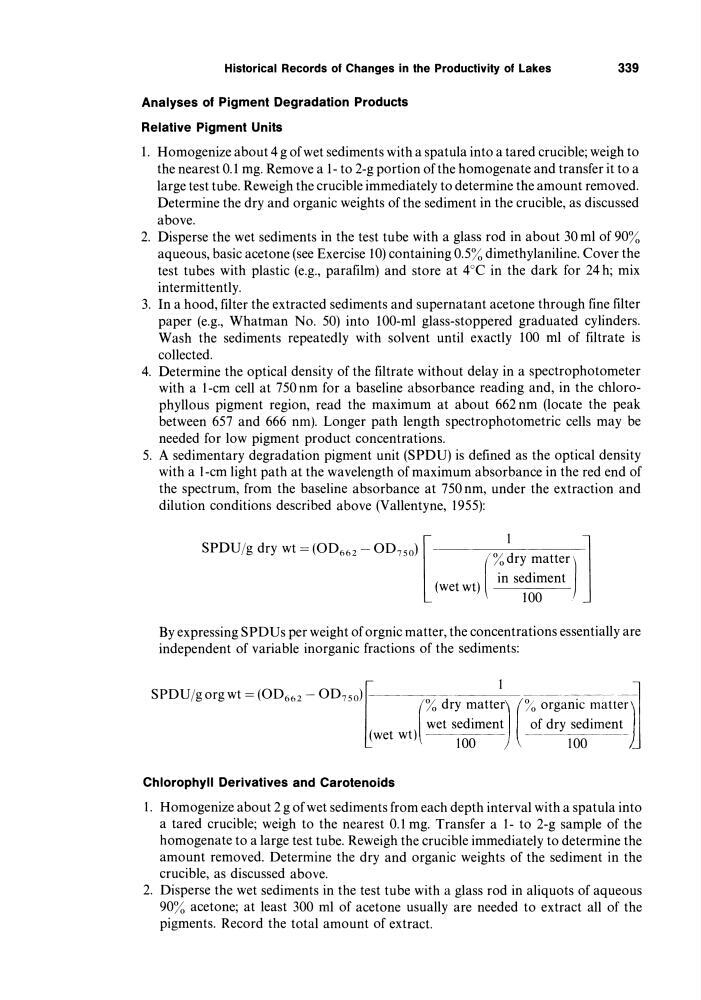
5. A sedimentary degradation pigment unit (SPDU) is defined as the optical density
with a I-cm light path at the wavelength of maximum absorbance in the red end of
the spectrum, from the baseline absorbance at 750 nm, under the extraction and
dilution conditions described above (Vallentyne, 1955):
SPDU/g dry wt = (OD662 - OD 750) l I . J
(
%dr y matter)
(
) in sediment
wetwt
100
By expressing SPDUs per weight of orgnic matter, the concentrations essentially are
independent of variable inorganic fractions of the sediments:
SPDU/gorgwt = (OD 662 - OD750)~·--(%drY~atte~) (% organic ~atterJ~
wet sedIment
of dry sedIment
(wet wt)
- - - - - - - - -
100
100
Chlorophyll Derivatives and Carotenoids
1. Homogenize about 2 g of wet sediments from each depth interval with a spatula into
a tared crucible; weigh to the nearest 0.1 mg. Transfer a 1- to 2-g sample of the
homogenate to a large test tube. Reweigh the crucible immediately to determine the
amount removed. Determine the dry and organic weights of the sediment in the
crucible, as discussed above.
2. Disperse the wet sediments in the test tube with a glass rod in aliquots of aqueous
90% acetone; at least 300 ml of acetone usually are needed to extract all of the
pigments. Record the total amount of extract.
Analyses of Pigment Degradation Products
Relative Pigment Units
339
1. Homogenize about 4 g of wet sediments with a spatula into a tared crucible; weigh to
the nearest 0.1 mg. Remove a 1- to 2-g portion of the homogenate and transfer it to a
large test tube. Reweigh the crucible immediately to determine the amount removed.
Determine the dry and organic weights of the sediment in the crucible, as discussed
above.
2. Disperse the wet sediments in the test tube with a glass rod in about 30 ml of 90%
aqueous, basic acetone (see Exercise 10) containing 0.5% dimethylaniline. Cover the
test tubes with plastic (e.g., parafilm) and store at 4°C in the dark for 24 h; mix
intermittently.
3. In a hood, filter the extracted sediments and supernatant acetone through fine filter
paper (e.g., Whatman No. 50) into 100-ml glass-stoppered graduated cylinders.
Wash the sediments repeatedly with solvent until exactly 100 ml of filtrate is
collected.
4. Determine the optical density of the filtrate without delay in a spectrophotometer
with a 1-cm cell at 750 nm for a baseline absorbance reading and, in the chlorophyllous pigment region, read the maximum at about 662 nm (locate the peak
between 657 and 666 nm). Longer path length spectrophotometric cells may be
needed for low pigment product concentrations.
5. A sedimentary degradation pigment unit (SPDU) is defined as the optical density
with a I-cm light path at the wavelength of maximum absorbance in the red end of
the spectrum, from the baseline absorbance at 750 nm, under the extraction and
dilution conditions described above (Vallentyne, 1955):
SPDU/g dry wt = (OD662 - OD 750) l I . J
(
%dr y matter)
(
) in sediment
wetwt
100
By expressing SPDUs per weight of orgnic matter, the concentrations essentially are
independent of variable inorganic fractions of the sediments:
SPDU/gorgwt = (OD 662 - OD750)~·--(%drY~atte~) (% organic ~atterJ~
wet sedIment
of dry sedIment
(wet wt)
- - - - - - - - -
100
100
Chlorophyll Derivatives and Carotenoids
1. Homogenize about 2 g of wet sediments from each depth interval with a spatula into
a tared crucible; weigh to the nearest 0.1 mg. Transfer a 1- to 2-g sample of the
homogenate to a large test tube. Reweigh the crucible immediately to determine the
amount removed. Determine the dry and organic weights of the sediment in the
crucible, as discussed above.
2. Disperse the wet sediments in the test tube with a glass rod in aliquots of aqueous
90% acetone; at least 300 ml of acetone usually are needed to extract all of the
pigments. Record the total amount of extract.