

284
Exercise 21
the dried residue with distilled water to a final volume of 50 to 100 ml and seal in glass
ampoules or bottles. Use immediately or freeze until use.
6. Collect lake water from the same depths as the original samples were taken and fill four
clean 300-ml opaque BOD (oxygen) bottles. Measure the temperature at these depths. Add
materials to duplicate bottles as follows:
a. Add one glass fiber filter containing radioactively labeled algae and detritus into
duplicate bottles; seal and cover the top of each with aluminium foil to exclude all light;
mix well.
b. Remove 2.5 or 5.0 ml of water from two bottles; discard. Add 2.5 or 5.0 ml of the
concentrated filtrate to each, seal, and cap with aluminium foil. Mix well.
c. Incubate the bottles in situ or in the laboratory at ambient temperatures for between
12 and 72 h
d. Control bottles, using lake water that has been autoclaved (l h; cooled) or treated with
formalin, are essential. Otherwise, treat identically to the experimental samples.
7. At the end of the incubation, remove 60 ml from each bottle in duplicate 30-ml aliquots for
measurement of dissolved inorganic carbon (see Exercise 8) and to create a head space in the
bottle necessary for the next step.
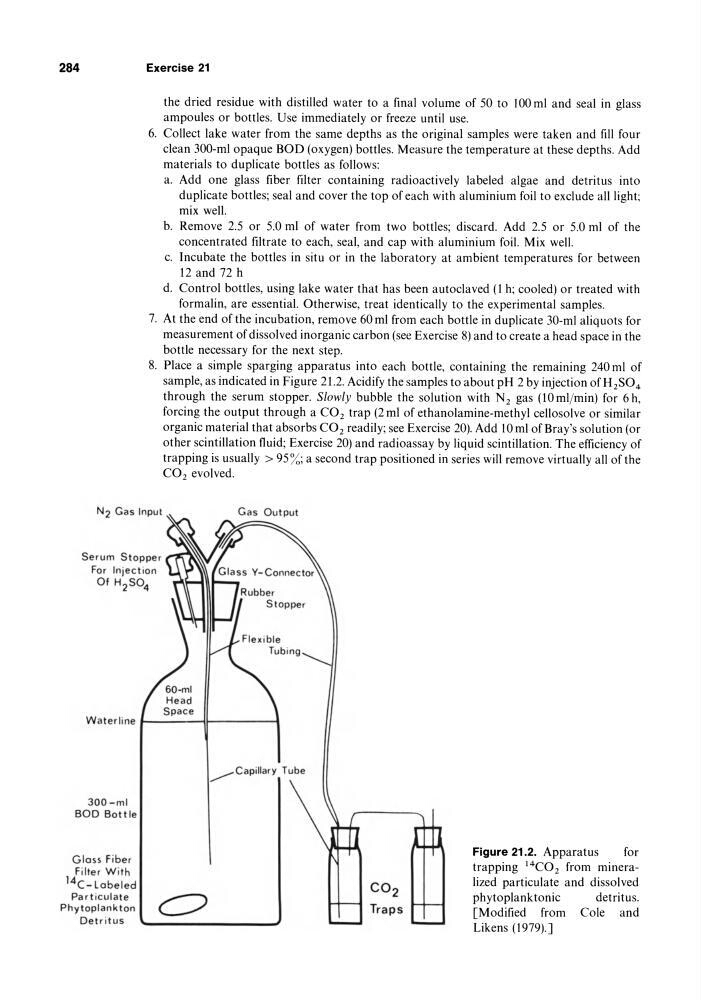
8. Place a simple sparging apparatus into each bottle, containing the remaining 240 ml of
sample, as indicated in Figure 21.2. Acidify the samples to about pH 2 by injection ofH 1 S0 4
through the serum stopper. Slowly bubble the solution with N2 gas (10mlj min) for 6h,
forcing the output through a CO 2 trap (2 ml of ethanolamine-methyl cellosolve or similar
organic material that absorbs CO 2 readily; see Exercise 20). Add 10 ml of Bray's solution (or
other scintillation fluid; Exercise 20) and radioassay by liquid scintillation. The efficiency of
trapping is usually > 95%; a second trap positioned in series will remove virtually all of the
CO 2 evolved.
Serum Stopper
For Injection
Of H 2 S0 4
Wa t erline I--- -- - i t - -- --t
300 -ml
BO D Bottle
Gloss Fiber
Fi lter W i th
14C_ Labele d
Par t iculate
Phy t oplankton
Detr i tus
............... Capillar y Tube
CO 2
Tra ps
Figure 21.2. Apparatus
for
trapping 14C02 from mineralized particulate and dissolved
phytoplanktonic
detritus.
[Modified from Cole and
Likens (1979).]
Exercise 21
the dried residue with distilled water to a final volume of 50 to 100 ml and seal in glass
ampoules or bottles. Use immediately or freeze until use.
6. Collect lake water from the same depths as the original samples were taken and fill four
clean 300-ml opaque BOD (oxygen) bottles. Measure the temperature at these depths. Add
materials to duplicate bottles as follows:
a. Add one glass fiber filter containing radioactively labeled algae and detritus into
duplicate bottles; seal and cover the top of each with aluminium foil to exclude all light;
mix well.
b. Remove 2.5 or 5.0 ml of water from two bottles; discard. Add 2.5 or 5.0 ml of the
concentrated filtrate to each, seal, and cap with aluminium foil. Mix well.
c. Incubate the bottles in situ or in the laboratory at ambient temperatures for between
12 and 72 h
d. Control bottles, using lake water that has been autoclaved (l h; cooled) or treated with
formalin, are essential. Otherwise, treat identically to the experimental samples.
7. At the end of the incubation, remove 60 ml from each bottle in duplicate 30-ml aliquots for
measurement of dissolved inorganic carbon (see Exercise 8) and to create a head space in the
bottle necessary for the next step.
8. Place a simple sparging apparatus into each bottle, containing the remaining 240 ml of
sample, as indicated in Figure 21.2. Acidify the samples to about pH 2 by injection ofH 1 S0 4
through the serum stopper. Slowly bubble the solution with N2 gas (10mlj min) for 6h,
forcing the output through a CO 2 trap (2 ml of ethanolamine-methyl cellosolve or similar
organic material that absorbs CO 2 readily; see Exercise 20). Add 10 ml of Bray's solution (or
other scintillation fluid; Exercise 20) and radioassay by liquid scintillation. The efficiency of
trapping is usually > 95%; a second trap positioned in series will remove virtually all of the
CO 2 evolved.
Serum Stopper
For Injection
Of H 2 S0 4
Wa t erline I--- -- - i t - -- --t
300 -ml
BO D Bottle
Gloss Fiber
Fi lter W i th
14C_ Labele d
Par t iculate
Phy t oplankton
Detr i tus
............... Capillar y Tube
CO 2
Tra ps
Figure 21.2. Apparatus
for
trapping 14C02 from mineralized particulate and dissolved
phytoplanktonic
detritus.
[Modified from Cole and
Likens (1979).]