

282
Exercise 21
decomposition varies through time depending on
a number of substrate and environmental
variables.
The relative rate of decomposition, k, can be
viewed in a simple way in relation to the controlling variables (Godshalk and Wetzel, 1978c):
k oc (T)(O)(NJ
(Re)(Sp)
where T = temperature (within biological limitations), 0 = dissolved oxygen or other electron
acceptors, Nu = mineral nutrients required for
microbial metabolism, Re = initial tissue refractility, and Sp = particle size (i.e., particle
size:surface area).
For example, k will be low and conditions will
not be conducive to rapid decomposition if
relative values of T,O, and/or Nu are low. Since
these factors interact with one another, high
values of one variable will offset low values of
another only to a limited extent. Mechanical
fragmentation by water turbulence or by animals
can cause lower values of Sp, which, in turn,
theoretically will increase decay rates in spite of
constant refractility or constant environmental
conditions.
The relative rate of decomposition k is the
amount of detrital carbon metabolized per unit
time (e.g., POM -+ DOM, POM -+ microbial
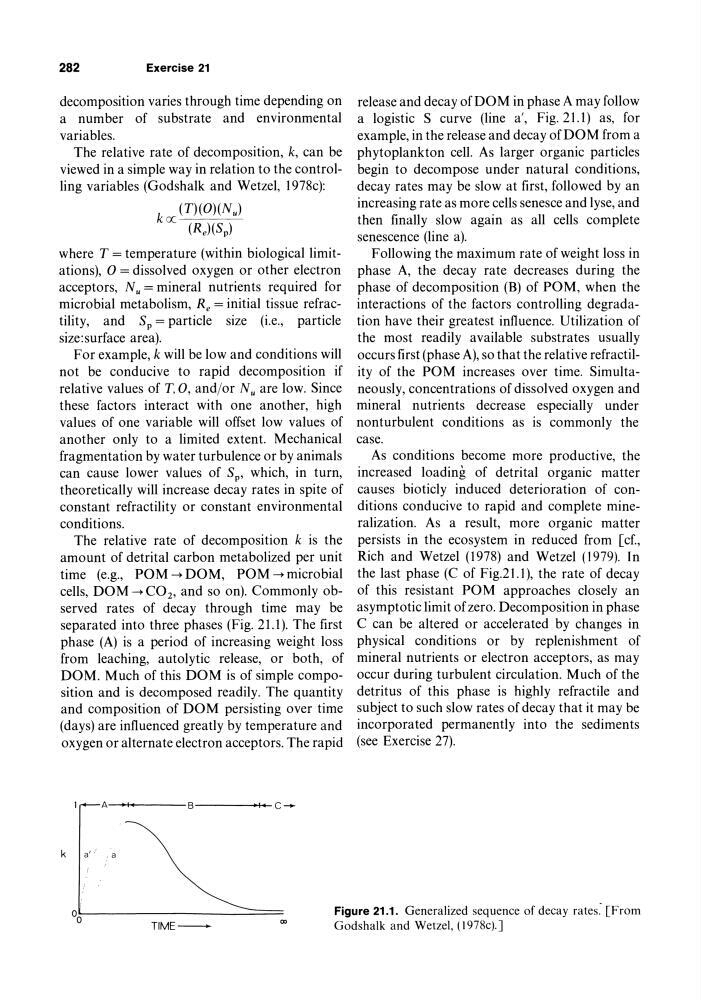
cells, DOM -+ CO 2 , and so on). Commonly observed rates of decay through time may be
separated into three phases (Fig. 21.1). The first
phase (A) is a period of increasing weight loss
from leaching, autolytic release, or both, of
DOM. Much of this DOM is of simple composition and is decomposed readily. The quantity
and composition of DOM persisting over time
(days) are influenced greatly by temperature and
oxygen or alternate electron acceptors. The rapid
A--j· .... I~. ---B----->.+I.<-c-k
a':, a
release and decay ofDOM in phase A may follow
a logistic S curve (line a', Fig. 21.1) as, for
example, in the release and decay ofDOM from a
phytoplankton cell. As larger organic particles
begin to decompose under natural conditions,
decay rates may be slow at first, followed by an
increasing rate as more cells senesce and lyse, and
then finally slow again as all cells complete
senescence (line a).
Following the maximum rate of weight loss in
phase A, the decay rate decreases during the
phase of decomposition (8) of POM, when the
interactions of the factors controlling degradation have their greatest influence. Utilization of
the most readily available substrates usually
occurs first (phase A), so that the relative refractility of the POM increases over time. Simultaneously, concentrations of dissolved oxygen and
mineral nutrients decrease especially under
nonturbulent conditions as is commonly the
case.
As conditions become more productive, the
increased loading of detrital organic matter
causes bioticly induced deterioration of conditions conducive to rapid and complete mineralization. As a result, more organic matter
persists in the ecosystem in reduced from [cf.,
Rich and Wetzel (1978) and Wetzel (1979). In
the last phase (C of Fig.21.l), the rate of decay
of this resistant POM approaches closely an
asymptotic limit of zero. Decomposition in phase
C can be altered or accelerated by changes in
physical conditions or by replenishment of
mineral nutrients or electron acceptors, as may
occur during turbulent circulation. Much of the
detritus of this phase is highly refractile and
subject to such slow rates of decay that it may be
incorporated permanently into the sediments
(see Exercise 27).
%~---------~~~oo
TIMEFigure 21.1. Generalized sequence of decay rates~ [From
Godshalk and Wetzel, (I 978c).]
Exercise 21
decomposition varies through time depending on
a number of substrate and environmental
variables.
The relative rate of decomposition, k, can be
viewed in a simple way in relation to the controlling variables (Godshalk and Wetzel, 1978c):
k oc (T)(O)(NJ
(Re)(Sp)
where T = temperature (within biological limitations), 0 = dissolved oxygen or other electron
acceptors, Nu = mineral nutrients required for
microbial metabolism, Re = initial tissue refractility, and Sp = particle size (i.e., particle
size:surface area).
For example, k will be low and conditions will
not be conducive to rapid decomposition if
relative values of T,O, and/or Nu are low. Since
these factors interact with one another, high
values of one variable will offset low values of
another only to a limited extent. Mechanical
fragmentation by water turbulence or by animals
can cause lower values of Sp, which, in turn,
theoretically will increase decay rates in spite of
constant refractility or constant environmental
conditions.
The relative rate of decomposition k is the
amount of detrital carbon metabolized per unit
time (e.g., POM -+ DOM, POM -+ microbial
cells, DOM -+ CO 2 , and so on). Commonly observed rates of decay through time may be
separated into three phases (Fig. 21.1). The first
phase (A) is a period of increasing weight loss
from leaching, autolytic release, or both, of
DOM. Much of this DOM is of simple composition and is decomposed readily. The quantity
and composition of DOM persisting over time
(days) are influenced greatly by temperature and
oxygen or alternate electron acceptors. The rapid
A--j· .... I~. ---B----->.+I.<-c-k
a':, a
release and decay ofDOM in phase A may follow
a logistic S curve (line a', Fig. 21.1) as, for
example, in the release and decay ofDOM from a
phytoplankton cell. As larger organic particles
begin to decompose under natural conditions,
decay rates may be slow at first, followed by an
increasing rate as more cells senesce and lyse, and
then finally slow again as all cells complete
senescence (line a).
Following the maximum rate of weight loss in
phase A, the decay rate decreases during the
phase of decomposition (8) of POM, when the
interactions of the factors controlling degradation have their greatest influence. Utilization of
the most readily available substrates usually
occurs first (phase A), so that the relative refractility of the POM increases over time. Simultaneously, concentrations of dissolved oxygen and
mineral nutrients decrease especially under
nonturbulent conditions as is commonly the
case.
As conditions become more productive, the
increased loading of detrital organic matter
causes bioticly induced deterioration of conditions conducive to rapid and complete mineralization. As a result, more organic matter
persists in the ecosystem in reduced from [cf.,
Rich and Wetzel (1978) and Wetzel (1979). In
the last phase (C of Fig.21.l), the rate of decay
of this resistant POM approaches closely an
asymptotic limit of zero. Decomposition in phase
C can be altered or accelerated by changes in
physical conditions or by replenishment of
mineral nutrients or electron acceptors, as may
occur during turbulent circulation. Much of the
detritus of this phase is highly refractile and
subject to such slow rates of decay that it may be
incorporated permanently into the sediments
(see Exercise 27).
%~---------~~~oo
TIMEFigure 21.1. Generalized sequence of decay rates~ [From
Godshalk and Wetzel, (I 978c).]