

272
Exercise 20
technique was proposed originally by Parsons
and Strickland (1962) and later developed by
Wright and Hobbie (1965, 1966) and Hobbie and
Crawford (1969a). Labeled organic compounds
are added to natural communities at serially
increasing concentration (J.lgjl) in a closed system
so that the 14C02 evolved by microbial degradation can be recovered. After a period of incubation at in situ temperatures, both the amount of
substrate synthesized into cellular components
and that portion respired as CO2 are measured.
The rate of turnover of the substrate then is
evaluated by a model system of enzyme kinetics.
The method evaluates the utilization of only one
simple substrate at a time and is subject to a
number of interpretative difficulties [e.g., Wright
(1973) and Caldwell (1977)], some of which will
be discussed below. Nonetheless, the method
represents one of few techniques available to
evaluate the relative in situ rates of utilization of
specific dissolved organic substrates.
Procedures
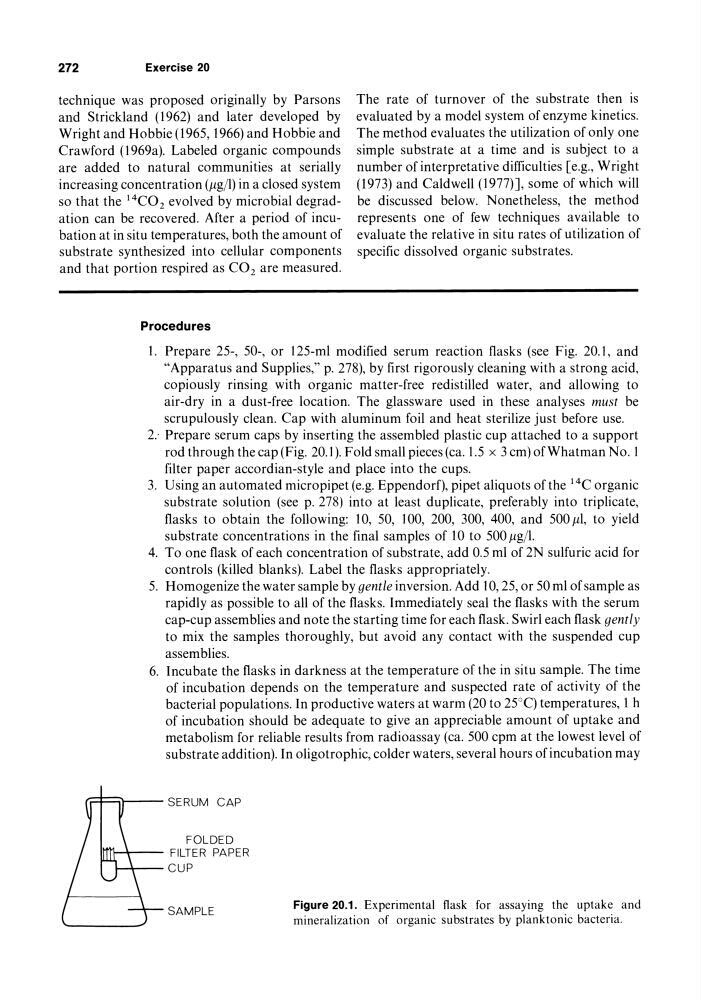
1. Prepare 25-, 50-, or 125-ml modified serum reaction flasks (see Fig. 20.1, and
"Apparatus and Supplies," p. 278), by first rigorously cleaning with a strong acid,
copiously rinsing with organic matter-free redistilled water, and allowing to
air-dry in a dust-free location. The glassware used in these analyses must be
scrupulously clean. Cap with aluminum foil and heat sterilize just before use.
2: Prepare serum caps by inserting the assembled plastic cup attached to a support
rod through the cap (Fig. 20.1). Fold small pieces (ca. 1.5 x 3 cm) of What man No.1
filter paper accordian-style and place into the cups.
3. Using an automated micropipet (e.g. Eppendorf), pipet aliquots ofthe 14C organic
substrate solution (see p. 278) into at least duplicate, preferably into triplicate,
flasks to obtain the following: 10, 50, 100, 200, 300, 400, and 500 J.ll, to yield
substrate concentrations in the final samples of 10 to 500 J.lgjl.
4. To one flask of each concentration of substrate, add 0.5 ml of 2N sulfuric acid for
controls (killed blanks). Label the flasks appropriately.
5. Homogenize the water sample by gentle inversion. Add 10,25, or 50 ml of sample as
rapidly as possible to all of the flasks. Immediately seal the flasks with the serum
cap-cup assemblies and note the starting time for each flask. Swirl each flask gently
to mix the samples thoroughly, but avoid any contact with the suspended cup
assemblies.
6. Incubate the flasks in darkness at the temperature of the in situ sample. The time
of incubation depends on the temperature and suspected rate of activity of the
bacterial populations. In productive waters at warm (20 to 25°C) temperatures, 1 h
of incubation should be adequate to give an appreciable amount of uptake and
metabolism for reliable results from radioassay (ca. 500 cpm at the lowest level of
substrate addition). In oligotrophic, colder waters, several hours of incubation may
r.::::I:=::::;:\---- SERUM CAP
FOLDED
Irm--+-- FILTER PAPER
1--'1--- CUP
SAMPLE
Figure 20.1. Experimental flask for assaying the uptake and
mineralization of organic substrates by planktonic bacteria.
Exercise 20
technique was proposed originally by Parsons
and Strickland (1962) and later developed by
Wright and Hobbie (1965, 1966) and Hobbie and
Crawford (1969a). Labeled organic compounds
are added to natural communities at serially
increasing concentration (J.lgjl) in a closed system
so that the 14C02 evolved by microbial degradation can be recovered. After a period of incubation at in situ temperatures, both the amount of
substrate synthesized into cellular components
and that portion respired as CO2 are measured.
The rate of turnover of the substrate then is
evaluated by a model system of enzyme kinetics.
The method evaluates the utilization of only one
simple substrate at a time and is subject to a
number of interpretative difficulties [e.g., Wright
(1973) and Caldwell (1977)], some of which will
be discussed below. Nonetheless, the method
represents one of few techniques available to
evaluate the relative in situ rates of utilization of
specific dissolved organic substrates.
Procedures
1. Prepare 25-, 50-, or 125-ml modified serum reaction flasks (see Fig. 20.1, and
"Apparatus and Supplies," p. 278), by first rigorously cleaning with a strong acid,
copiously rinsing with organic matter-free redistilled water, and allowing to
air-dry in a dust-free location. The glassware used in these analyses must be
scrupulously clean. Cap with aluminum foil and heat sterilize just before use.
2: Prepare serum caps by inserting the assembled plastic cup attached to a support
rod through the cap (Fig. 20.1). Fold small pieces (ca. 1.5 x 3 cm) of What man No.1
filter paper accordian-style and place into the cups.
3. Using an automated micropipet (e.g. Eppendorf), pipet aliquots ofthe 14C organic
substrate solution (see p. 278) into at least duplicate, preferably into triplicate,
flasks to obtain the following: 10, 50, 100, 200, 300, 400, and 500 J.ll, to yield
substrate concentrations in the final samples of 10 to 500 J.lgjl.
4. To one flask of each concentration of substrate, add 0.5 ml of 2N sulfuric acid for
controls (killed blanks). Label the flasks appropriately.
5. Homogenize the water sample by gentle inversion. Add 10,25, or 50 ml of sample as
rapidly as possible to all of the flasks. Immediately seal the flasks with the serum
cap-cup assemblies and note the starting time for each flask. Swirl each flask gently
to mix the samples thoroughly, but avoid any contact with the suspended cup
assemblies.
6. Incubate the flasks in darkness at the temperature of the in situ sample. The time
of incubation depends on the temperature and suspected rate of activity of the
bacterial populations. In productive waters at warm (20 to 25°C) temperatures, 1 h
of incubation should be adequate to give an appreciable amount of uptake and
metabolism for reliable results from radioassay (ca. 500 cpm at the lowest level of
substrate addition). In oligotrophic, colder waters, several hours of incubation may
r.::::I:=::::;:\---- SERUM CAP
FOLDED
Irm--+-- FILTER PAPER
1--'1--- CUP
SAMPLE
Figure 20.1. Experimental flask for assaying the uptake and
mineralization of organic substrates by planktonic bacteria.