

16
Exercise 2
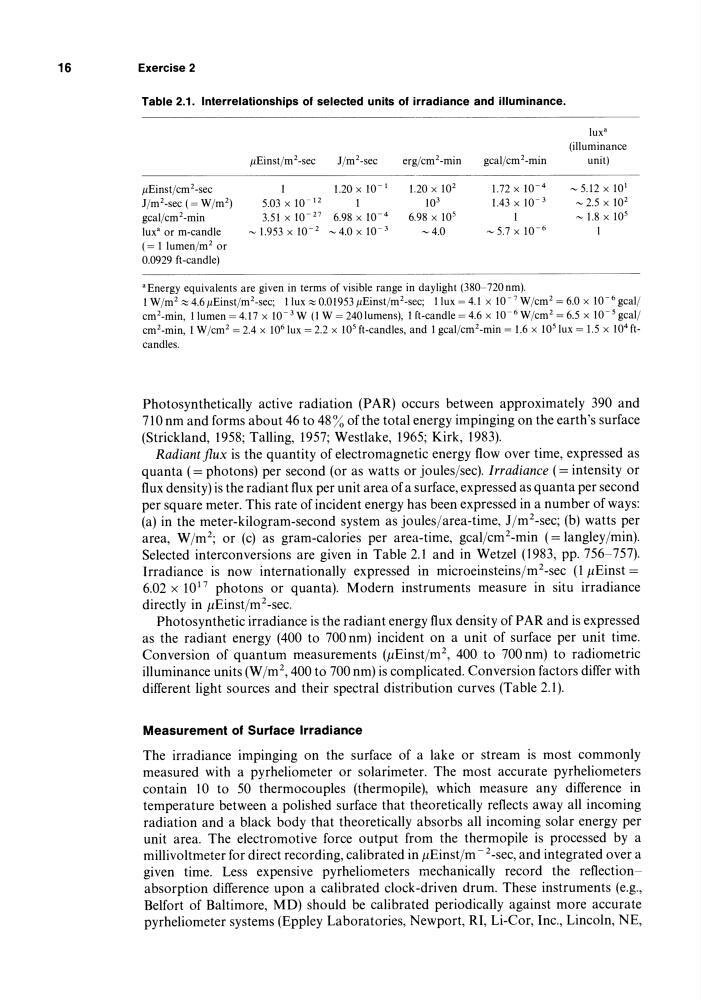
Table 2.1. Interrelationships of selected units of irradiance and illuminance.
JlEinst/cm 2 -sec
1/m 2 -sec (= W/m2)
gcaljcm 2 -min
lux' or m-candle
( = 1 lumen/m 2 or
0.0929 ft -candle)
5.03 X 10- 12
3.51 X 10- 27
~ 1.953 X 10- 2
1.20 X 10- 1
1
6.98 X 10- 4
~4.0 X 10- 3
1.20 X 10 2
10 3
6.98 X 10⁵
~4.0
1.72 X 10- 4
1.43 X 10- 3
1
~ 5.7 X 10- 6
lux'
(illuminance
unit)
~ 5.12 X 10 1
~ 2.5 X 10 2
~ 1.8 X 10⁵
1
• Energy equivalents are given in terms of visible range in daylight (380-720 nm).
1W/m2~4.6JlEinst/m2-sec; llux~0.01953JlEinst/m2-sec; llux=4.l x 1O- 7 W/cm 2 =6.0x 1O- 0 gcalj
cm 2 -min, llumen = 4.17 x 10- 3 W (1 W = 240 lumens), 1ft-candle = 4.6 x 10- 6 W/cm 2 = 6.5 x 10- 5 gcalj
cm 2 -min, 1 W/cm 2 = 2.4 x 10 6 lux = 2.2 x 105 ft-candles, and 1 gcal/cm2-min = 1.6 x 10⁵ lux = 1.5 x 10 4 ftcandles.
Photosynthetically active radiation (PAR) occurs between approximately 390 and
710nm and forms about 46 to 48% of the total energy impinging on the earth's surface
(Strickland, 1958; TaIling, 1957; Westlake, 1965; Kirk, 1983).
Radiant flux is the quantity of electromagnetic energy flow over time, expressed as
quanta (= photons) per second (or as watts or joules/sec). Irradiance (= intensity or
flux density) is the radiant flux per unit area of a surface, expressed as quanta per second
per square meter. This rate of incident energy has been expressed in a number of ways:
(a) in the meter-kilogram-second system as joules/area-time, 1/m 2 -sec; (b) watts per
area, W/m2; or (c) as gram-calories per area-time, gcaljcm2-min (= langley/min).
Selected interconversions are given in Table 2.1 and in Wetzel (1983, pp. 756-757).
Irradiance is now internationally expressed in microeinsteins/m 2 -sec (lllEinst =
6.02 x 10 17 photons or quanta). Modern instruments measure in situ irradiance
directly in IlEinst/m2-sec.
Photosynthetic irradiance is the radiant energy flux density of PAR and is expressed
as the radiant energy (400 to 700 nm) incident on a unit of surface per unit time.
Conversion of quantum measurements (IlEinst/m2, 400 to 700nm) to radiometric
illuminance units (W /m 2 ,400 to 700 nm) is complicated. Conversion factors differ with
different light sources and their spectral distribution curves (Table 2.1).
Measurement of Surface Irradiance
The irradiance impinging on the surface of a lake or stream is most commonly
measured with a pyrheliometer or solarimeter. The most accurate pyrheliometers
contain 10 to 50 thermocouples (thermopile), which measure any difference in
temperature between a polished surface that theoretically reflects away all incoming
radiation and a black body that theoretically absorbs all incoming solar energy per
unit area. The electromotive force output from the thermopile is processed by a
millivoltmeter for direct recording, calibrated in IlEinst/m - 2-sec, and integrated over a
given time. Less expensive pyrheliometers mechanically record the reflectionabsorption difference upon a calibrated clock-driven drum. These instruments (e.g.,
Belfort of Baltimore, MD) should be calibrated periodically against more accurate
pyrheliometer systems (Eppley Laboratories, Newport, RI, Li-Cor, Inc., Lincoln, NE,
Exercise 2
Table 2.1. Interrelationships of selected units of irradiance and illuminance.
JlEinst/cm 2 -sec
1/m 2 -sec (= W/m2)
gcaljcm 2 -min
lux' or m-candle
( = 1 lumen/m 2 or
0.0929 ft -candle)
5.03 X 10- 12
3.51 X 10- 27
~ 1.953 X 10- 2
1.20 X 10- 1
1
6.98 X 10- 4
~4.0 X 10- 3
1.20 X 10 2
10 3
6.98 X 10⁵
~4.0
1.72 X 10- 4
1.43 X 10- 3
1
~ 5.7 X 10- 6
lux'
(illuminance
unit)
~ 5.12 X 10 1
~ 2.5 X 10 2
~ 1.8 X 10⁵
1
• Energy equivalents are given in terms of visible range in daylight (380-720 nm).
1W/m2~4.6JlEinst/m2-sec; llux~0.01953JlEinst/m2-sec; llux=4.l x 1O- 7 W/cm 2 =6.0x 1O- 0 gcalj
cm 2 -min, llumen = 4.17 x 10- 3 W (1 W = 240 lumens), 1ft-candle = 4.6 x 10- 6 W/cm 2 = 6.5 x 10- 5 gcalj
cm 2 -min, 1 W/cm 2 = 2.4 x 10 6 lux = 2.2 x 105 ft-candles, and 1 gcal/cm2-min = 1.6 x 10⁵ lux = 1.5 x 10 4 ftcandles.
Photosynthetically active radiation (PAR) occurs between approximately 390 and
710nm and forms about 46 to 48% of the total energy impinging on the earth's surface
(Strickland, 1958; TaIling, 1957; Westlake, 1965; Kirk, 1983).
Radiant flux is the quantity of electromagnetic energy flow over time, expressed as
quanta (= photons) per second (or as watts or joules/sec). Irradiance (= intensity or
flux density) is the radiant flux per unit area of a surface, expressed as quanta per second
per square meter. This rate of incident energy has been expressed in a number of ways:
(a) in the meter-kilogram-second system as joules/area-time, 1/m 2 -sec; (b) watts per
area, W/m2; or (c) as gram-calories per area-time, gcaljcm2-min (= langley/min).
Selected interconversions are given in Table 2.1 and in Wetzel (1983, pp. 756-757).
Irradiance is now internationally expressed in microeinsteins/m 2 -sec (lllEinst =
6.02 x 10 17 photons or quanta). Modern instruments measure in situ irradiance
directly in IlEinst/m2-sec.
Photosynthetic irradiance is the radiant energy flux density of PAR and is expressed
as the radiant energy (400 to 700 nm) incident on a unit of surface per unit time.
Conversion of quantum measurements (IlEinst/m2, 400 to 700nm) to radiometric
illuminance units (W /m 2 ,400 to 700 nm) is complicated. Conversion factors differ with
different light sources and their spectral distribution curves (Table 2.1).
Measurement of Surface Irradiance
The irradiance impinging on the surface of a lake or stream is most commonly
measured with a pyrheliometer or solarimeter. The most accurate pyrheliometers
contain 10 to 50 thermocouples (thermopile), which measure any difference in
temperature between a polished surface that theoretically reflects away all incoming
radiation and a black body that theoretically absorbs all incoming solar energy per
unit area. The electromotive force output from the thermopile is processed by a
millivoltmeter for direct recording, calibrated in IlEinst/m - 2-sec, and integrated over a
given time. Less expensive pyrheliometers mechanically record the reflectionabsorption difference upon a calibrated clock-driven drum. These instruments (e.g.,
Belfort of Baltimore, MD) should be calibrated periodically against more accurate
pyrheliometer systems (Eppley Laboratories, Newport, RI, Li-Cor, Inc., Lincoln, NE,