

Bacterial Growth and Productivity
257
the filter with modest vacuum and rinse with 2 to 3 ml of filtered sterile distilled
water. Alternatively, the stain (0.2 ml of 0.05 to 0.10% acridine orange per 2-ml
sample) can be added to the initial sample and exposed for 2 min before filtration
and rinsing.
5. Remove the Nuclepore filter, blot for 30 sec on a cellulose acetate filter (e.g.,
Gelman), and place flat onto a drop of nonfluorescent immersion oil on a clean
microscope slide.
6. Allow one drop of immersion oil to drop onto the center of the filter. Cover with
a cover glass. After a brief period, press slightly to flatten and expel the excess
oil. Retain the slide mount in the dark until examination.
7. With an appropriately matched epifluorescent compound microscope (see
"Apparatus and Supplies"), observe samples in a semidarkened room. Caution:
Do not look directly at the ultraviolet light sources of the microscope system.
Use oil immersion at 1250 x. Count the bacterial cells with a Whipple eyepiece
grid (ca. 71 x 71 11m). An appropriate density of organisms filtered onto the filter
would yield 10 to 30 organisms per grid field. Count 10 to 15 fields per slide to
achieve at least 300 cells for each sample.
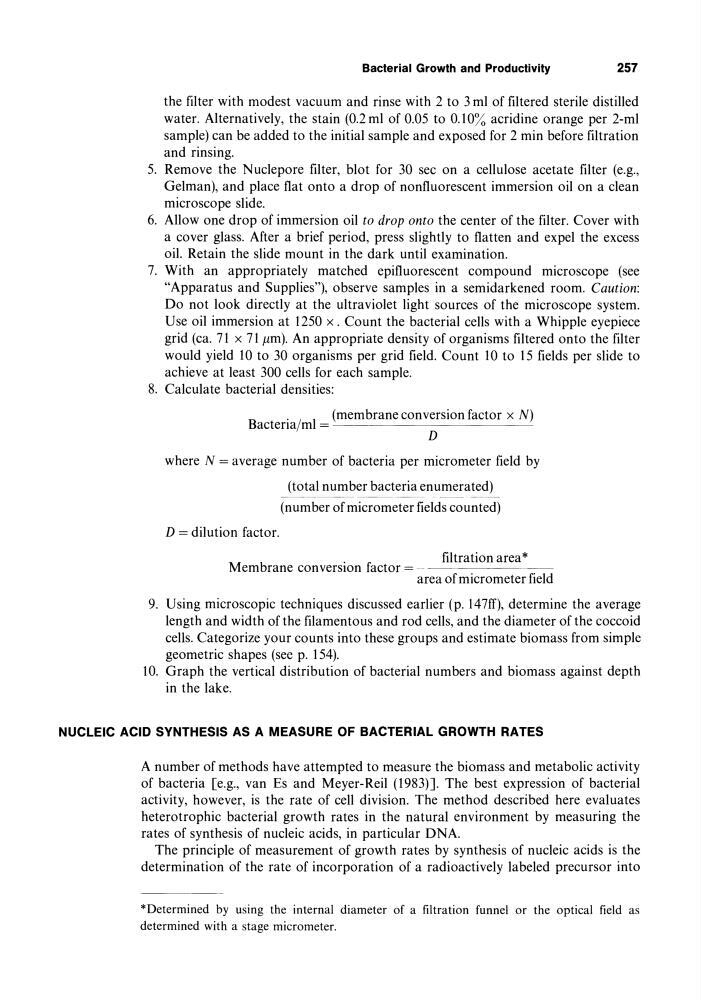
8. Calculate bacterial densities:
. / I (membrane conversion factor x N)
BacterIa m = - - - - - - - - - - - - -
D
where N = average number of bacteria per micrometer field by
(total number bacteria enumerated)
(number of micrometer fields counted)
D = dilution factor.
filtration area*
Membrane conversion factor = - - - - - - - - - - -
area of micrometer field
9. Using microscopic techniques discussed earlier (p. 147ff), determine the average
length and width of the filamentous and rod cells, and the diameter of the coccoid
cells. Categorize your counts into these groups and estimate biomass from simple
geometric shapes (see p. 154).
10. Graph the vertical distribution of bacterial numbers and biomass against depth
in the lake.
NUCLEIC ACID SYNTHESIS AS A MEASURE OF BACTERIAL GROWTH RATES
A number of methods have attempted to measure the biomass and metabolic activity
of bacteria [e.g., van Es and Meyer-Reil (1983)]. The best expression of bacterial
activity, however, is the rate of cell division. The method described here evaluates
heterotrophic bacterial growth rates in the natural environment by measuring the
rates of synthesis of nucleic acids, in particular DNA.
The principle of measurement of growth rates by synthesis of nucleic acids is the
determination of the rate of incorporation of a radioactively labeled precursor into
*Determined by using the internal diameter of a filtration funnel or the optical field as
determined with a stage micrometer.
257
the filter with modest vacuum and rinse with 2 to 3 ml of filtered sterile distilled
water. Alternatively, the stain (0.2 ml of 0.05 to 0.10% acridine orange per 2-ml
sample) can be added to the initial sample and exposed for 2 min before filtration
and rinsing.
5. Remove the Nuclepore filter, blot for 30 sec on a cellulose acetate filter (e.g.,
Gelman), and place flat onto a drop of nonfluorescent immersion oil on a clean
microscope slide.
6. Allow one drop of immersion oil to drop onto the center of the filter. Cover with
a cover glass. After a brief period, press slightly to flatten and expel the excess
oil. Retain the slide mount in the dark until examination.
7. With an appropriately matched epifluorescent compound microscope (see
"Apparatus and Supplies"), observe samples in a semidarkened room. Caution:
Do not look directly at the ultraviolet light sources of the microscope system.
Use oil immersion at 1250 x. Count the bacterial cells with a Whipple eyepiece
grid (ca. 71 x 71 11m). An appropriate density of organisms filtered onto the filter
would yield 10 to 30 organisms per grid field. Count 10 to 15 fields per slide to
achieve at least 300 cells for each sample.
8. Calculate bacterial densities:
. / I (membrane conversion factor x N)
BacterIa m = - - - - - - - - - - - - -
D
where N = average number of bacteria per micrometer field by
(total number bacteria enumerated)
(number of micrometer fields counted)
D = dilution factor.
filtration area*
Membrane conversion factor = - - - - - - - - - - -
area of micrometer field
9. Using microscopic techniques discussed earlier (p. 147ff), determine the average
length and width of the filamentous and rod cells, and the diameter of the coccoid
cells. Categorize your counts into these groups and estimate biomass from simple
geometric shapes (see p. 154).
10. Graph the vertical distribution of bacterial numbers and biomass against depth
in the lake.
NUCLEIC ACID SYNTHESIS AS A MEASURE OF BACTERIAL GROWTH RATES
A number of methods have attempted to measure the biomass and metabolic activity
of bacteria [e.g., van Es and Meyer-Reil (1983)]. The best expression of bacterial
activity, however, is the rate of cell division. The method described here evaluates
heterotrophic bacterial growth rates in the natural environment by measuring the
rates of synthesis of nucleic acids, in particular DNA.
The principle of measurement of growth rates by synthesis of nucleic acids is the
determination of the rate of incorporation of a radioactively labeled precursor into
*Determined by using the internal diameter of a filtration funnel or the optical field as
determined with a stage micrometer.