

Primary Productivity of Phytoplankton
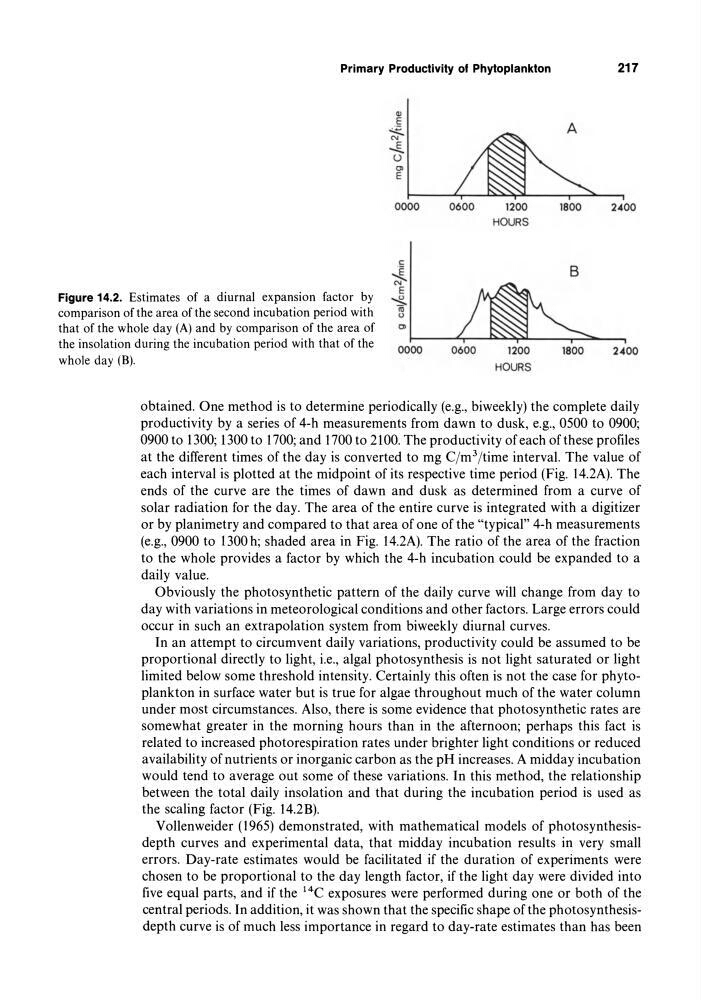
Figure 14.2. Estimates of a diurnal expansion factor by
comparison of the area of the second incubation period with
that of the whole day (A) and by comparison of the area of
the insolation during the incubation period with that of the
whole day (B).
0000
c
..;t
N E
~
m u
0>
0000
0600
1200
0600
HOURS
1200
HOURS
217
1800
2400
B
1800
2400
obtained. One method is to determine periodically (e.g., biweekly) the complete daily
productivity by a series of 4-h measurements from dawn to dusk, e.g., 0500 to 0900;
0900 to 1300; 1300 to 1700; and 1700 to 2100. The productivity of each of these profiles
at the different times of the day is converted to mg Cjm 3 /time interval. The value of
each interval is plotted at the midpoint of its respective time period (Fig. 14.2A). The
ends of the curve are the times of dawn and dusk as determined from a curve of
solar radiation for the day. The area of the entire curve is integrated with a digitizer
or by planimetry and compared to that area of one of the "typical" 4-h measurements
(e.g., 0900 to 1300 h; shaded area in Fig. 14.2A). The ratio of the area of the fraction
to the whole provides a factor by which the 4-h incubation could be expanded to a
daily value.
Obviously the photosynthetic pattern of the daily curve will change from day to
day with variations in meteorological conditions and other factors. Large errors could
occur in such an extrapolation system from biweekly diurnal curves.
In an attempt to circumvent daily variations, productivity could be assumed to be
proportional directly to light, i.e., algal photosynthesis is not light saturated or light
limited below some threshold intensity. Certainly this often is not the case for phytoplankton in surface water but is true for algae throughout much of the water column
under most circumstances. Also, there is some evidence that photosynthetic rates are
somewhat greater in the morning hours than in the afternoon; perhaps this fact is
related to increased photorespiration rates under brighter light conditions or reduced
availability of nutrients or inorganic carbon as the pH increases. A midday incubation
would tend to average out some of these variations. In this method, the relationship
between the total daily insolation and that during the incubation period is used as
the scaling factor (Fig. 14.2B).
Vollenweider (1965) demonstrated, with mathematical models of photosynthesisdepth curves and experimental data, that midday incubation results in very small
errors. Day-rate estimates would be facilitated if the duration of experiments were
chosen to be proportional to the day length factor, if the light day were divided into
five equal parts, and if the 14C exposures were performed during one or both of the
central periods. In addition, it was shown that the specific shape of the photosynthesisdepth curve is of much less importance in regard to day-rate estimates than has been
Figure 14.2. Estimates of a diurnal expansion factor by
comparison of the area of the second incubation period with
that of the whole day (A) and by comparison of the area of
the insolation during the incubation period with that of the
whole day (B).
0000
c
..;t
N E
~
m u
0>
0000
0600
1200
0600
HOURS
1200
HOURS
217
1800
2400
B
1800
2400
obtained. One method is to determine periodically (e.g., biweekly) the complete daily
productivity by a series of 4-h measurements from dawn to dusk, e.g., 0500 to 0900;
0900 to 1300; 1300 to 1700; and 1700 to 2100. The productivity of each of these profiles
at the different times of the day is converted to mg Cjm 3 /time interval. The value of
each interval is plotted at the midpoint of its respective time period (Fig. 14.2A). The
ends of the curve are the times of dawn and dusk as determined from a curve of
solar radiation for the day. The area of the entire curve is integrated with a digitizer
or by planimetry and compared to that area of one of the "typical" 4-h measurements
(e.g., 0900 to 1300 h; shaded area in Fig. 14.2A). The ratio of the area of the fraction
to the whole provides a factor by which the 4-h incubation could be expanded to a
daily value.
Obviously the photosynthetic pattern of the daily curve will change from day to
day with variations in meteorological conditions and other factors. Large errors could
occur in such an extrapolation system from biweekly diurnal curves.
In an attempt to circumvent daily variations, productivity could be assumed to be
proportional directly to light, i.e., algal photosynthesis is not light saturated or light
limited below some threshold intensity. Certainly this often is not the case for phytoplankton in surface water but is true for algae throughout much of the water column
under most circumstances. Also, there is some evidence that photosynthetic rates are
somewhat greater in the morning hours than in the afternoon; perhaps this fact is
related to increased photorespiration rates under brighter light conditions or reduced
availability of nutrients or inorganic carbon as the pH increases. A midday incubation
would tend to average out some of these variations. In this method, the relationship
between the total daily insolation and that during the incubation period is used as
the scaling factor (Fig. 14.2B).
Vollenweider (1965) demonstrated, with mathematical models of photosynthesisdepth curves and experimental data, that midday incubation results in very small
errors. Day-rate estimates would be facilitated if the duration of experiments were
chosen to be proportional to the day length factor, if the light day were divided into
five equal parts, and if the 14C exposures were performed during one or both of the
central periods. In addition, it was shown that the specific shape of the photosynthesisdepth curve is of much less importance in regard to day-rate estimates than has been