

Primary Productivity of Phytoplankton
215
same compound. Liquid scintillation radioassay is used most commonly with
fluors that accept appreciable quantities of water without severe quenching problems.
Calculations
1.
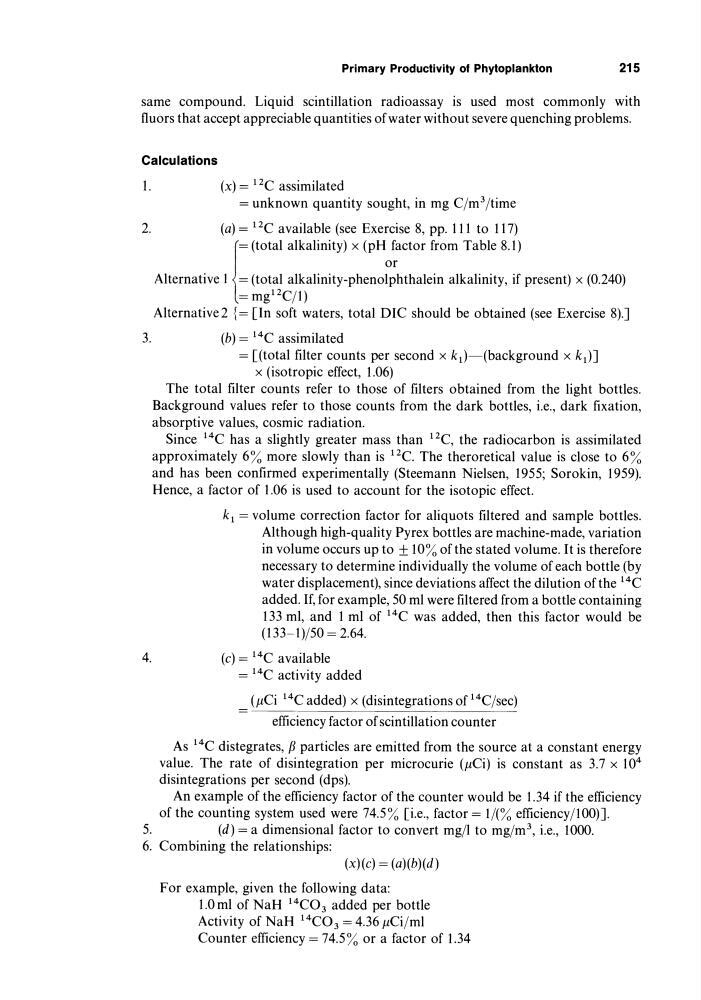
(x) = 12C assimilated
= unknown quantity sought, in mg C/m 3 /time
2.
(a) = 12C available (see Exercise 8, pp. 111 to 117)
{
= (total alkalinity) x (pH factor from Table 8.1)
or
Alternative 1 = (total alkalinity-phenolphthalein alkalinity, if present) x (0.240)
= mg 12 C/l)
Alternative 2 {= [In soft waters, total DIC should be obtained (see Exercise 8).]
3.
(b) = 14C assimilated
4.
= [(total filter counts per second x k 1 )-(background x k 1 )]
x (isotropic effect, 1.06)
The total filter counts refer to those of filters obtained from the light bottles.
Background values refer to those counts from the dark bottles, i.e., dark fixation,
absorptive values, cosmic radiation.
Since 14C has a slightly greater mass than 12C, the radiocarbon is assimilated
approximately 6% more slowly than is 12c. The theroretical value is close to 6%
and has been confirmed experimentally (Steemann Nielsen, 1955; Sorokin, 1959).
Hence, a factor of 1.06 is used to account for the isotopic effect.
kl = volume correction factor for aliquots filtered and sample bottles.
Although high-quality Pyrex bottles are machine-made, variation
in volume occurs up to ± 10% ofthe stated volume. It is therefore
necessary to determine individually the volume of each bottle (by
water displacement), since deviations affect the dilution ofthe 14C
added. If, for example, 50 ml were filtered from a bottle containing
133 ml, and 1 ml of 14C was added, then this factor would be
(133-1)/50 = 2.64.
(c) = 14C available
= 14C activity added
(,uCi 14C added) x (disintegrations of 14C/sec)
efficiency factor of scintillation counter
As 14C distegrates, f3 particles are emitted from the source at a constant energy
value. The rate of disintegration per microcurie (,uCi) is constant as 3.7 x 10 4
disintegrations per second (dps).
An example of the efficiency factor of the counter would be 1.34 if the efficiency
of the counting system used were 74.5% [i.e., factor = 1/(% efficiency/100)].
5.
(d) = a dimensional factor to convert mgjI to mg/m 3 , i.e., 1000.
6. Combining the relationships:
(x)(c) = (a)(b)(d)
For example, given the following data:
1.0ml of NaH 14C0 3 added per bottle
Activity of NaH 14C0 3 = 4.36 ,uCi/ml
Counter efficiency = 74.5% or a factor of 1.34
215
same compound. Liquid scintillation radioassay is used most commonly with
fluors that accept appreciable quantities of water without severe quenching problems.
Calculations
1.
(x) = 12C assimilated
= unknown quantity sought, in mg C/m 3 /time
2.
(a) = 12C available (see Exercise 8, pp. 111 to 117)
{
= (total alkalinity) x (pH factor from Table 8.1)
or
Alternative 1 = (total alkalinity-phenolphthalein alkalinity, if present) x (0.240)
= mg 12 C/l)
Alternative 2 {= [In soft waters, total DIC should be obtained (see Exercise 8).]
3.
(b) = 14C assimilated
4.
= [(total filter counts per second x k 1 )-(background x k 1 )]
x (isotropic effect, 1.06)
The total filter counts refer to those of filters obtained from the light bottles.
Background values refer to those counts from the dark bottles, i.e., dark fixation,
absorptive values, cosmic radiation.
Since 14C has a slightly greater mass than 12C, the radiocarbon is assimilated
approximately 6% more slowly than is 12c. The theroretical value is close to 6%
and has been confirmed experimentally (Steemann Nielsen, 1955; Sorokin, 1959).
Hence, a factor of 1.06 is used to account for the isotopic effect.
kl = volume correction factor for aliquots filtered and sample bottles.
Although high-quality Pyrex bottles are machine-made, variation
in volume occurs up to ± 10% ofthe stated volume. It is therefore
necessary to determine individually the volume of each bottle (by
water displacement), since deviations affect the dilution ofthe 14C
added. If, for example, 50 ml were filtered from a bottle containing
133 ml, and 1 ml of 14C was added, then this factor would be
(133-1)/50 = 2.64.
(c) = 14C available
= 14C activity added
(,uCi 14C added) x (disintegrations of 14C/sec)
efficiency factor of scintillation counter
As 14C distegrates, f3 particles are emitted from the source at a constant energy
value. The rate of disintegration per microcurie (,uCi) is constant as 3.7 x 10 4
disintegrations per second (dps).
An example of the efficiency factor of the counter would be 1.34 if the efficiency
of the counting system used were 74.5% [i.e., factor = 1/(% efficiency/100)].
5.
(d) = a dimensional factor to convert mgjI to mg/m 3 , i.e., 1000.
6. Combining the relationships:
(x)(c) = (a)(b)(d)
For example, given the following data:
1.0ml of NaH 14C0 3 added per bottle
Activity of NaH 14C0 3 = 4.36 ,uCi/ml
Counter efficiency = 74.5% or a factor of 1.34