

212
14C UPTAKE
Exercise 14
of productivity detectable is in the range of 20mgC/m 3 (ca. 15mgC/m 3 when
duplicate titrations are averaged) (Strickland, 1960). Depending on the conditions,
populations, and duration of the experiments, the lower limit of detection may be
reduced to ca. 3mgC/m 3 /h, although values below 10mgC/m 3 /h obtained by the
oxygen method must be viewed with caution. The method is applicable within a
range of ca. 3 to 2000 mg C/m 3 /h (Strickland and Parsons, 1972).
The ability of phytoplankton to take up and incorporate tracer amounts of radioactive
isotopes into organic matter during photosynthesis permits measurement of the in
situ rates of primary production. Although tritiated water eH 2 0) alone can be used
(McKinley and Wetzel, 1977), dilution of the tracer by greater amounts of nonlabeled
water necessitates addition of large amounts of high specific activity isotope in order
to follow uptake and incorporation into the algae. Application of the 3H 2 0 method
is limited largely to specialized cases where use of other isotopes is complicated by
various interferences.
The most commonly used method is to add a tracer amount of 14C02 as labeled
bicarbonate (e.g., NaH 14C03) to the water sample. When the total CO 2 content of
the water is known and the 14C content of the phytoplankton is measured after a
period of incubation, the total amount of carbon assimilated can be calculated by
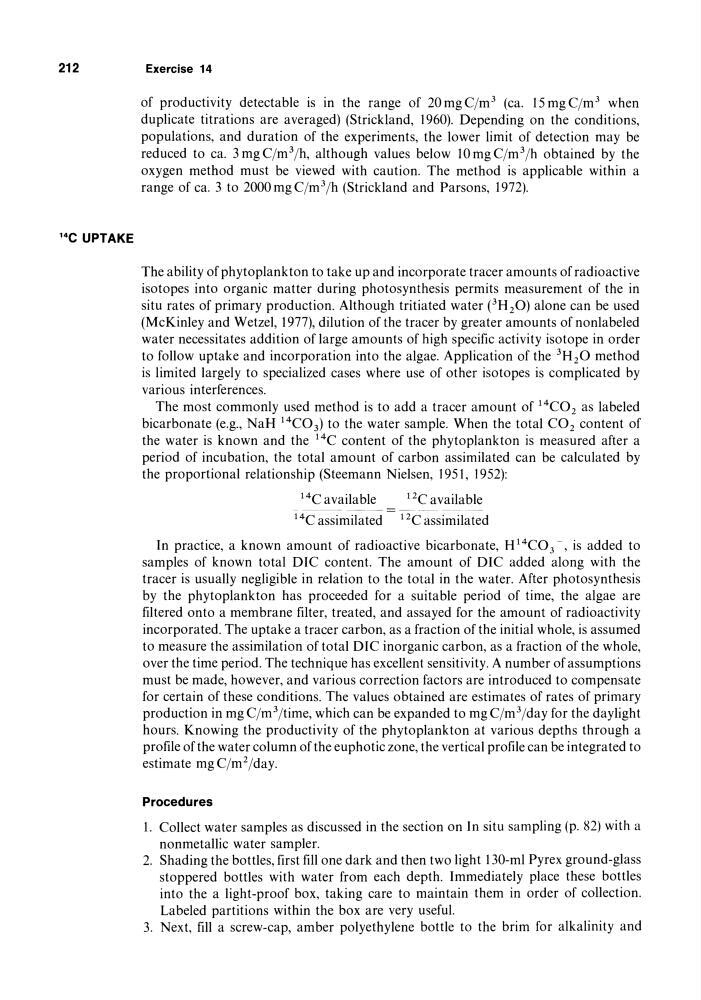
the proportional relationship (Steemann Nielsen, 1951, 1952):
14C available
12C available
-
14C assimilated 12C assimilated
In practice, a known amount of radioactive bicarbonate, H 14 C0 3 -, is added to
samples of known total DIC content. The amount of DIC added along with the
tracer is usually negligible in rclation to the total in the water. After photosynthesis
by the phytoplankton has proceeded for a suitable period of time, the algae are
filtered onto a membrane filter, treated, and assayed for the amount of radioactivity
incorporated. The uptake a tracer carbon, as a fraction of the initial whole, is assumed
to measure the assimilation of total DIC inorganic carbon, as a fraction of the whole,
over the time period. The technique has excellent sensitivity. A number of assumptions
must be made, however, and various correction factors are introduced to compensate
for certain of these conditions. The values obtained are estimates of rates of primary
production in mg C/m 3 /time, which can be expanded to mg C/m 3 /day for the daylight
hours. Knowing the productivity of the phytoplankton at various depths through a
profile of the water column of the euphotic zone, the vertical profile can be integrated to
estimate mg C/m 2 /day.
Procedures
1. Collect water samples as discussed in the section on In situ sampling (p. 82) with a
nonmetallic water sampler.
2. Shading the bottles, first fill one dark and then two light 130-ml Pyrex ground-glass
stoppered bottles with water from each depth. Immediately place these bottles
into the a light-proof box, taking care to maintain them in order of collection.
Labeled partitions within the box are very useful.
3. Next, fill a screw-cap, amber polyethylene bottle to the brim for alkalinity and
14C UPTAKE
Exercise 14
of productivity detectable is in the range of 20mgC/m 3 (ca. 15mgC/m 3 when
duplicate titrations are averaged) (Strickland, 1960). Depending on the conditions,
populations, and duration of the experiments, the lower limit of detection may be
reduced to ca. 3mgC/m 3 /h, although values below 10mgC/m 3 /h obtained by the
oxygen method must be viewed with caution. The method is applicable within a
range of ca. 3 to 2000 mg C/m 3 /h (Strickland and Parsons, 1972).
The ability of phytoplankton to take up and incorporate tracer amounts of radioactive
isotopes into organic matter during photosynthesis permits measurement of the in
situ rates of primary production. Although tritiated water eH 2 0) alone can be used
(McKinley and Wetzel, 1977), dilution of the tracer by greater amounts of nonlabeled
water necessitates addition of large amounts of high specific activity isotope in order
to follow uptake and incorporation into the algae. Application of the 3H 2 0 method
is limited largely to specialized cases where use of other isotopes is complicated by
various interferences.
The most commonly used method is to add a tracer amount of 14C02 as labeled
bicarbonate (e.g., NaH 14C03) to the water sample. When the total CO 2 content of
the water is known and the 14C content of the phytoplankton is measured after a
period of incubation, the total amount of carbon assimilated can be calculated by
the proportional relationship (Steemann Nielsen, 1951, 1952):
14C available
12C available
-
14C assimilated 12C assimilated
In practice, a known amount of radioactive bicarbonate, H 14 C0 3 -, is added to
samples of known total DIC content. The amount of DIC added along with the
tracer is usually negligible in rclation to the total in the water. After photosynthesis
by the phytoplankton has proceeded for a suitable period of time, the algae are
filtered onto a membrane filter, treated, and assayed for the amount of radioactivity
incorporated. The uptake a tracer carbon, as a fraction of the initial whole, is assumed
to measure the assimilation of total DIC inorganic carbon, as a fraction of the whole,
over the time period. The technique has excellent sensitivity. A number of assumptions
must be made, however, and various correction factors are introduced to compensate
for certain of these conditions. The values obtained are estimates of rates of primary
production in mg C/m 3 /time, which can be expanded to mg C/m 3 /day for the daylight
hours. Knowing the productivity of the phytoplankton at various depths through a
profile of the water column of the euphotic zone, the vertical profile can be integrated to
estimate mg C/m 2 /day.
Procedures
1. Collect water samples as discussed in the section on In situ sampling (p. 82) with a
nonmetallic water sampler.
2. Shading the bottles, first fill one dark and then two light 130-ml Pyrex ground-glass
stoppered bottles with water from each depth. Immediately place these bottles
into the a light-proof box, taking care to maintain them in order of collection.
Labeled partitions within the box are very useful.
3. Next, fill a screw-cap, amber polyethylene bottle to the brim for alkalinity and